

This article first appeared in Forum, The Edge Malaysia Weekly on March 30, 2026 - April 5, 2026
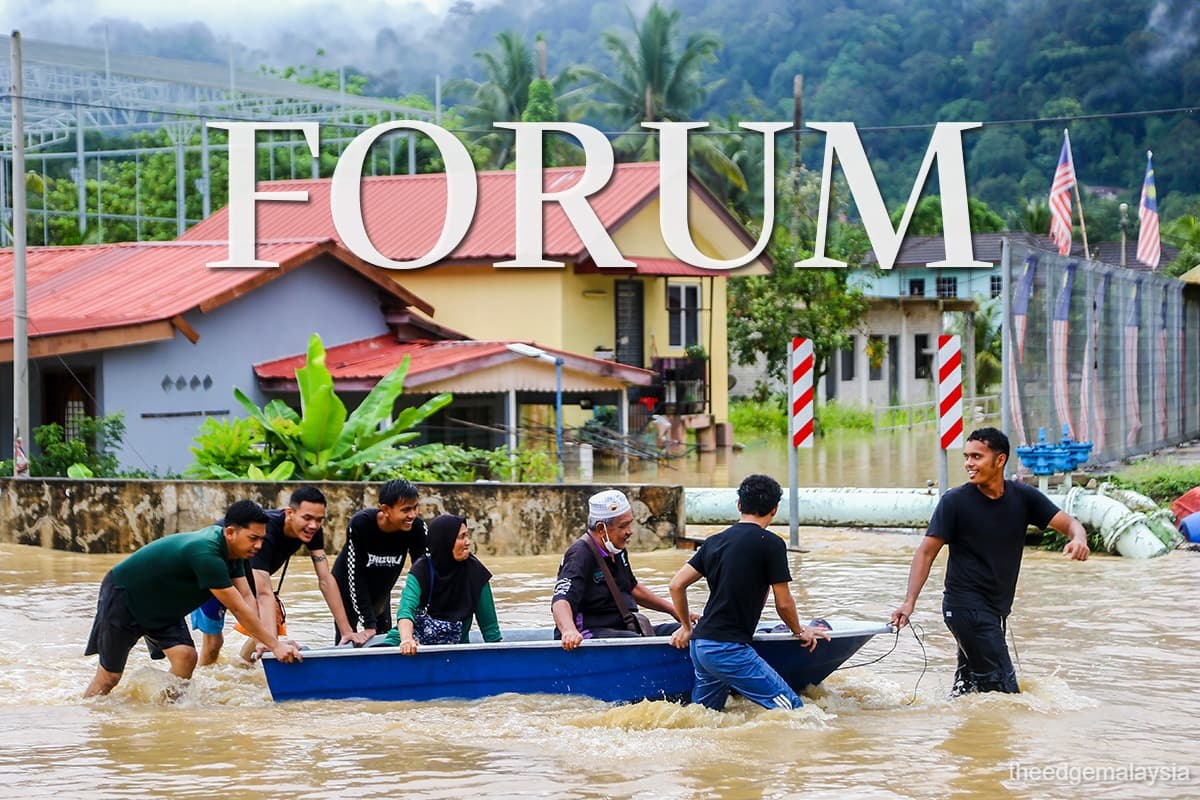
Malaysia floods. This is not a metaphor. Roughly a third of the country’s land area is flood-prone, and in the years since the 2021-2022 monsoon season that displaced over 70,000 people, the question of how to build meaningful early warning capacity has become urgent. The government — through the National Disaster Management Agency (Nadma) and others — has invested in infrastructure. Scientists have invested in sensors. What neither has adequately invested in is the most precise, real-time instrument available: the eyes, phones and lived knowledge of the people already standing in the water.
Crowdsourced flood monitoring — enlisting residents to submit geo-tagged photos, water depth observations and hazard reports via mobile apps — has quietly proven itself across the world. Pilot projects in Nepal, India, Indonesia and the Netherlands show that community-submitted data, properly structured and verified, can improve hydrological forecast accuracy by 30% to 50% over sensor-only models. Systems like MAppERS, BluPix and Pin2Flood demonstrate that a photograph of floodwater next to a car tyre or road sign, combined with GPS coordinates and a timestamp, can yield water depth estimates accurate to within 15cm. That is not anecdote. That is science.
However, a framework paper on community-based early warning systems (CBEWS) from Climate Governance Malaysia notes that public awareness of such portals remains low, engagement is inconsistent and the data that does flow in is frequently unverified. The familiar failure modes recur: a top-down system designed without genuine community input, a funding model that evaporates when the non-governmental organisation departs, and residents who contribute during a crisis only to be forgotten once the waters recede. These are not technical problems. They are economic and governance problems. And they have a solution that Malaysia is unusually well-placed to pioneer.
The emerging global conversation around personal data ownership offers a powerful reframe. For two decades, the digital economy has operated on a lopsided premise: individuals generate data and corporations extract value from it. Search queries, location histories, purchase patterns, health signals — all flow upstream to entities whose business models depend on that raw material, while the humans who produced it receive nothing beyond the convenience of a free service. Economists and legal scholars have increasingly argued that this is neither inevitable nor fair. Data has real economic value, and there is no structural reason why the person who created it should not participate in the upside.
Apply this principle to climate governance and disaster data and the implications are immediate. A resident who submits a verified flood photograph is not performing an act of charity. She is producing a licensed data asset: hyper-local, timestamped, ground-truthed intelligence unavailable from any satellite or river gauge. Climate funds, reinsurers, municipal planners and logistics companies rerouting supply chains during monsoon events all need exactly this. They are willing to pay for it. The question is whether that payment reaches the communities that generated it, or is absorbed by intermediaries.
Platforms built on data equity principles, such as Bluenumber, where contributors retain ownership of their submissions and license them to institutional buyers via micropayments, present a workable answer. The model is not theoretical. MillionMakers, an analogous system, has already compensated thousands of supply chain workers in garments and agriculture for verified data contributions. Applied to flood monitoring: a resident submits a photo of a submerged road sign; artificial intelligence verification confirms water depth against known reference heights; the contribution is logged to a digital wallet; and when a government agency or insurer purchases a data package covering that event, a share flows directly to the contributor. A well-incentivised system of this kind can sustain three times the submission volume of volunteer-only models.
The poverty of ambition in most early warning frameworks is that they treat community participation as a cost to be minimised rather than an asset to be compensated. Consider what genuine data equity unlocks beyond the immediate flood. Structured submissions over time — water levels at specific locations across multiple monsoon seasons — constitute a longitudinal dataset of extraordinary value for climate adaptation. Which streets flood first? At what rainfall threshold does a particular kampung become inaccessible? How has a coastal village’s flood envelope shifted over a decade of sea level rise? No government dataset currently answers these questions with precision, because none has the observational density that an incentivised community network could provide.
The applications extend well beyond floods. Air quality reports from residents near industrial corridors. Landslide risk observations from hillside farmers. Coastal erosion measurements from fishing communities. Each constitutes hyper-local environmental intelligence absent from national datasets, gatherable through the same infrastructure — provided the incentive architecture is right. The data would not merely inform crisis response, it would drive resource allocation decisions: where to reinforce embankments; relocate vulnerable communities; or invest in mangrove restoration as a natural flood buffer.
Malaysia’s Personal Data Protection Act (PDPA) and evolving digital economy frameworks provide a regulatory foundation for exactly this. Contributor payments should be structured as licensing royalties on data assets, not charitable donations. Anti-money-laundering obligations require identity verification above threshold payment levels, but this is manageable through existing e-wallet infrastructure and simplified due diligence for low-value transactions. The architecture is not simple, but it is buildable — and functioning precedents like Bluenumber exist.
None of this diminishes the role of the government. Community-generated data is most powerful when assimilated into physics-based hydrological models, cross-validated against official gauge networks, and disseminated through a tiered alert system reaching every resident — including the elderly and those without smartphones — via SMS, sirens and community networks. The CBEWS model, properly implemented, gives Nadma ground truth that no sensor network can provide.
What does Malaysian leadership here look like? It would mean elevating the resident of a flood-prone kampung from a passive recipient of government warnings, to being a vital and active node in a distributed sensing network — compensated for her contribution, retaining ownership of the data she generates, and fully vested in the system’s accuracy and continuity. The fisherfolk of Kelantan, the smallholders of Negeri Sembilan, the coastal communities of Johor: stewards, in a precise and remunerable sense, of the environmental intelligence their country needs most.
The monsoon does not wait for institutional consensus. But Malaysia has the digital infrastructure, the legal frameworks and the community networks to engineer the confluence of a flood warning system, a climate data commons, and a mechanism for economic inclusion. The only thing left is the political will to recognise that the data generated by vulnerable communities has value; and that the people who generate it deserve to benefit.
Puvan J Selvanathan is founder and CEO of Bluenumber, a platform for worker-owned data and digital identity in global supply chains. This column is part of a series coordinated by Climate Governance Malaysia, the national chapter of the World Economic Forum’s Climate Governance Initiative. The CGI is an effort to support boards of directors in discharging their duty of care as long-term stewards of the companies they oversee, specifically to ensure that climate risks and opportunities are adequately addressed.
Save by subscribing to us for your print and/or digital copy.
P/S: The Edge is also available on Apple's App Store and Android's Google Play.