

This article first appeared in The Edge Malaysia Weekly on March 23, 2026 - March 29, 2026
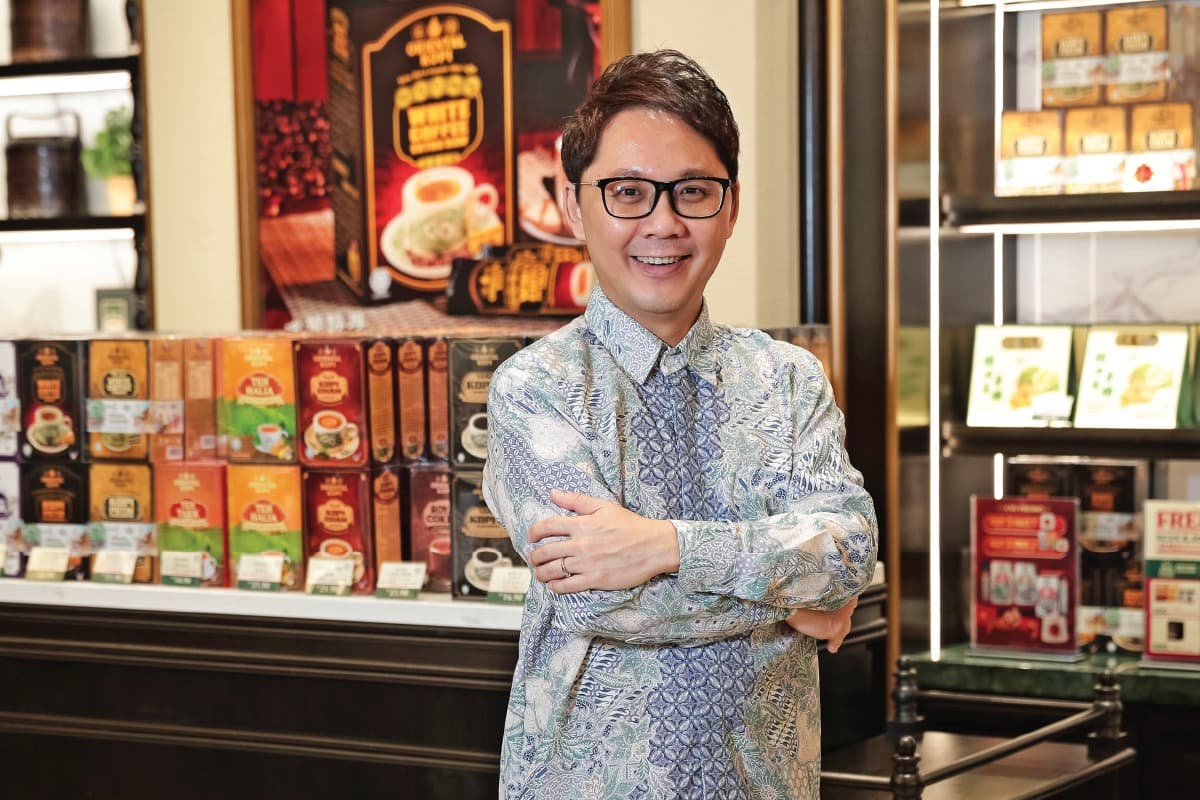
WHEN Datuk Calvin Chan Jian Chern sits down for an exclusive interview with The Edge at Oriental Kopi Holdings Bhd’s (KL:KOPI) outlet in Pavilion Damansara Heights, he begins by ordering some drinks and snacks. But instead of looking at the menu, the company’s founder and managing director calls out the menu item codes — the same ones the staff use when keying in customer orders — to the waiter.
This small detail offers a glimpse into how hands-on Calvin remains despite the rapid rise of the Nanyang-style kopitiam chain he leads. The 44-year-old entrepreneur says he still steps in to help out whenever things get busy at the outlets he visits every week.
“If the outlet is crowded, I will help. I can still wash dishes, serve customers or even stand at the cashier’s counter. This business started from the ground up, so I must always understand what is happening at the outlet level,” Calvin tells The Edge.
In just over five years, Puchong-headquartered Oriental Kopi has gone from being a single kopitiam in Johor to one of Malaysia’s most popular food and beverage (F&B) brands. Since opening its first outlet in December 2020, the group has expanded to more than 30 outlets across Malaysia and Singapore, riding on the strong demand for its modern take on classic Malaysian dishes such as nasi lemak, mee siam, char kway teow, chicken hor fun, chicken rice, cendol, rojak and kaya toast.
Notably, Oriental Kopi’s signature egg tarts were awarded the titles of “Thickest egg tart” and “Most number of egg tarts sold” in The Malaysia Book of Records. These remarkable achievements have drawn interest from not only food lovers but also investors.

About a year after its much talked about ACE Market listing on Bursa Malaysia in January 2025, Oriental Kopi’s market capitalisation has grown to more than RM2 billion. The shares have been trading at between 35 and 45 times earnings over the past few months, reflecting the strong optimism about the company’s prospects.
Calvin acknowledges that such lofty expectations inevitably bring pressure.
“At our IPO price of 44 sen, our market cap was RM880 million. In October last year, our market cap hit the RM3 billion mark. I am flattered, but at the same time, I must admit, I do feel a bit of pressure now to deliver results,” he says.
“If you look at our historical price-earnings ratio (PER), investors’ expectations are high. There is a Chinese proverb that goes: ‘The higher you climb, the colder it gets’,” he adds, acknowledging that the expectations of fund managers, shareholders and investors have risen in tandem with the share price.
Even so, Calvin insists that Oriental Kopi will resist aggressive expansion. Rather than relying on the franchise model commonly used by F&B chains, the group intends to expand at a measured pace while retaining control of its outlets — a strategy he believes is crucial to safeguarding the brand as it grows.
“Don’t get me wrong, it’s not a bad thing that we have a good stock valuation, but it’s a happy problem. Now, we have to stay focused, improve further every day and keep the momentum going. If we identify our weaknesses, we must work harder and overcome them,” he remarks.
Calvin says while some investors may consider Oriental Kopi’s PER high, the current valuation may not seem steep if the company eventually grows into a global brand like Starbucks or McDonald’s. “To me, this is just the beginning,” he adds.
He reveals that Oriental Kopi initially intended to list directly on the Main Market, but the company opted for the ACE Market instead, believing that as a young public listed company, it still had much to learn, particularly in meeting compliance requirements.
“We needed to put more effort and energy into our expansion plan and training programme for our staff, and also to invest and enhance our food development. We were worried that if we were to list on the Main Market, we wouldn’t be able to handle it and get distracted, and that could affect our operations,” he elaborates.
“To be honest, our share price performance on listing day [almost doubled to 87.5 sen], indeed exceeding my own expectations. I didn’t expect such strong support from investors. I am very happy and grateful that the public not only recognise our restaurant and brand, but also like our stock.”
A year after the listing, Calvin says his sense of responsibility has grown as he has to answer to not only customers, but also his team and other stakeholders, even though the company’s vision is unchanged. He adds that Oriental Kopi’s achievements have far exceeded expectations.

Expanding F&B outlets and FMCG SKUs
Today, Oriental Kopi operates 32 outlets — 29 in Malaysia and three in Singapore — as well as 12 merchandise stores. In terms of profit contribution, the restaurant division contributes about 91% and the fast-moving consumer goods (FMCG) segment the other 9%.
“For 2025, we initially planned to open 10 outlets [as per its prospectus]. But we eventually opened 11 outlets and eight merchandise stores. In other words, our expansion was faster than expected last year. Our brand has become more popular and consumer confidence has increased,” says Calvin.
Oriental Kopi has about 40 stock-keeping units (SKUs) in the FMCG segment, with plans to launch 20 new products this year. Its existing SKUs include instant coffee, pineapple tarts, kaya, peanut butter, pan mee, sauces and pastes.
“There is still plenty of room for imagination in terms of expansion and product development. There is so much more we can do in the F&B and FMCG space,” he says.
Calvin explains that Oriental Kopi’s F&B operations, with their relatively low profit margins, rely heavily on volume. He points out that selling coffee and toast alone does not generate significant earnings. Instead, the key to success lies in operational efficiency.
“It’s all about table management, staff efficiency and speed. We need to get these things right to achieve a good table turnover rate,” he says.
Meanwhile, Calvin notes that Oriental Kopi’s FMCG products are gaining traction, with exports already reaching markets such as Singapore, Hong Kong, Canada and Australia.
“Their financial contributions are not high at the moment. But we intend to export to more places such as the Middle East and China, which have a big population and strong consumption power. Generally, they also like Malaysian foods,” he explains.
For its overseas restaurant operations, Oriental Kopi currently operates three cafés in Singapore through a 30:70 joint venture with Paradise Group Holdings Pte Ltd, a Singaporean dining firm that operates 167 outlets with 17 brands in 22 cities, mainly across Asia.
Oriental Kopi plans to penetrate more Southeast Asian countries, but in a moderate way.
“We are currently looking at Vietnam, Indonesia and Cambodia, but we have not made any decision yet. One thing is for sure, our priority is to run the stores ourselves instead of using the franchise model,” says Calvin.
“Yes, we may still need a local partner wherever we go — as we did in Singapore with Paradise Group — but we want to be in control of how the restaurants are operated.”
Calvin, together with his younger sister Callie Chan Yen Min and his brother-in-law Sean Koay Song Leng, owns the lion’s share of Oriental Kopi at 67.35%, held via their family vehicle United Gomax Sdn Bhd. Callie — who co-founded Golden Whale with Calvin about eight years ago — and her husband Sean sit on the board of Oriental Kopi as executive directors.
Calvin and Callie’s cousin Chan Wei Jet is the group’s business development and FMCG manager, while Sean’s elder sister Jackline Koay Chor Leng is the retail operation manager.
Among Oriental Kopi’s top 30 largest shareholders are KAF funds, Kenanga funds, Amanah Saham Nasional funds, Principal funds, Prulink Strategic Fund 2, Public Strategic Smallcap Fund and AIA Bhd.
In February, Oriental Kopi reported a 30.2% jump in its net profit to RM17.05 million for the first quarter ended Dec 31, 2025 (1QFY2026) from RM13.09 million a year earlier, as revenue surged to another quarterly record high of RM139.19 million. In its inaugural year as a listed company, it generated earnings of RM60.75 million on revenue of RM450.92 million in the financial year ended Sept 30, 2025 (FY2025).
When asked about the potential impact of the US-Israel’s war with Iran, Calvin says Oriental Kopi is monitoring the situation closely but has yet to engage its suppliers on the issue. “So far, we do not see any immediate impact, and we think the costs are manageable.”
‘No’ to franchise model

Calvin says that from day one, he has focused on making Oriental Kopi a business that can expand nationally and eventually internationally. But the journey was not without tempting opportunities.
“In the early days, people offered us funding or opportunities that could have accelerated growth, but we resisted. At the start, capital was tight and shortcuts were tempting. But maintaining control and vision from the beginning allowed us to grow sustainably,” he says.
“This discipline has been crucial to our success. That is why until today, I will not consider the franchise model, especially for our Malaysian operations.”
According to him, running a restaurant is never simple, as the owners have to manage taste, freshness, cooking speed, environment, pricing and logistics — all at the same time. Moreover, a good restaurateur needs to ensure that every dish meets the standards.
“That’s why we don’t rely on a central kitchen. We insist on doing things ourselves to maintain quality. Our secret is patience, humility and constant learning,” says Calvin.
“Markets change, customer tastes evolve, and we must adapt without losing our core values. We pay attention to every detail — from the heat of the food to the presentation — and ensure the entire experience reflects our brand.”
He mentions that he does not view competitors who performed less successfully as failures, pointing out that many started with different business models, such as family-run operations or businesses focused primarily on local markets.
“We chose a bigger-scale business approach, prioritising consistency, quality and scalability from the beginning. Our priority was building a brand that could grow, not just a family business,” he highlights.
Early dose of kopitiam trade
Calvin came from humble beginnings. After completing the Sijil Pelajaran Malaysia in 1999, he began a career in the telecommunications industry selling mobile phones and accessories at Digiworld Enterprise.
Subsequently, he founded and managed several companies, including Tenggara Telecentre Sdn Bhd, Mars Mobile Distribution Sdn Bhd and Leagoo (M) Sdn Bhd, which were engaged in the wholesale and retail of mobile devices and related equipment, between 2009 and 2014.
In 2018, he pivoted to the F&B industry through Golden Whale International Sdn Bhd, the operator of Black Whale bubble milk tea chain, before opening the first Oriental Kopi outlet in 2020.
Calvin, who hails from Kota Tinggi, Johor, recalls that he was exposed to the kopitiam business when he was a teenager.
“My aunt opened a small kopitiam in Johor. I woke up at 5am every day and helped her from 6am to 11am or 11.30am before heading off to school. I did everything — made tea, delivered food and beverages, washed dishes — whatever needed to be done,” he recalls.
“At that time, I didn’t realise it, but I was actually learning the foundations of running a business — discipline, hard work, attention to detail and, most importantly, the importance of quality. Every task, no matter how small, mattered.”
Since then, Calvin realised that building a successful restaurant required a strong focus on taste and consistency.
“When we started Oriental Kopi, I wanted to do more than just run a restaurant. I wanted to create a brand that could eventually represent Malaysia globally. We began with local favourites — Hainanese chicken rice, homemade coffee, kaya and butter toast, traditional snacks — and we focused on maintaining high quality at every step,” he says.
“As you are probably aware, I was involved in the boba tea business, namely Black Whale. I learnt that if you compromise on quality, your brand will never grow. That lesson has stayed with me, and I’ve made it a point to never repeat those mistakes at Oriental Kopi.”
Calvin believes that his experience in mobile phone distribution has helped him navigate his current business path.
“In the 2000s, I worked as an importer and distributor, selling phones to Malaysians from China and Hong Kong. That experience taught me logistics, supply chain management and market understanding on a much larger scale,” he explains.
Notably, he is also founder of Beutea, a modern tea beverage chain, where he served as a director between 2022 and 2024. It is now managed by professional teams.
With more than 70 outlets, Beutea reportedly plans to scale up to 300 outlets in the coming years. The tea beverage business, however, faces stiff competition from Chinese brands such as Chagee, Mixue, Heytea and Auntea Jenny, which have flocked to the Malaysian market.
See also 'Beneficiary of Visit Malaysia 2026'

Save by subscribing to us for your print and/or digital copy.
P/S: The Edge is also available on Apple's App Store and Android's Google Play.