

This article first appeared in The Edge Malaysia Weekly on March 23, 2026 - March 29, 2026
A proposal by Tunku Mahkota Johor Tunku Ismail Sultan Ibrahim to redevelop land parcels in Holland Road for residential use could yield up to 200 low-rise, low-density homes — Good Class Bungalows (GCBs) included, says ERA Singapore CEO Marcus Chu.
The “highly exclusive” GCBs represent the apex of Singapore’s residential market as there are only 39 gazetted GCB areas today, he adds. “Each property occupies a minimum land area of 1,400 sq m, making them exceptionally rare and sought after for their prestige and privacy.”
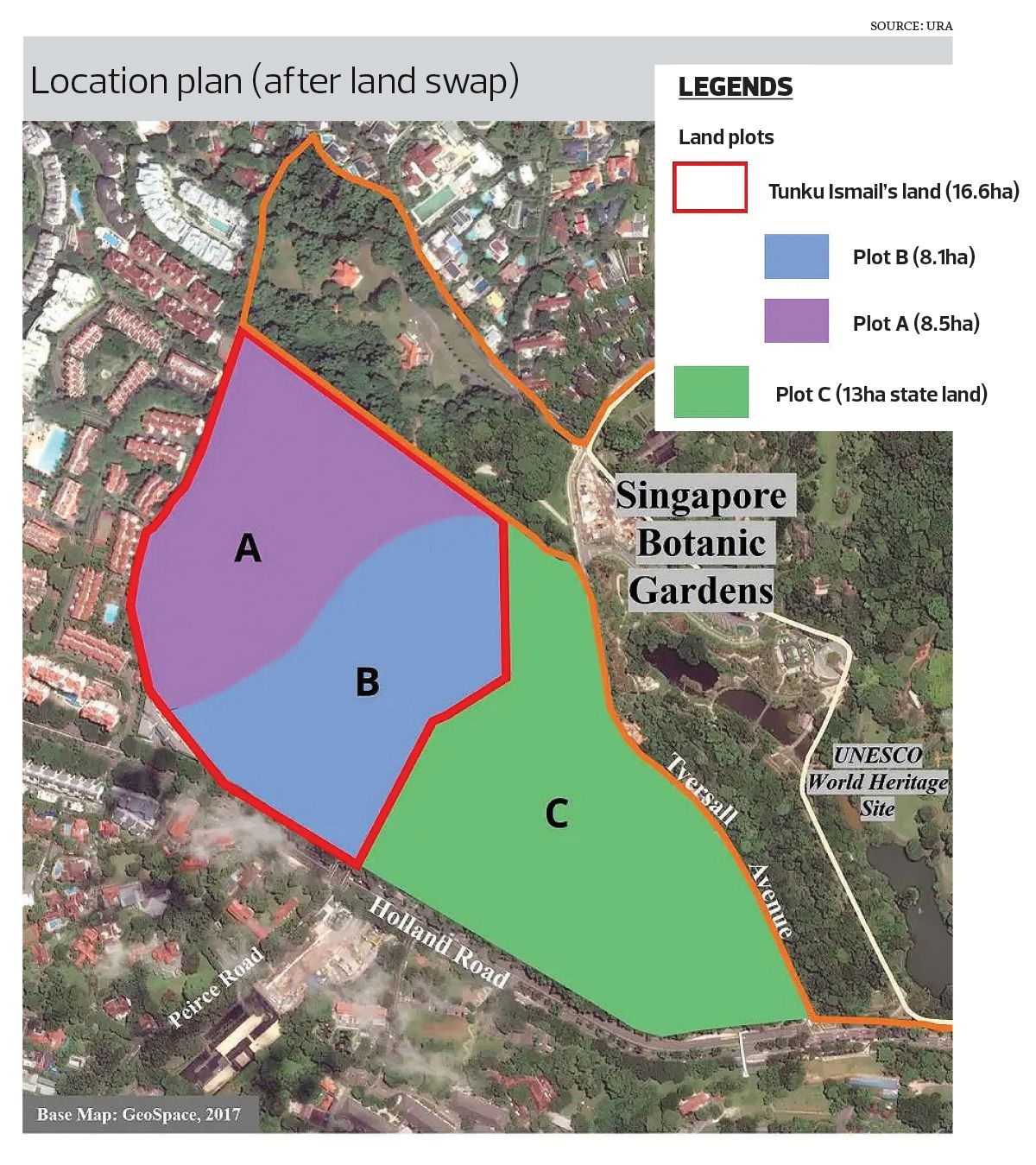
The Urban Redevelopment Authority (URA) announced on March 17 that Tunku Ismail had applied to develop his 16.6ha land parcel for low-rise, low-density housing with a gross plot ratio of 1.4, as well as GCBs.
The Singapore government announced in June 2025 that Tunku Ismail had received an 8.5ha plot (Plot A) in exchange for his 13ha plot (Plot C), so that his planned developments would be further away from the Singapore Botanic Gardens. Tunku Ismail has applied to redevelop Plot A and the adjacent 8.1ha Plot B.
In the March 17 statement, URA says the relevant agencies have reviewed the development application and assessed that the proposed plans are compatible with and sensitive to the surrounding residential neighbourhood. It adds that the proposal also complies with the current height restrictions that protect the visual amenity of the Singapore Botanic Gardens.
URA is proposing to rezone Plot A and Plot B to “Residential” from “Special Use” and “Open Space” respectively. Should the rezoning proposal be approved, a part of the land parcels zoned “Residential” will also be designated as a GCB area “to reflect the type of housing to be developed”, it says.
The Singapore government will keep Plot C — which is currently zoned “Open Space” and “Special Use” — undeveloped for now “while keeping open our future plans for the area”. Hence, URA is also proposing to rezone the part of Plot C that is zoned “Special Use” to “Open Space” to reflect this intention.
Singapore’s 40th GCB area?
Should the entire 16.6ha site be developed into a landed residential enclave, it could yield 100 to 200 low-rise, low-density homes, including GCBs, depending on the final planning parameters, says ERA Singapore’s Chu.
If the rezoning is approved, this could lead to the creation of a new GCB area, increasing the total to 40 and introducing a distinct luxury housing enclave within the highly desirable District 10, he adds.
Tunku Ismail’s rezoning application comes amid a resurgence in GCB market activity. In 2025, the segment saw several high-profile transactions, including the sale of a freehold 80,000 sq ft GCB in December 2025, which set a new price benchmark.
This indicates that market conditions may be favourable for such a rezoning initiative, says Chu.
The demand for GCBs has increased owing to newly naturalised Singapore citizens and their spouses who can purchase landed homes without special approval, he notes. At the same time, more young buyers — frequently the heirs of established business families — are entering the market.
Indeed, with the Singapore government intending to take in up to 30,000 new citizens annually, some well-heeled individuals may look to buy a GCB, according to Huttons Asia.
Tunku Ismail’s 16.6ha site is located on prime land in District 10, between the well-established GCB areas of Gallop Road/Woollerton Park and Holland Park. Landed homes in prime districts like 9, 10 and 11 are “highly desirable” because of their limited supply and “long-standing prestige”, says Chu. “Additionally, there are few chances to develop new landed housing in these regions.”
Alternatively, demand is likely to stay robust if the site is turned into low-rise, non-landed residences, particularly if offered on a freehold basis, he notes. Recent prime developments like Watten House, 21 Anderson and 32 Gilstead have shown high take-up rates that support this expectation, he points out.
‘Signs of pickup’ in prime landed market
The proposal comes at a time when activity at the top end of the landed market has shown signs of pickup, says Mohan Sandrasegeran, head of research and data analytics at Singapore Realtors Inc.
In 2025, about 30 caveated GCB transactions were recorded, up from 23 transactions in 2024, reflecting a gradual return of participation among high-net-worth buyers, he adds.
More broadly, landed transactions in the price range of S$10 million (RM30.64 million) and above also increased, supported in part by renewed interest in GCB properties. This was highlighted by the transaction in Peirce Road, which saw a GCB change hands for S$148 million, marking one of the highest recorded transactions in more than a decade.
GCBs continue to be regarded as one of the most prestigious forms of landed housing in Singapore, says Sandrasegeran. “They are subject to strict planning controls to preserve their exclusivity and low-density character, which in turn supports their appeal as a store of wealth. For many buyers, these properties serve not only as a residence but also as a long-term asset for wealth preservation across generations.”
From a planning perspective, the proposal reflects how Singapore continues to unlock land value through “careful and calibrated refinements” rather than intensification, he adds. “By maintaining a low-rise and low-density profile, the development remains consistent with the surrounding landed housing character while still contributing to the overall housing supply.”
Jovi Ho is the editor of City & Country at The Edge Singapore. This article first appeared on theedgesingapore.com.
Save by subscribing to us for your print and/or digital copy.
P/S: The Edge is also available on Apple's App Store and Android's Google Play.