

This article first appeared in City & Country, The Edge Malaysia Weekly on March 23, 2026 - March 29, 2026
The Real Estate and Housing Developers’ Association (Rehda) Malaysia is calling for a review of the 30% affordable housing allocation imposed on developments saying the requirement contributes to overhang units when supply does not match local demand.
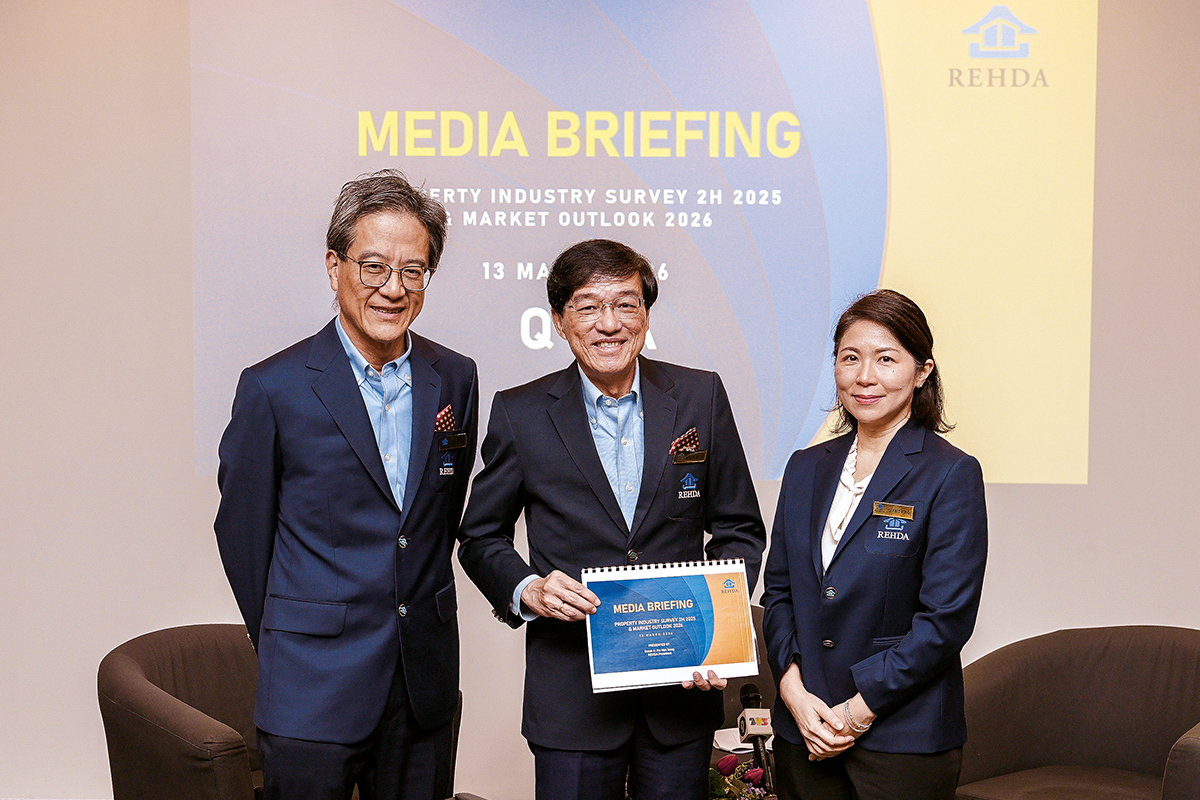
The association says the policy, which requires developers to include affordable housing regardless of location, should be replaced with a data-driven approach to housing demand, according to findings presented on March 13 from the association’s Property Industry Survey and Property Sentiment Survey, which drew responses from 166 and 107 Rehda members in Peninsular Malaysia respectively.
“A data-driven supply-and-demand concept needs to be adopted so that developers know that what they develop under the Rumah Mampu Milik allocation will achieve the necessary take-up rate,” Rehda Malaysia president Datuk Ho Hon Sang told the press conference after the presentation of the survey.
He noted that in some cases, developers face slow take-up rates during construction and after completion, sometimes having to approach the government to purchase the units.
Findings from Rehda Malaysia’s Property Industry Survey show that 93% of respondents reported their projects did not fall under the requirement for price-controlled housing, while 7% opted to pay a contribution in lieu to the state authority. Only 11% of respondents reported having price-controlled housing components in their projects in the second half of 2025 (2H2025).


Among developers implementing price-controlled housing components, the top challenges cited were difficulty maintaining profitability because of price caps (24%), insufficient demand from target low- to middle-income buyers (17%) as well as delayed approvals and bureaucratic hurdles (14%).
Cross-subsidy pushes up prices
Meanwhile, Rehda Malaysia immediate past president Datuk N K Tong pointed out a market-price mismatch caused by the affordable housing requirement, as developers must cross-subsidise price-controlled units by increasing the prices of other units in the same project. This has resulted in unsold residential units when prices exceed what buyers can afford, he explained.
“The way our industry works is not market-driven. The fact that we have cross-subsidies means there will always be units that are priced beyond what we think the market can support.
“If we were given a free hand, pricing would be very straightforward. Let’s say units priced in the range of RM500,000 to RM600,000 will be sold in a project. The moment the 30% affordable housing allocation is assigned, developers estimate that it adds RM50,000 to RM100,000 to the selling price.
“That means instead of launching at RM500,000 or RM600,000, developers may need to launch from RM550,000 to RM700,000,” Tong said, stating that the price-to-market mismatch contributes to the affordability gap.
He added that a similar approach could be explored in housing financing. “Perhaps banks should consider allocating about 30% of their mortgage portfolios to affordable loans, so they work harder to accommodate those who need help.”
According to the survey, by property type, 2- to 3-storey terraced houses accounted for 26% of unsold units, followed by serviced residences (19%) and 1-storey terraced houses (18%).
Homes priced between RM500,001 and RM700,000 recorded the highest share of unsold stock, accounting for 16% of non-bumiputera units and 13% of bumiputera units on the open market.
Tong reckoned that housing affordability should not be assessed based solely on property prices but also on buyers’ ability to obtain financing.
“If you look at housing affordability, the first factor is the cost of the home and the second is the cost of financing. As we’ve seen, buyers have difficulty accessing financing,” he said.

Financing hurdles remain a key challenge
Financing constraints for both buyers and developers remain one of the most persistent issues that affect housing demand.
According to the survey, 72% of developers reported facing financing issues in 2H2025, with the majority attributing end-financing constraints, where buyers failed to secure housing loans as the main cause.
“If buyers have outstanding credit card balances or excessive debt commitments, it affects their eligibility for housing loans,” Ho said. “We encourage developers to guide buyers on managing their finances but, ultimately, if they do not meet the eligibility requirements, it becomes difficult for banks to approve the loan.”
The survey also found that homes priced between RM500,001 and RM700,000 recorded the highest loan rejection rates, with an average of 38% of transactions failing to obtain financing approval.

As at Dec 31, 2025, 60% of developers surveyed reported unsold completed residential units, with loan rejections, weak demand and high property prices cited as the main reasons. Unsold completed residential units less than one year old made up 61% of the total, while those older than three years accounted for 22%.
Developers also face financing issues, with Tong noting that they need assistance in obtaining faster loan approvals to better address market supply.
The survey also provided insights into buyer demographics. At 48%, purchasers aged 29 to 44 accounted for the largest share of homebuyers, followed by those aged 45 to 60 at 32%, reflecting demand from young families and upgraders. Local buyers continued to dominate the market, representing 74% of transactions.
Foreign demand remained relatively subdued, with 64% of developers expecting higher stamp duties of between 4% and 8% on foreign buyers to dampen overseas demand, reinforcing the sector’s reliance on domestic purchasers.

Launch activity slows amid cautious sentiment
The number of residential launches increased slightly in 2H2025, but sales performance weakened in the same period.
According to the survey, developers launched 17,971 residential units in 2H2025, representing a marginal 0.6% increase from the 17,859 units launched in 1H2025.
Total units sold fell to 3,784, translating into a take-up rate of 21%, significantly lower than the 38% recorded in 1H2025.
Among property types, townhouses recorded the highest take-up rate at 60%, followed by 1-storey terraced houses at 41%.
In terms of pricing, 36% of launches in 2H2025 were priced at RM500,000 and below, comprising 8% below RM300,000 and 28% in the RM300,001-to-RM500,000 range.
As at 2H2025, properties priced below RM500,000 were most commonly launched in Perak, Melaka, Kedah, Terengganu and Negeri Sembilan, while launches in the RM500,001-to-RM700,000 price range remained concentrated in Segambut, Kuala Lumpur.
Looking ahead, 47% of developers indicated plans to launch projects in 1H2026, while those holding back cited unfavourable market conditions, delays in approvals, higher unsold stock and weaker demand in project locations.
Overall demand confidence remained cautious among developers, although many expect sales performance to improve gradually within six months of project launches.
According to Rehda Malaysia’s projections, 1H2026 will see the launch of about 5,015 landed residential units and 12,669 strata residential units, with developers expecting sales performance to improve gradually from below 25% at three months to between 25% and 50% after six months.

Outlook for 2026
Rising operating costs remain another key concern for developers.The survey found that 74% of developers reported higher operating costs in 2H2025, driven mainly by increases in construction materials, labour and compliance costs. Construction costs rose between 3% and 6% during the period, while the expanded sales and service tax, or SST, also added to project cost pressures.
Despite these challenges, Ho said, the broader economic environment remains supportive for the property market.
“The economy did very well towards the last quarter of last year. Our growth is over 5%. The OPR [overnight policy rate], which is very important in property development, is stable at 2.75%,” he said.
“Although construction costs rose, it appears that this increase can be handled moderately. Based on this, we expect it to be the scenario for 2026.”

Despite softer sales performance in 2H2025, developers appear to be maintaining a longer-term outlook for the market. The survey showed that 55% of respondents plan to expand their land bank in the next 12 months, while 45% expect capital expenditure to increase over the same period.
The survey also highlighted industrial development as a leading growth area for property developers, reflecting strong demand from logistics, manufacturing and data-related sectors.
Meanwhile, Rehda Federal Territories (Kuala Lumpur) branch chair Carrie Fong said land constraints — particularly in Kuala Lumpur — could drive more redevelopment and repurposing projects.
“Kuala Lumpur is behind Johor, Perak and Selangor in terms of transaction volumes, probably owing to land scarcity and rising land values. I foresee that the city will gradually move towards redevelopment, adaptive reuse and repurposing,” she said.
Save by subscribing to us for your print and/or digital copy.
P/S: The Edge is also available on Apple's App Store and Android's Google Play.