

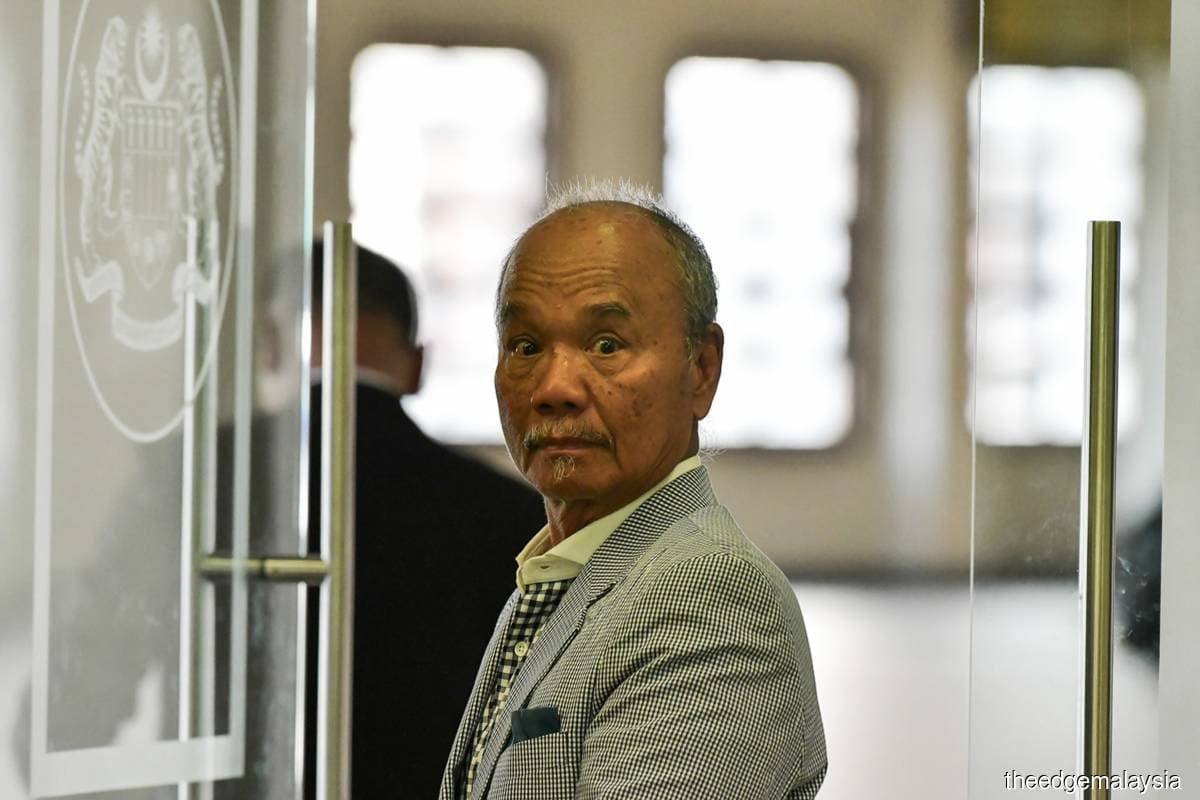
KUALA LUMPUR (March 16): Former prime minister Datuk Seri Najib Razak was viewed by the board of SRC International Sdn Bhd as being in a position to receive the best advice on the company's management from the top federal institutions in the country, a former director told the High Court on Monday.
The former director, Datuk Che Abdullah @ Rashidi Che Omar, said SRC's board assumed that Najib had received proper guidance from the Economic Planning Unit (EPU), the Ministry of Finance,and Bank Negara Malaysia before issuing instructions to spend the company's funds.
Che Abdullah was testifying in the civil suit filed against Najib by SRC and its subsidiary, Gandingan Mentari Sdn Bhd, to seek a declaration that Najib is liable for the company's losses amounting to RM42 million.
“We assumed the company owner had followed all the advice from those institutions to write a letter to the board to spend that money in that type of investment,” Che Abdullah said during cross-examination from Najib’s legal counsel, Tan Sri Muhammad Shafee Abdullah.
When Shafee suggested that the board's reliance on Najib was "topsy-turvy", arguing they were the ones with skills in management and employees whereas Najib was only one person and "cannot micro-manage", Che Abdullah maintained that the board viewed the then prime minister's direction as vetted information.
The witness also disagreed with Najib's claim that the former prime minister had no power to decide or be involved in SRC’s decision-making, asserting the company's structure granted Najib wide-ranging powers as adviser emeritus.
In this trial before High Court judge Raja Ahmad Mohzanuddin Shah Raja Mohzan, the court has allowed Najib to bring six third-party defendants into the proceedings. He claimed they were the ones actually responsible — wholly or partly — for the loss in question.
The six third-party defendants are: Che Abdullah, Tan Sri Ismee Ismail, Datuk Suboh Md Yassin, Datuk Shahrol Azral Ibrahim Halmi, Datuk Mohammed Azhar Osman Khairuddin and Nik Faisal Ariff Kamil. Nik Faisal is still at large.
BSI Bank 'deception'
Che Abdullah further told the court that the board’s decision to place RM4 billion — which originated from a loan from the Retirement Fund Incorporated (KWAP) — in BSI Bank in Switzerland was based on representations that the funds were "safe", a claim that later turned out to be a "big lie".
He explained that a year after the investment was made, the board travelled to Switzerland to meet with BSI’s management in an effort to trace the funds purportedly sitting in the bank's coffers.
“We saw the bank. The bank was a large organisation... They said the money was still there. The purchase was safe,” he testified.
However, Shafee argued that this representation was a deception and that the money was never recouped. Che Abdullah acknowledged he was aware that BSI Bank in Singapore was later shut down in 2016 due to serious breaches of money laundering regulations and poor oversight related to 1Malaysia Development Bhd (1MDB) and its then subsidiary, SRC; its senior members were also prosecuted by the Monetary Authority of Singapore (MAS).
Reliance on Nik Faisal
The former director also admitted that the board relied heavily on the truthfulness of former SRC chief executive officer Nik Faisal, who acted as the conduit for Najib's instructions but is now on the run.
Che Abdullah also agreed with the suggestion that because of Nik Faisal's disappearance, the board's defence is now based on statements from someone who cannot be held accountable as he remains a fugitive.
Shafee then suggested that the board had "abandoned" its fiduciary duties by simply following orders, noting that the board is legally the ultimate decision-maker, not the shareholder.
Che Abdullah disagreed, saying that because the company has only one shareholder, he viewed acting in the owner's interest as being synonymous with his loyalty to the company.
During cross-examination, Che Abdullah, who has served on several boards including Kuala Lumpur Kepong Bhd (KL:KLK) as well as statutory bodies like the Federal Land Development Authority, was asked if his work at "blue-chip" companies faced similar levels of interference.
The witness confirmed that he did not see similar reach or interference by the prime minister in those plantation companies.
'I was not involved in KWAP loan'
In a sworn written statement prepared before cross-examination, Che Abdullah denied any involvement in the application or approval of the company's RM4 billion loan from KWAP, saying he was not a director at the time.
Having joined the company in 2011, Che Abdullah said he only became aware of the loan after it had been approved and was later tabled during a board meeting.
"I was not a director during that time (of the loan application in June 2011). Therefore, I am not and cannot be involved in the loan application or approval," he said.
He said his role in SRC was limited as a director, and that all primary decisions were made by Najib as the company's sole shareholder.
"My involvement was only limited to approving the shareholders' resolution which was presented to the SRC's board of director. At that material time, all the decisions were proposed, made and approved by SRC's sole shareholder (Ministry of Finance Incorporated) without the discretion of the board of directors (BOD).
"I did not think the BOD can ever contradict or object to the shareholders' resolution as it always supersedes the decision of the BOD. This is because the said resolution is not only the decision of the shareholder, but also the decision of the prime minister and finance minister at that material time, which can be interpreted as the decision of the government," he said.
He added that the company's corporate structure at the material time meant that the BOD typically endorsed and approved instructions issued by Najib in his capacity as adviser emeritus, while Najib was also serving as prime minister and finance minister.
Che Abdullah also said he had no personal knowledge of the transfer of RM123 million from SRC or through its subsidiary, from which RM42 million was later transferred to Najib.
"Despite the transaction happening during my tenure as a director in SRC, nevertheless, I was neither a signatory nor approving party to the transactions," he said.
In this lawsuit, Najib is also being sued for breach of fiduciary duties, knowing receipt of the funds, dishonest assistance, tort of misfeasance and abuse of power.
Che Abdullah was the final witness in this trial, with hearing now wrapped up. Raja Mohzanuddin set Aug 7 for parties to present oral submissions. Once oral submissions are concluded, the judge will set a date to deliver his decision.