

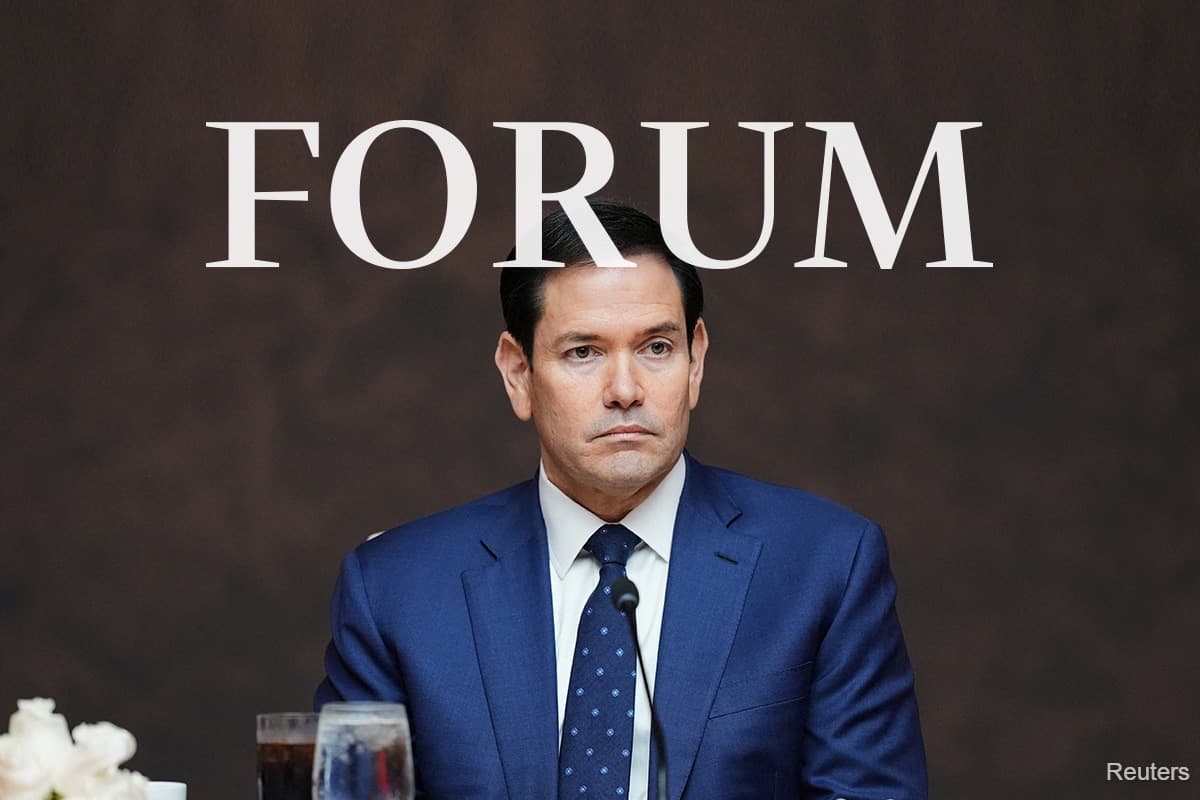
This article first appeared in Forum, The Edge Malaysia Weekly on March 16, 2026 - March 22, 2026
US Secretary of State Marco Rubio’s Munich speech last month seemed to have seduced the European elite behind President Donald Trump, against the “Rest”, especially “the resource-rich” Global South.
New international order?
Recognising the deliberate “wrecking-ball” demolition of the post-1945 world order, the 62nd Munich Security Conference’s theme was “Under Destruction”. Billed as the world’s leading forum for international security, the conference programme made clear whose interests and security were being prioritised.
In its first year, Trump 2.0 bombed 10 nations, besides threatening aggression against four other Latin American nations, but none were represented in Munich.
The Munich conference shed all pretence of objectivity and diplomacy on Iran, applauding Israeli-led military intervention to overthrow the Islamic republic.
German Chancellor Friedrich Merz emphasised the world’s return to great power competition after the post-Cold War “unipolar moment”, making his loyalty clear.
At Davos in January, Canadian Prime Minister Mark Carney noted that Trump 2.0’s geopolitical “rupture” had forced many to abandon earlier illusions.
Dangerous new trends have been emerging, hardly any “order”. Trump insists that US supremacy must be even more dominant, isolating rather than confronting rivals.
In January, the US withdrew from dozens of mainly multilateral organisations. Old rules — even those revised during his first term — are out, alarming many accustomed to them.
Trump’s predecessors’ “rules-based order” had offered a legal and diplomatic fig leaf to subordinate other states to US supremacy.
Now, Washington repudiates the very framework it demanded others accept, instead of the ostensibly universal but sometimes inconvenient “rule of law”.
Instead of diplomatic and commercial negotiations, economic and military threats prevail. Without the velvet gloves of soft power, the mailed fists of military force and economic weaponry are exposed.
Reuniting the West
Rubio welcomed this “new era in geopolitics”, urging better transatlantic relations while reiterating Trump 2.0’s demands for Europe to pay more, albeit more gently.
After the end of the Cold War, Samuel Huntington’s Clash of Civilizations urged defending the “Judaeo-Christian” West against the “Rest”, including Catholic Latin America.
In Munich, Cuban-American Rubio reinvented himself as a White Christian European, warning his European audience that the West is under threat.
For Rubio, “the West had been expanding” to “settle new continents, build vast empires extending out across the globe” over the last five centuries.
His history obscured Western imperialism’s dispossession, exploitation and slaughter of indigenous peoples worldwide, especially in the Global South.
Praising the superiority of European civilisation and values, he lamented setbacks to these “great Western empires” due to “godless communist” and “anti-colonial” uprisings after World War II.
Rather than progress inspired by the 1776 US Declaration and War of Independence, for Rubio, national self-determination was a civilisational setback.
“We in America have no interest in being polite and orderly caretakers of the West’s managed decline.” For Rubio, no more “liberal” human rights, freedom and democracy rhetoric. He did not hesitate to invoke racist, white supremacist mythology and crusader ideology to demand stronger militaries to defend Western civilisation.
The renewed Western alliance will share their common civilisational identity, bound by “Christian faith, culture, heritage, language, ancestry”.
Ethno-chauvinistic beliefs about race, religion and culture are the new bases for solidarity and authority. “Defending Christians” became the pretext for the US 2025 Christmas Day bombing of Nigeria.
Another Western century?
Rubio appealed for pan-European Western unity against multilateralism and other threats, calling for increased military spending and immigration controls.
He urged Europe to “take back control” of “Western” industries and supply chains. After all, Nato allies have joined the US in seizing foreign assets at will.
Vassal-like and desperate for reassurance after a year of Trump’s blatant contempt and threats, the audience welcomed his speech with a standing ovation.
Fearing Washington might negotiate with Moscow over Ukraine without them, European leaders have intensified demands for an all-out war against Russia.
Rubio is working to secure the supply of critical minerals against “extortion from other powers”, including Europe, through opaque bilateral agreements secured with threats.
Trump 2.0 is making military threats for profit, including post-war ownership, mining and other rights. For many, Nato’s US-Europe divide is not over peace, but rather sharing the Ukraine war costs and spoils.
While funding for European welfare states and other “social” purposes continues to fall, military budgets continue to spike, as demanded by Trump.
Meanwhile, Merz has invoked military Keynesianism to justify Germany’s largest ever military budget since the Cold War, aimed at strengthening Nato.
Ostensibly to strengthen national security, the Trump administration has cut social programmes. Instead, US military spending is being prioritised.
Meanwhile, the US Congress has shown support by approving a larger War Department budget than the Pentagon requested. Armaments contracts have mainly benefited established companies, while the “tech bros” increasingly supply newer weapons and related systems using artificial intelligence.
Following Trump, the European elites are strengthening their already powerful militaries and securing commercial deals for their own advantage, rather than defending the peaceful multilateral cooperation they once advocated.
Jomo Kwame Sundaram is a senior adviser at Khazanah Research Institute (KRI). A former economics professor, he was United Nations assistant secretary-general for economic development. He is a recipient of the Wassily Leontief Prize for Advancing the Frontiers of Economic Thought.
K Kuhaneetha Bai studied at Universiti Malaya and does policy research at KRI.
Save by subscribing to us for your print and/or digital copy.
P/S: The Edge is also available on Apple's App Store and Android's Google Play.