

This article first appeared in Forum, The Edge Malaysia Weekly on March 16, 2026 - March 22, 2026
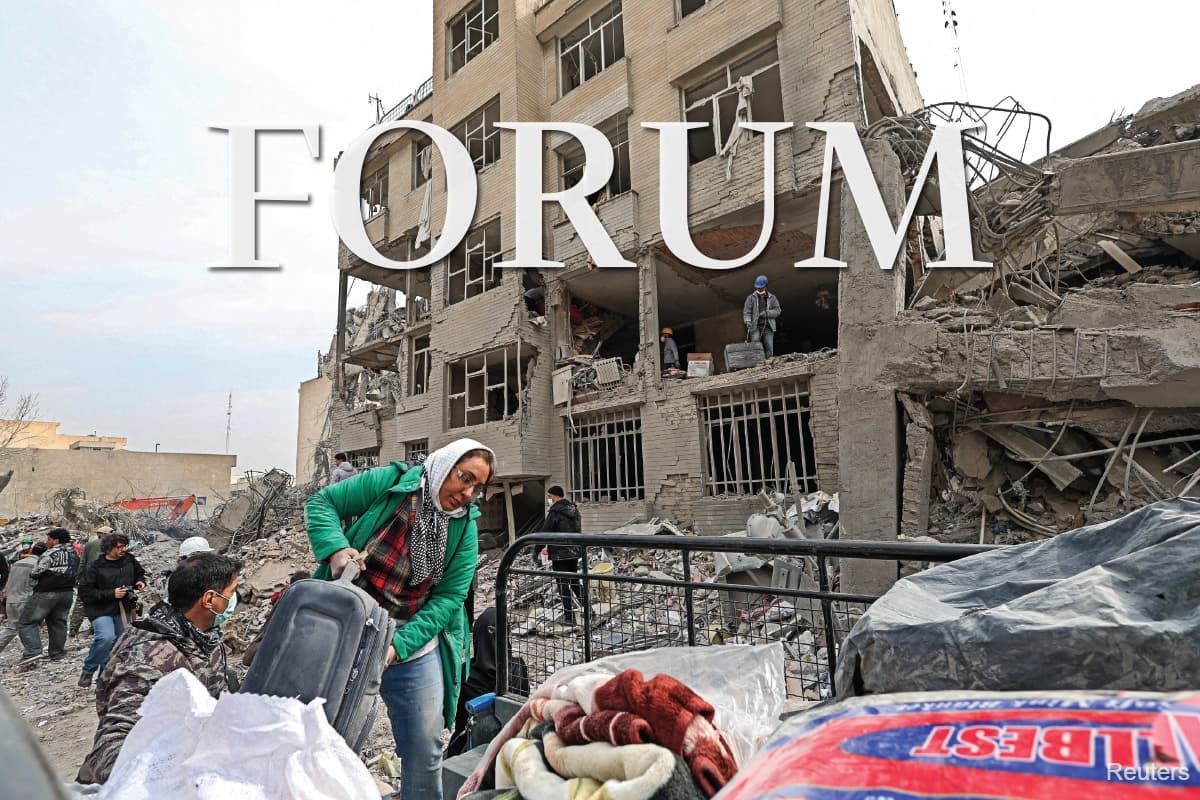
Despite President Donald Trump’s vow that the war will end “very soon”, the reality is that the crisis in the Middle East is intensifying. Iran’s retaliation is bringing more countries into the conflict while Israel has broadened its offensive beyond Iran to Lebanon and is stepping up its offensive against Iran. Given the breakdown of trust and the absence of an off-ramp that would allow both sides to de-escalate, there is little prospect of a quick resolution.
The risks for the world and Asian economies go beyond the damage caused by high oil prices, bad enough though that may be. The war also means even more uncertainty for businesses, which itself will slow economic activity. But the potential danger markets may be underestimating is that the sharp falls and greater volatility in currency, commodity, equity and bond markets could ignite latent financial and economic vulnerabilities in the world economy.
A conflict that is likely to last several weeks or more
The war aims of the US and Israel and the Iranian regime’s survival strategy imply little chance of a near-term end to the fighting. Even if the US wants to de-escalate, Israel’s approach will make it difficult to do so. Israel is determined to ensure that Iran’s capacity to threaten Israel in any way is eliminated and is prepared to pay a high price for that. On its part, the Iranian regime does not trust the US, making good-faith negotiations impossible — their strategy is to impose as high a cost as possible in terms of surging oil prices and attacks on US allies in the region so that the US eventually backs off. Thus, this war is going to last for at least several weeks more, if not longer.
The longer the crisis lasts, the longer it is that shipping through the Strait of Hormuz is disrupted. Since the Hormuz links the Persian Gulf to the Indian Ocean, this will cripple the shipment of items that are critical for the world economy including crude oil, natural gas, refined petroleum, petrochemicals, fertilisers and aluminium. The knock-on effects on the world economy will therefore be substantial and damaging.
Iran’s navy has been mostly scuttled and a large proportion of its missiles has reportedly been destroyed. But, the regime retains shore-based drones and unmanned surface vehicles that can be used to attack ships traversing the Strait. Iran has every incentive to disrupt the Hormuz because it is its most effective lever for imposing economic costs on the US coalition.
Mitigating actions by the US and others will take time to take effect — and may not be sufficient. Naval convoying is theoretically viable — during the Iran-Iraq war of the 1980s, the US and allies mounted the Earnest Will operation which helped keep naval traffic moving in those waters. But such an operation requires months of preparation, and the US has yet to kick-start the process. In addition, the US and Gulf nations are trying to secure Ukrainian interceptor drones, which have proven effective against the Iranian designed Shahed drones that Russia uses. But logistics issues mean that solution is still several weeks away from being available. Trump’s promise to provide shipping insurance could help but only to a small extent — shipping firms will not move until actual threat reduction is demonstrated.
In other words, the war will last long enough to materially depress economic growth around the world. Estimates vary but most analysts see a reduction in global growth of at least 0.2 to 0.5 percentage points below the 2.8%-3.0% global growth that had been expected earlier. Global inflation could rise by anything between 0.8 and 1.2 percentage points. Oil importing countries could see their trade deficits widen by around 1% of gross domestic product.
Watch out for new stress points
This scale of damage to global economic conditions is worrying. But the potential dangers go beyond this — there is a risk that the after-effects of the Iran crisis could ignite pre-existing vulnerabilities.
Take the US economy as an example. It appears to be better positioned to absorb an oil shock than in previous Middle East crises. The US is unlikely to face a supply-side energy crisis because its shale production can absorb a large share of that impact. But its energy prices will follow global prices and surge, raising inflation and complicating the Federal Reserve’s monetary policy decision-making while also increasing business uncertainty. These factors could trigger existing weak points in the US economy.
America’s recent growth has been excessively dependent on the artificial intelligence (AI) capital expenditure boom, a boom premised on cheap and abundant energy since data centres and graphics processing unit clusters are energy-intensive. Companies spending billions on AI probably did not factor in such high power and fuel costs as now prevail. Concerns about stretched AI valuations will grow and a reassessment of project commitments is likely to reverse some of the capital spending.
Private credit markets present another risk because the lending has been concentrated in logistics operators, manufacturers and distributors with thin margins and significant exposure to energy costs. A sustained rise in energy costs directly hits operating cash flows, impairing debt serviceability. Covenant-lite documentation means that stress may not surface until a refinancing event forces it into the open, at which point contagion to broader credit markets becomes harder to contain.
US households, especially lower-income ones, were already under strain as pandemic savings had been exhausted and real wage gains had narrowed. This is why credit card delinquencies have been rising recently. A rise in gasoline prices will compress real incomes and spending power. The resulting weaker consumption spending would remove a significant buffer just when other stresses are building.
Slower US consumption and investment would translate directly into weaker import demand and create significant headwinds for Asian exporters. A troubled American economy would also increase investors’ risk aversion given how important US demand has been to the world economy. More risk-off episodes can be expected, resulting in outflows from emerging markets, and tightening financial conditions across the region.
Asian economies must prepare for weaker growth
A prolonged disruption in Hormuz shipping would inflict an acute energy supply shock on Asia. Even countries that have diversified their energy sources away from the Persian Gulf would suffer higher energy prices. In terms of the energy supply mix, the three main sources are oil, gas, and coal; renewables play only a minor role across the region.
Countries with a heavy reliance on imported oil and gas will be more exposed to both physical supply disruptions and terms-of-trade deterioration. Most major Asian economies are net oil importers, with only Malaysia and Indonesia meeting at least 40% of their consumption from domestic production. The picture for gas is more mixed: Indonesia and Malaysia are net exporters, while Vietnam has, until recently, been self-sufficient, though accelerating field depletion means it is likely to become a net liquified natural gas importer within the coming years.
Despite its vulnerability as a highly open economy, Singapore has some offsetting factors. As it is a regional refining and trading entrepôt, much of its crude oil intake is processed for re-export, overstating net domestic exposure. Its power sector is also predominantly gas-fired rather than oil-dependent, with supplies locked in. Its position as a commodity trading hub affords greater supply flexibility than its import ratios suggest.
Taking energy structure and trade balance factors together, the countries that are most directly exposed to a Hormuz-driven energy price shock are the high-income East Asian economies, the Philippines, and Thailand, owing to their heavy dependence on oil and gas for energy and their limited domestic production.
That said, Asian economies have made progress in reducing the energy intensity of growth. There are cross-country differences reflecting their different industrial bases, with lower-income economies generally exhibiting lower energy intensity, given the prevalence of lower-value-added activities — informal services and basic manufacturing — that demand less energy. From a longer-term perspective, most countries are better positioned to withstand an energy shock than in previous decades, owing to greater energy efficiency from both technological change and government policy.
But the danger goes beyond the damage from high energy prices.
Indonesia is a significant net importer of refined petroleum products, and its current account is sensitive to swings in commodity prices. More critically, the rupiah has historically been among the most volatile currencies in the region during risk-off episodes, and Bank Indonesia’s room to cut rates — already constrained by the need to defend the currency — would narrow further. Investor confidence in Indonesia’s policy framework has already been rattled by concerns expressed by rating agencies over its fiscal policy and market transparency. Thus, the rupiah and Indonesian equities remain vulnerable.
The economies of Thailand and the Philippines are currently running below potential growth while policy uncertainty has affected investor confidence. This could weaken their ability to absorb a simultaneous external and terms-of-trade shock. The Philippines faces another risk — it is dependent on remittances, much of which come from Filipino workers in the troubled Middle East.
Watch out for longer-term effects as well
The Iran crisis is a major turning point in global politics and will produce major shifts over time. Some of the more likely ones are given below:
Expect new defence alliances: The countries of the Persian Gulf had long turned to the US for protection, giving the US an extraordinary level of influence in the region. But that association and these countries’ willingness to host American military facilities have exposed them to Iranian attacks. The US was not able to prevent all these attacks and also appears to have been unable to re-supply those allies with Patriot and other anti-missile interceptors when these were depleted. The Gulf sheikhdoms will now have to rethink their defence strategies. The recent Saudi Arabian alliance with Pakistan could be broadened out to include other regional powers such as Türkiye, for instance.
An all-powerful Israel would worry the region: Once the dust settles after this conflict, Israel will emerge as the most powerful force in the Middle East. If it uses this power to further undermine Palestinian rights or to impose its will on neighbours such as Lebanon, we could see more tensions and new crises in the region.
More countries may seek nuclear protection: Some countries will take note that North Korea, a nuclear power, has not been targeted by the US while Iran which had not reached nuclear status has been decimated by the US — as were other non-nuclear countries such as Iraq, Syria and Libya. It would not surprise us if some countries in the Middle East and elsewhere decide to pursue a nuclear weapons capability.
Is Dubai’s role as a global heart of commerce and finance really at risk? Despite some astute diplomacy in the past, the United Arab Emirates and its two major cities of Abu Dhabi and Dubai have been targeted for missile and drone attacks. This has hurt their status as safe havens in a troubled region. Dubai, in particular, had emerged as a major global hub for finance, aviation and business headquarters. The spectacle of explosions near its iconic Burj Khalifa tower would have hit global investors’ confidence in Dubai. However, once the conflict ends, some of these concerns are likely to ease. Major hubs such as Dubai are resilient and adaptable — our sense is that it is premature to expect Dubai’s role to diminish in favour of Asian cities such as Hong Kong or Singapore.
Conclusion: a rough time ahead for Asia
The war against Iran is a defining moment in the Middle East with potentially momentous implications for Asia. In the near term, Asian economies will have to endure slower growth and higher inflation. In the longer term, they will have to prepare for significant political and economic shifts that make the world a less safe place.
Manu Bhaskaran is CEO of Centennial Asia Advisors
Save by subscribing to us for your print and/or digital copy.
P/S: The Edge is also available on Apple's App Store and Android's Google Play.