

This article first appeared in The Edge Malaysia Weekly on March 16, 2026 - March 22, 2026
Compared with other materials, glass waste is rarely collected from Malaysian consumers and recycled due to the lack of collection and recycling infrastructure for such products.
This is, however, a chicken-and-egg problem: The lack of awareness means few consumers send their used glass bottles and waste to be recycled, and thus, recyclers cannot justify the investment to take in this material.
Tobias Mangelmann, managing director of Lasaju Consulting Sdn Bhd, has been trying to tackle this problem with Glass Loop, an initiative that runs pilots to aggregate post-consumer glass and streamline glass recycling activities in the country. Glass Loop has glass collection bins in 38 locations in the Klang Valley, including Selangor’s 1 Utama shopping mall, which had a soft launch in October 2025, as well as other areas in Ara Damansara and Puchong. It also collects waste from retail businesses.

“If you try to sell glass to a glass melting company, the revenue is not enough to cover the cost of collection, transport and sorting … If you have high volumes, then the collection becomes cheaper. Then you would need to invest in bins and the infrastructure, but then again, if you don’t have the volumes, it will never work,” explains Mangelmann.
According to the Solid Waste Management and Public Cleansing Corp, glass accounts for 2.7% of the 39,078 tonnes of solid waste thrown away by Malaysians daily, which is equivalent to about 380,000 tonnes of glass ending up in landfills annually.
The glass recycling process involves four main steps: collecting and transporting; sorting by material and colour (transparent, green and brown); crushing it into little pieces called cullets; and melting it in a furnace.
While Malaysia has companies that are able to transport and sort glass, there are only two big furnaces nationwide — OI-BJC Glass Malaysia and JG Containers — that are capable of large-scale melting, says Mangelmann.
Because the costs associated with each step are high, scale is necessary.
The country also plans to introduce an extended producer responsibility (EPR) scheme that will hold producers accountable for the life cycle of their products. As of now though, not much is being done for post-consumer glass.
The process of sorting and recycling glass can be labour-intensive. Mangelmann says technologies such as glass colour-sorting with near-infrared optical sorters can be implemented, but they are costly.
“The workers remove the labels one by one with a blade, then they remove the caps and so on. It’s still a very tedious process, which is why we always need to reach 300kg for the glass end-recyclers to make sense of the whole process. So, again, it really just goes back to the initial collection volume.”
Raising awareness
Although Glass Loop has seen positive response from residents living near the 1 Utama glass bins, the same awareness is not present in other communities.
“Normally, the [community in the] areas that have or want these bins already have education and awareness … When we start, we make sure — especially for glass, because the infrastructure is also not cheap to begin with — to aim for residential areas [that are more educated on glass recycling],” says Venus Lim Shuen Huey, a business analyst at Lasaju Consulting.
She adds that many people are still unaware of the types of glass that are accepted by Glass Loop.
“For example, you see a lot of ceramics or light bulbs in the collection bins sometimes, but we don’t accept them. We also cannot accept items like Pyrex and borosilicate glass because they have a different composition and melt at different points. Re-educating is always a little harder, because everybody already has a preconception of what glass is,” says Lim.
Sharing his experience growing up in Germany, Mangelmann says he had been taught from young to recycle glass, and the practice has evolved into something akin to a tradition and a habit.
“Most European countries, especially those that have a long history like Austria, Germany and France — and probably Asian nations such as Taiwan and Japan — already have a very strong EPR policy. Because [Germany has been recycling glass] for 30 years, it can push for this kind of thing.”
Germany has a law on the separation of trash at source, which when replicated here, could cultivate a recycling culture and drive up collection volumes here, Mangelmann says.
Although glass is a recyclable material, the reality is that there is nothing that can be 100% recycled. Raw materials will still be needed to manufacture new glass, although the demand is reduced by using recycled glass.
“Will mining for raw materials ever end? The answer is that would never happen, [as] we still need raw materials to feed [back into the loop]. If we do get the volumes of recycled cullets, 80% to 90% of the feedstock could be just from recycled materials,” says Lim.

Repurposing glass
Another solution for addressing glass waste is repurposing. Ecocycle Dynamic Solutions Sdn Bhd, for instance, has been repurposing glass waste to be used for roads and surfaces.
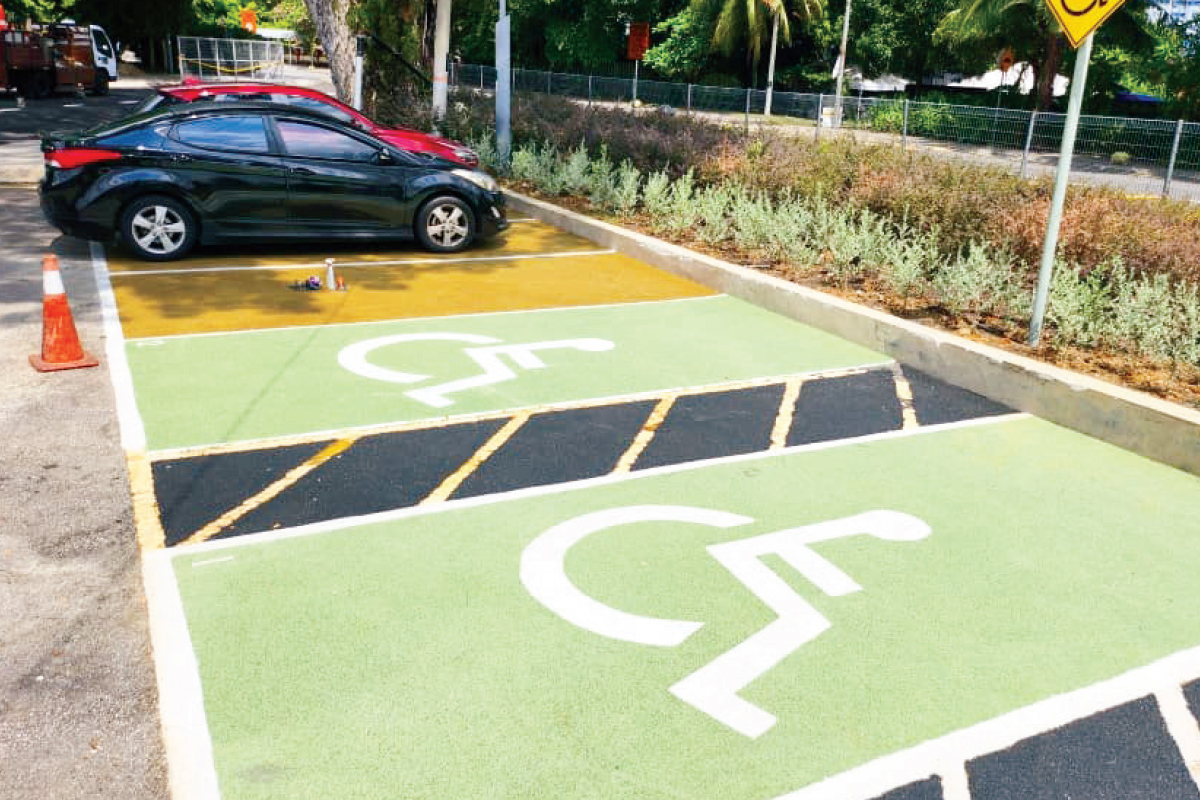
The company takes the glass sent by various parties, crushes it into various degrees of fineness and uses the cullets to pave roads and line parking lots for clients. Glass that is crushed to a finer granularity can be used in tree pits or muddy areas.
Instead of turning glass into different products that might otherwise still end up in the landfill, Ecocycle’s Glaste solution only requires crushed glass and a resin mixture that binds the shards together.
Ecocycle does not limit the type of glass it accepts, and its solution works with glass from different sources, such as construction glass and even glass from solar panels, although liquor bottles are its preferred material.
“Glass becomes brittle and keeps getting thinner because of the heat, but if you repurpose it, then it will stay there as something you want. And if you don’t want it anymore, it can just become sand,” says Ecocycle director Datuk Seri Wan Mohd Fauzi Wan Kamaruddin.
Repurposed glass can be extracted, reused and refined. One of Ecocycle’s main challenges lies in the awareness among the general public, says Wan Mohd Fauzi.
“We’re trying to tell the local authorities and prove that our solution can address glass waste. But the impression is that glass is sharp, glass causes injuries and that it’s not usable, but it’s not. [You can choose what you] want it to be.”
He is also trying to change mindsets by showing that Ecocycle is not just a dumping ground for discarded glass, and that the glass it receives can be repurposed for a particular function. This is to prevent Ecocycle’s grounds from simply becoming another landfill.
The company’s main clients are government agencies, alongside a few businesses. It is currently trying to obtain Sirim certification on the product’s durability and reliability.

Working with distributors
One industry that deals with a lot of glass waste is food and beverage. Carlsberg Brewery Malaysia Bhd (KL:CARLSBG), which sells beer in glass bottles, has established a system to retrieve used glass bottles to be recycled through a distributor return scheme (DRS).
The DRS involves collecting used glass bottles from commercial partners, and then putting them through a bottling line to detect and determine the durability and integrity of the bottles.
Bottles in good condition will proceed to thorough washing, inspection and then filling. Damaged or dirty bottles will be sent to Carlsberg’s internal ecosystem for bottle recycling or upcycled for other uses.
Carlsberg has set targets for recycled and renewable packaging to reach 100% by 2030, and to have 50% of recycled content in bottles and cans.
“[The DRS] has helped reduce our carbon footprint through higher recycled content. By using 60% recycled content in our glass bottles, we reduce the need for virgin materials and lower furnace energy demand, which directly reduces CO2 emissions across the packaging life cycle,” says Pearl Lai, director of corporate affairs and sustainability at Carlsberg Malaysia.
“Carlsberg Malaysia continuously enhanced its DRS throughout 2025, including [making] improvements in systems, logistics and collection efficiency as part of its broader Zero Packaging Waste ambition and sustainability commitments.”
Despite this, the DRS is only applicable to the ecosystem of Carlsberg’s business partners and does not involve consumers directly. This is because the company’s long-established scheme only incentivises trade partners to return bottles through a fee-based programme.
Elsewhere, countries like Latvia have a deposit return scheme for beverage products, including Carlsberg’s. Consumers pay a deposit that is then refunded when they return empty bottles at drop-off machines.
Carlsberg will also be supporting a similar policy in Singapore, called the Beverage Container Return Scheme, from April 2026.
Save by subscribing to us for your print and/or digital copy.
P/S: The Edge is also available on Apple's App Store and Android's Google Play.