

This article first appeared in The Edge Malaysia Weekly on March 9, 2026 - March 15, 2026
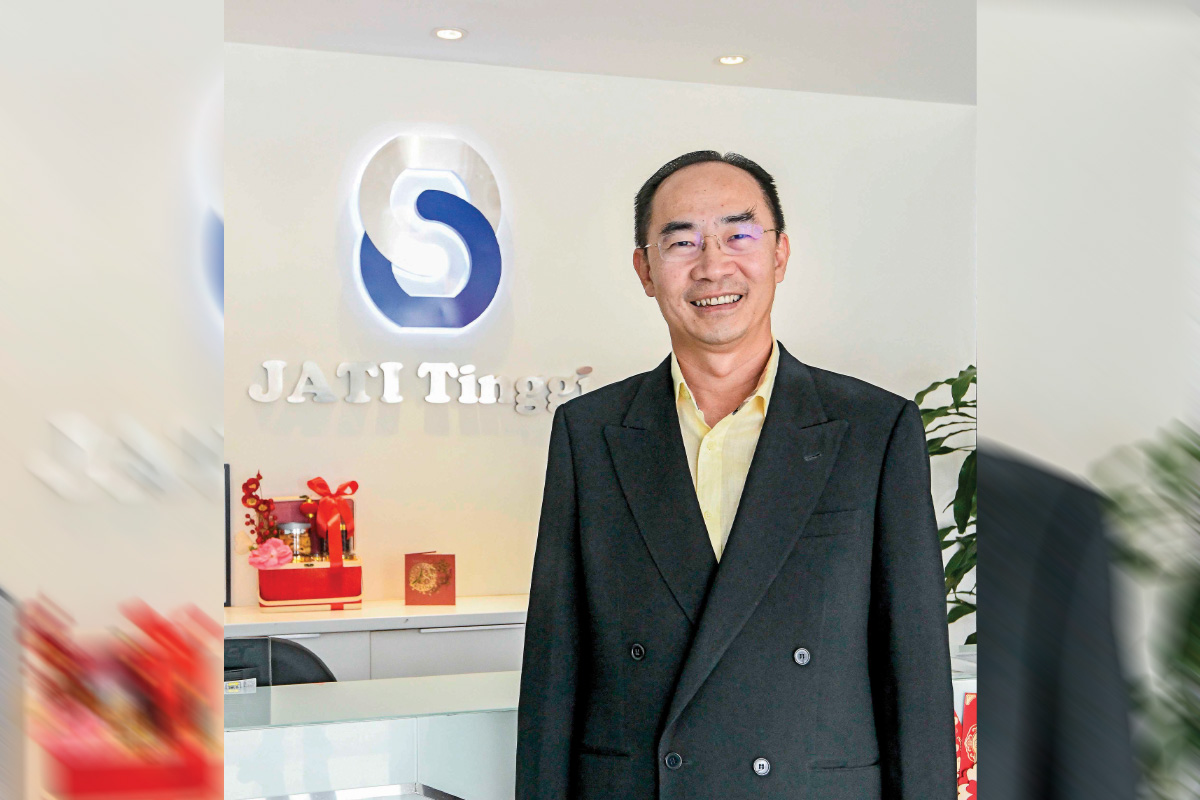
AFTER achieving a record profit in the financial year ended Nov 30, 2025 (FY2025), Jati Tinggi Group Bhd (KL:JTGROUP) continues to enjoy a strong project pipeline, with data centre (DC)-linked jobs now accounting for about half of its total order book.
In an interview with The Edge, managing director Datuk Seri Lim Yeong Seong says contribution from such jobs has risen to 50% from 20% in 2024. Between December 2024 and January 2026, the infrastructure, utilities and engineering solutions provider secured about RM586 million worth of projects, including joint ventures, lifting its order book to RM733 million. As such, Lim says earnings visibility remains robust over the next few years.
“Last year, we secured quite a substantial amount of work. These will be executed this year and next year, so I hope that 2026 will be a better year for us,” he says optimistically.
In FY2025, its record net profit stood at RM10.01 million compared with a net profit of RM9.67 million in FY2024, with revenue expanding to RM195 million from RM128.01 million previously. Net profit margin, however, eased to 5.1% from 7.6% due to higher cost of sales.
Besides the provision of underground utilities engineering services and solutions, the group is also involved in substation engineering, procurement, construction and commissioning (EPCC) services, and the trading of equipment for substations and street lighting services.
The rapid expansion of Malaysia’s DC industry is emerging as a key growth driver for utility infrastructure players, according to Lim, who has 30 years of experience in the electrical and engineering industry.
“The DC industry is being pushed in quite a big way. Because of DCs, there are many project awards from Tenaga Nasional Bhd (KL:TENAGA) involving substation upgrades, new substations and new cable connections. I would say the [growth] curve is just starting. Definitely, there are more jobs to come. Currently, more than 150 DCs are registered with Tenaga,” he highlights.
Among the key projects that Jati Tinggi has clinched in recent months are two contracts to undertake works related to the 275kV bulk power supply connection to DCs in Johor, worth RM117.17 million and RM161.45 million respectively.
Lim notes that only a handful of players — including Jati Tinggi — are capable of undertaking ultra-high-voltage jobs. With a strengthened workforce, the group is well positioned to meet the tight delivery timelines for DC projects.
To support its expanding order book, the group has stepped up hiring and enhanced its enterprise resource planning (ERP) system to improve project tracking, operational efficiency and decision-making.
“There will be a lot of jobs in the next three years. We must have very good governance in terms of project, staff and financial management,” says Lim. The group employs more than 140 staff.
Currently, it is focused on Peninsular Malaysia, where job opportunities remain abundant. It is currently tendering for jobs worth about RM2 billion.
Besides DCs, Jati Tinggi is also benefiting from the Asean power grid initiative, which connects the electricity grid of various countries across the region. The initiative is critical for energy transition, as it enables countries with surplus renewable energy to share it with others.
Tenaga has committed to upgrade the national power grid to help handle growing energy demand and support renewable energy by using advanced technologies like artificial intelligence and battery storage systems.
Looking ahead, Lim says the group is exploring merger and acquisition opportunities and is prepared to undertake fundraising exercises if needed to support its growing pipeline.
“Our order book has doubled from less than RM300 million the year before, so we may need more capital,” he says.
Its latest move is its entry into the pipe manufacturing segment, announced last Thursday, via the proposed purchase of a 51% stake in Roflex Pipe Sdn Bhd for RM6.12 million. Roflex Pipe is one of the suppliers of polyethylene pipes to Jati Tinggi.

While higher raw material costs and competition remain challenges, Lim is confident that margins can be managed through its cost pass-through mechanisms.
“When we bag a job, we immediately lock in the cable supply. If raw material prices rise, we will tender at higher prices,” he explains.
He adds that the increase in transportation costs is manageable. “It is not a very big portion in our cost structure, though it will increase slightly.”
Copper prices touched an all-time high of over US$14,500 (RM57,208) a tonne in late January, before paring gains to trade around US$13,300 early last week. In a report last month, BMI, a unit of Fitch Solutions, revised its copper price forecast upward to an annual average of US$11,900 a tonne following the commodity gain buoyed by a weak US dollar, robust fundamentals, persistent supply-side tightness concerns and continued uncertainty around looming US tariff pressures.
On a positive note, the stronger ringgit has helped lower the cost of imported high-voltage cables. Other key materials are pipes, cable joints, link boxes, relays and batteries.
Operationally, Lim says the group will continue implementing ERP. The system has evolved into a project management tool used to manage resource allocation, logistics, workflow scheduling and progress for its projects in an effective and efficient manner.
“We have changed our ERP system to adapt to the new trend, so that decision-making will be faster as data will be more in hand,” he explains, noting that DCs require completion within a very short period.
Lim reveals that Jati Tinggi has expanded into the renewable energy segment for the supply and installation of photovoltaic solar panel systems for Public Bank Bhd’s (KL:PBBANK) branches with an estimated cost of RM14.88 million. The foray will provide an additional revenue stream for the group.
As at end-FY2025, Jati Tinggi was in a net cash position of RM15.39 million, with cash and cash equivalents of RM65.13 million exceeding bank borrowings of RM49.74 million.
The group is 45.87%-owned by Broad River Capital Sdn Bhd, which is controlled by Lim, executive director Chin Jiunn Shyong and his spouse Lim Ming Hong. (Chin and Ming Hong are Lim’s brother-in-law and sister.) Individually, Lim, Chin and Ming Hong hold 11.7%, 3.99% and 3.85% stakes in the group respectively.
Jati Tinggi is covered solely by AmInvestment Bank Research, which has a target price of RM1 — suggesting an upside potential of 68.1% against last Tuesday’s closing price of 59.5 sen, which valued the group at RM259.42 million. Over the past 12 months, the stock is up more than 70%.
According to the research house, DC-related works remain a key earnings catalyst for Jati Tinggi.
“With a strong RM733 million order book (3.8 times revenue cover), we expect earnings momentum to remain robust. Given Jati Tinggi’s established track record in power-infrastructure works, the company is well positioned to benefit from Tenaga’s RM35 billion grid capex (capital expenditure) cycle. Coupled with an expanding order book and improving margins, Jati Tinggi is poised to deliver multi-year earnings growth,” it said in a Jan 29 note.
The group has not declared any dividends since its listing in December 2023, as it requires significant capital outlay to fund project execution and support its expanding order book.
According to AskEdge, Jati Tinggi is trading at a price-earnings ratio of 25.9 times, significantly higher than its peer MN Holdings Bhd’s (KL:MNHLDG) 14.2 times. MN Holdings, a key beneficiary of the DC boom, recently reported a doubling of its six-month net profit to RM46.77 million, underpinned by strong substation engineering jobs, with an order book of about RM861.33 million.
Save by subscribing to us for your print and/or digital copy.
P/S: The Edge is also available on Apple's App Store and Android's Google Play.