

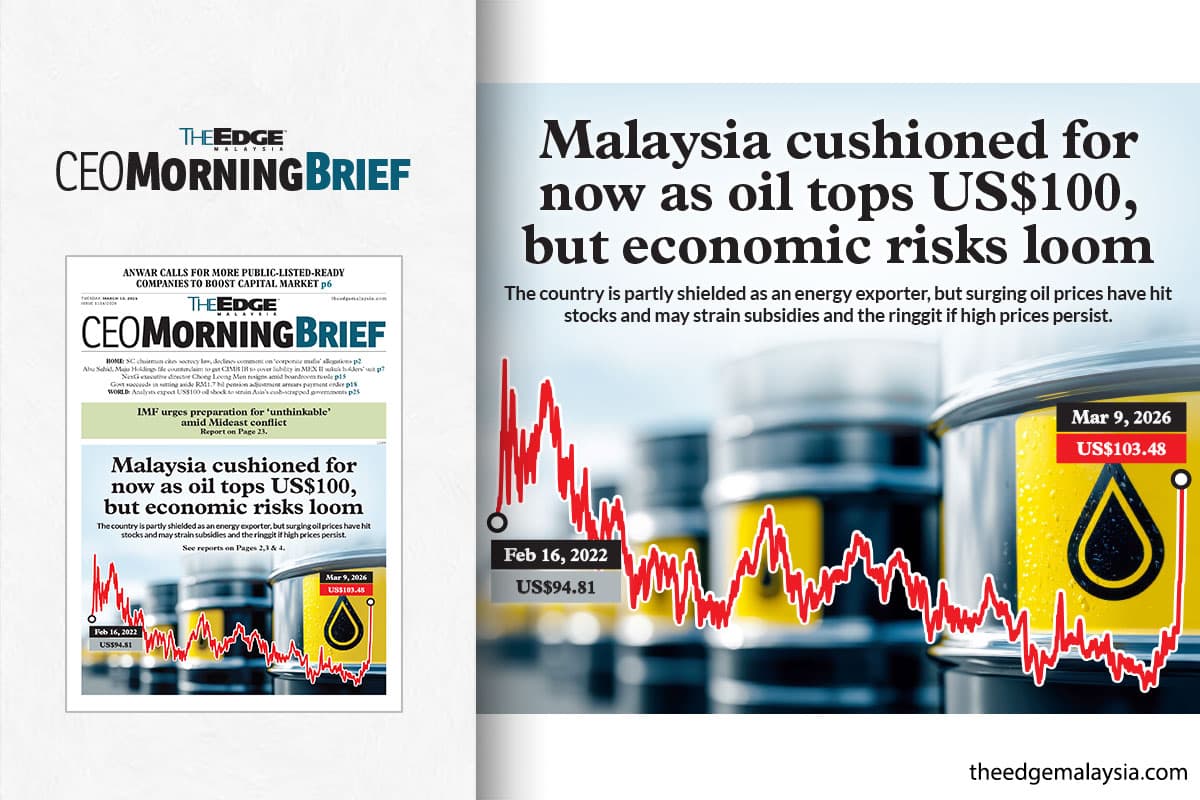
KUALA LUMPUR (March 10): Malaysia may be relatively cushioned from the latest oil price spike due to its energy export revenues, but economists warn that sustained crude prices above US$100 (RM473.18) per barrel could complicate subsidy management, weaken the ringgit and raise cost pressures for businesses.
Brent crude surged as high as US$118.93 a barrel on Monday, indicating the biggest-ever absolute price jump in a single day, amid escalating conflict in the Middle East and disruptions to shipping through the Strait of Hormuz, a chokepoint that handles about one-fifth of global oil supply. Experts at UOB Global Economics and Markets Research in a March 6 note had put chances of Brent crude topping US$100 a barrel at 15%.
The surge pushed crude prices past US$100 per barrel for the first time since Russia’s 2022 invasion of Ukraine. At 8.41pm on Monday, Brent crude was trading at US$103.48 per barrel.

The spike rattled global financial markets and triggered broad selling across regional equities as investors reassessed the potential inflationary impact of higher energy prices.
In Malaysia, the benchmark FBM KLCI dropped as much as 54 points, or more than 3%, to 1,664.07 before trimming losses to close at 1,674.17, still down 43.89 points or 2.55%.
Mixed impact for Malaysia
Higher oil prices typically present a mixed impact for Malaysia, which exports crude oil and liquefied natural gas (LNG) but also subsidises domestic fuel prices.
“It’s a two-way dynamic. On one hand, higher oil prices mean the government has to spend more on RON95 subsidies. On the other hand, Malaysia is a net exporter of oil, so it also stands to benefit from higher petroleum revenues,” Mohd Redza Abdul Rahman, director of research at BIMB Securities Sdn Bhd, told The Edge.
Prime Minister Datuk Seri Anwar Ibrahim on Monday said the government would maintain the subsidised price of RON95 petrol at RM1.99 per litre despite the spike in global oil prices.
However, Redza noted that rising refining costs and widening product spreads could create margin pressure across downstream industries even as upstream oil producers benefit from higher crude prices.
He said the recent surge in petroleum product prices has significantly outpaced the increase in crude oil, pushing refining margins — or crack spreads — to record highs.
“It’s not just the RON95 subsidy that could come under pressure. Refining costs have also surged, which means the price of refined petroleum products could face additional risks,” he said.
“That’s something we are concerned about. If a company has more upstream operations, the impact is limited because higher oil prices directly support earnings. But if you rely on intermediate products to produce end products, rising refining costs could become a major concern.”
The pressure is particularly acute for petrochemical producers that rely on naphtha-based feedstock, where input costs have risen faster than the selling prices of petrochemical products, compressing margins across the sector, he added.
Industries such as airlines and petrochemical producers could face rising input costs if refining margins continue to climb amid fears of supply shortages.
Ringgit could face pressure
Julia Goh, senior economist at UOB Malaysia, said Malaysia’s exposure to oil price volatility is relatively lower than many regional peers due to its energy exports and targeted fuel subsidy policies.
“Malaysia is less energy price sensitive than many peers thanks to sizable LNG exports and targeted subsidies to cushion the effect on households,” she told The Edge.
However, she cautioned that recent policy reforms mean the cost shock could be passed through more widely across the economy than during previous Middle East flare-ups.
UOB expects oil prices to remain volatile in the near term before moderating later this year if geopolitical tensions ease.
“Our base case assumes oil prices could surge further in near term before moderating later in 2026. We are projecting Brent crude oil to moderate back to US$80 by year end,” Goh said.
The ringgit, she added, could face near-term pressure as global investors reassess risk and shift towards safe-haven assets.
“The ringgit, in line with regional peers, is unlikely to be fully insulated from shifts in portfolio flows as global risk appetite undergoes a reassessment,” she said. “We expect some unwinding of the ringgit's strong rally as investors lock in gains after several months of outperformance.”
Supply risks emerge as Hormuz shipping disrupted
Earlier on Monday, Public Investment Bank issued a research note saying that the escalating US–Israel–Iran conflict has introduced a significant geopolitical risk premium into global oil markets as shipping disruptions intensify in the Gulf region.
The research house said the war has severely disrupted shipping through the Strait of Hormuz, with tanker traffic largely stalled and many vessels remaining idle outside the Gulf due to heightened security concerns.
It warned that prolonged disruptions to shipping routes and energy infrastructure could turn what initially appears to be a logistical bottleneck into a genuine supply shock.
“In such a scenario, the market could shift from a transit disruption to a physical supply shock, potentially sustaining oil prices above US$100/barrel,” the note added.
Public Investment Bank said its base case assumes Brent crude will remain above US$100 per barrel for about five months as geopolitical risk premiums persist and global inventories are gradually drawn down before easing later in the year.
It added that global oil inventories could provide a temporary buffer against supply disruptions, noting that worldwide stockpiles rose to about 8.2 billion barrels in 2025 — the highest level since 2021 — following sustained builds throughout the year.
"While these inventories can cushion short-term supply disruptions, prolonged disruptions could still tighten the global oil balance as stocks are gradually drawn down," the research house cautioned.