

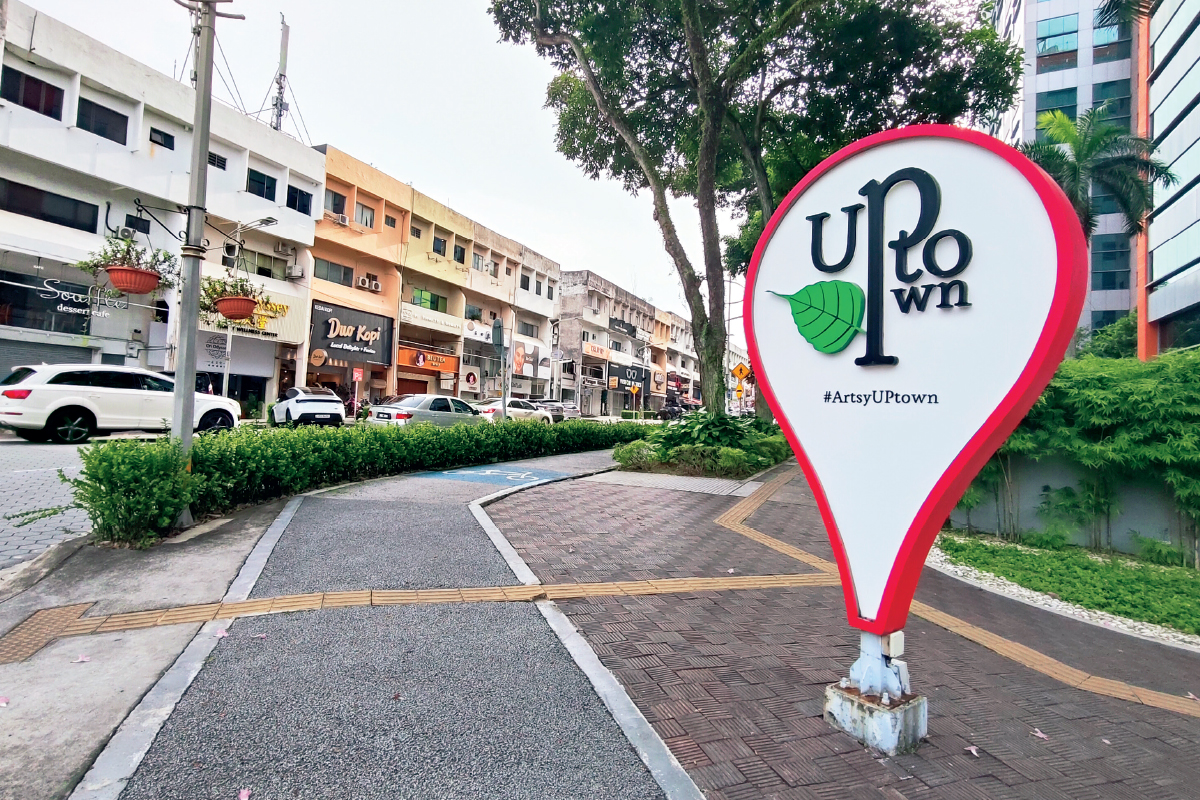
This article first appeared in City & Country, The Edge Malaysia Weekly on March 9, 2026 - March 15, 2026
Caryn, who worked in the Uptown 5 office tower in Damansara Uptown, Selangor, in the early 2000s, remembers the Damansara Utama commercial area as a laid-back district offering a mix of F&B outlets and local and international banks.
Today, the roads are narrower, traffic is heavier and street parking is extremely difficult to find.
While the area used to be busy even then, finding street parking was never a problem. “The roads [in the outer square] back then were wider, without street parking in the middle. It was easy to get around — the small lanes between the rows were accessible by car, so we didn’t have to circle the entire area like we do now.”
In the heart of Damansara Uptown was an open-air parking lot. Master developer See Hoy Chan Sdn Bhd Group later transformed the site into a mixed-use development, now home to the Starling shopping mall, Somerset Residences at Damansara Uptown, Uptown Residences condominium and Imazium — a 31-storey, MSC-status, LEED Platinum-certified Grade A office building.

Back then, Caryn says, the famous Village Park restaurant had just moved into its current location. It is still there today, along with old establishments such as Damansara Uptown Hokkien Mee and Restaurant Koon Kee (both on Jalan SS21/37) as well as The Ship Damansara (Jalan SS21/56b).
Other famous F&B outlets include Tiong Hokkien Mee, Annie 1 and Edward’s Urban Fish & Chips as well as franchises such as Hot Bird Damansara Uptown and Aftermeal Desserts.
Brader John Burger Damansara Uptown is a late-night favourite that operates from a food truck usually parked next to RHB Bank Damansara Utama on Jalan SS21/58.
Then there is Uptown Eats, the refurbished Damansara Uptown food court, which opened last November, at Uptown 7 on Jalan SS21/39.
Like Caryn, Catherine, who has been working in Petaling Jaya and Damansara for 30 years, remembers better traffic and parking conditions back then.
“My colleagues and I used to drive to Uptown for lunch because the food was nice and parking was relatively easy. But we no longer go there because it is so hard to find a parking bay there now,” she says.
Like many commercial areas in Petaling Jaya, Damansara Uptown is laid out as a square. Consisting mostly of 3½- and 4-storey shopoffices, the area is generally divided into the inner square (Jalan SS21/37, Jalan SS21/39, Jalan SS21/58 and Jalan SS21/60) and the outer square (Jalan SS21/1a, Jalan SS21/35, Jalan SS21/56b and Jalan SS21/62).
Developed in the early 1980s, some of the earliest buildings there are the shopoffices and office towers (Uptown 1, 3 and 5). A car park building — known as Uptown 7 — and the mixed-use development were added later.

Slower rental and price growth
IVPS Property Consultant Sdn Bhd moved into Uptown 1 in 2017. Its country manager Tiffany Goh notes that the Damansara Uptown market remains active but has entered a more mature phase, with slower rental and price growth and more selective tenant demand.
Goh says units in the inner square generally command higher rentals than those in the outer square, supported by stronger and more consistent foot traffic, a higher concentration of F&B outlets and a more vibrant day-and-night environment, which has rebounded more quickly after the pandemic.
“In contrast, the outer square relies more on vehicular traffic and road visibility, and while it suits certain business types, rents there are typically lower, as recovery [from the pandemic] has been more gradual compared with the inner square. It is well known that the inner circle of Damansara Uptown, especially those facing the Starling, and those with high visibility along Lebuhraya Damansara-Puchong (LDP) are performing significantly better than the other roads,” she tells City & Country.
CCO & Associates (KL) Sdn Bhd director Chan Wai Seen concurs, saying this contrasts with conventional shopoffices where units facing main roads are more popular. He attributes this mainly to the fact that most of the key businesses — banks, popular F&B outlets and the shopping mall — are located at the inner part of the main commercial centre.
“Damansara Uptown has long been established as a prominent and popular main commercial centre in the Damansara area. Its popularity has not diminished over time. Instead, it has continued to strengthen, supported by the completion of key catalyst developments such as the Starling, Imazium and Uptown Residences,” Chan says.
He notes that, owing to its popularity, shopoffices in Damansara Uptown are in high demand, with unit owners — especially those in prime locations — able to secure tenants easily. As a result, these shopoffices continue to attract investors, drawn by stable rental income and strong potential for capital appreciation.
“In 2025, 3½-storey shopoffices at the outer square and farther away from the LDP were transacted at between RM4.5 million and RM4.97 million, while shopoffices within the inner square were transacted at RM5.25 million to RM6.1 million. Damansara Utama is an established and mature commercial centre with limited units available for sale. Owing to strong demand, there is limited room for negotiation,” he says.
IVPS’s Goh observes that in recent years, shopoffice transaction volumes in Damansara Uptown have remained stable, averaging 11 transactions a year. She adds that these units are heavily sought after by investors because of demand and high occupancy rates, attracting businesses ranging from F&B to services. They are generally viewed by investors as long-term holds, supported by the area’s mature, prime location, strong tenant mix and resilient demand.
Nevertheless, she also observes a short-term yield opportunity, particularly for shoplots and retail units offering attractive rental returns, even though overall sentiment favours sustainable income and long-term capital appreciation over quick flips.

Transactions and rental
According to data from IVPS, transactions of shopoffices in Damansara Uptown are generally close to asking prices.
A shopoffice with a built-up of 5,988 sq ft on Jalan SS21/39 was transacted at RM5.7 million on Oct 21, 2025, while another unit with a built-up of 5,209 sq ft on Jalan SS21/35 was sold at the same price eight months earlier on Feb 20.
“This indicates a relatively tight pricing gap, with limited room for negotiation, particularly for well-located and well-maintained units,” Goh says.
Chan notes a strong recovery in transactional activity for shopoffices in Damansara Uptown after the Covid-19 pandemic, with total consideration values ranging between RM55.28 million and RM62.45 million a year, reflecting sustained market interest in shopoffices in the area.
“While the initial gross rental yield is relatively modest at 2% to 4%, a holding period exceeding five years could generate a higher internal rate of return of 6% to 8%. Yet, most investors demonstrate a willingness to hold these assets over the medium to long term, underpinned by expectations of capital appreciation rather than short-term income returns,” says Chan.

According to Goh, the rental market for the shopoffices remains relatively resilient, supported by steady demand from F&B operators, services and lifestyle businesses, although rental growth is now more stable than aggressive.
Occupancy is generally healthy, she adds, especially for well-located ground-floor units in the inner square or on prominent streets, while secondary locations require more competitive rents to secure tenants.
“Based on current asking rents and transaction levels, investors can typically expect gross rental yields in the range of 4% to 5.5%, with prime assets occasionally achieving slightly higher yields if fully occupied,” she says.
“Typical monthly rents of 4-storey shops in Damansara Utama range from RM17,000 to RM25,000, depending on the road. Those undergoing renewals are seeing rental increases, owing to strong demand in the area.”
Goh explains that rental demand is driven mainly by the F&B sector, with a noticeable presence of stylish and trendy cafés that draw younger consumers seeking popular hangout spots.
Chan adds that the success of the Starling mall and office buildings has increased footfall in Damansara Uptown. Banking branches as well as destination retail outlets also enhance the popularity of this main commercial centre.
Both Chan and Goh remain optimistic about the outlook for shopoffices in Damansara Utama over the next 12 months, as the area has now reached a mature and well-established phase.
“Prices and rental rates will increase gradually, owing largely to the limited supply of shopoffices in prime locations in Damansara Utama,” Chan says.
Goh expects Damansara Uptown shopoffices to remain in a stabilisation phase with positive momentum, underpinned by healthy occupancy rates and steady demand from F&B and lifestyle operators.
“Rents are likely to see growth, particularly for well-located units. Shop transactions should remain active but selective, with limited-to-mild price appreciation focused mainly on prime assets. Overall, the market outlook points to stable performance, with incremental rental uplift rather than aggressive rental or capital value growth. Buying activity in Damansara Uptown has been consistently maintained over the past few years as well,” she says.
Save by subscribing to us for your print and/or digital copy.
P/S: The Edge is also available on Apple's App Store and Android's Google Play.