

A confirmation hearing refers to a legislative process where nominees for high public office are publicly scrutinised and must secure approval from lawmakers before assuming office. In the US, senior appointments including the Attorney General require Senate confirmation.
KUALA LUMPUR (March 3): Malaysia is rejecting calls to introduce a parliamentary confirmation hearing for a proposed bill on the creation of a public prosecutor.
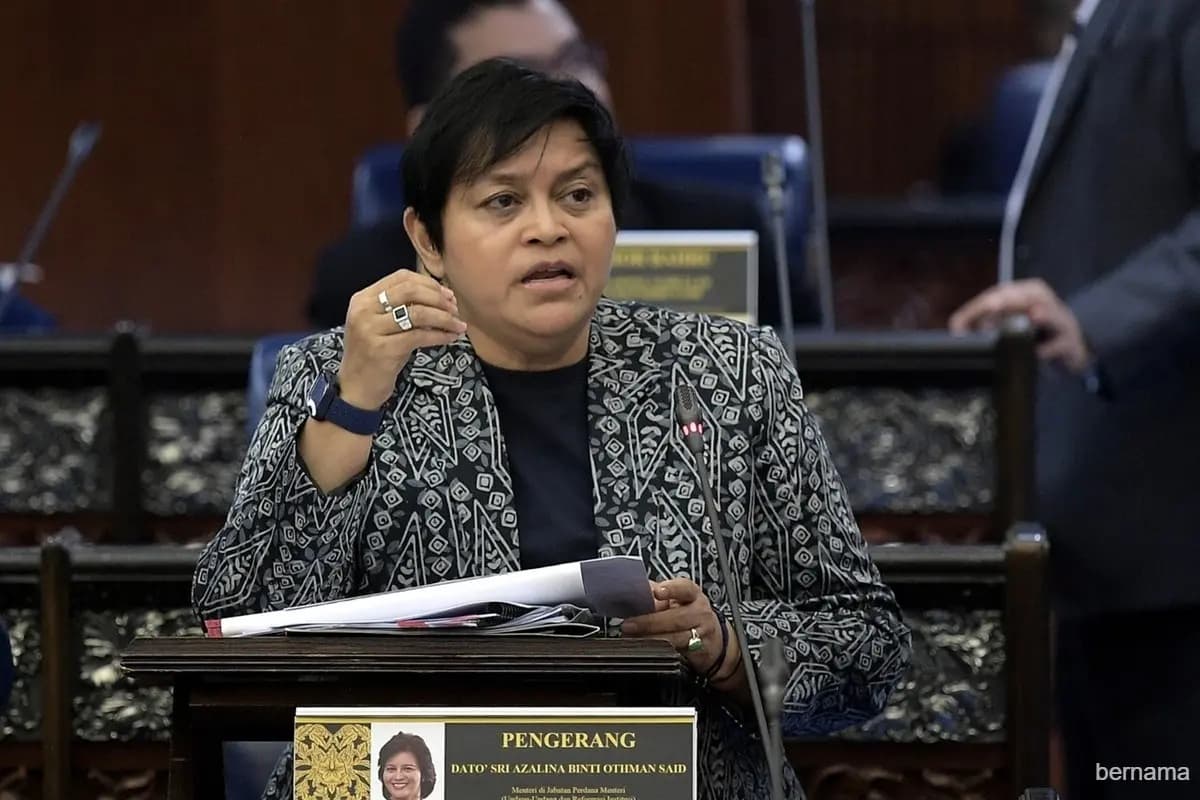
The absence of such a US-style confirmation process is a deliberate policy choice consistent with Malaysia’s constitutional structure and does not signal any form of weakness, said Datuk Seri Azalina Othman, minister in charge of law and institutional reform.
The policy is in line with “the primary objective of this reform to ensure that the appointment of the public prosecutor is based on professional merit and safeguarded from partisan influence", Azalina said when tabling the bill for its second reading.
The bill, which seeks to carve out the role of public prosecutor from the office of the attorney general, is being referred to a newly established parliamentary special select committee. The committee will have three months to examine and propose recommendations to the bill.
Current proposals, which require amendment to the Federal Constitution, have drawn suggestions including from former economy minister Datuk Seri Mohd Rafizi Ramli that the public prosecutor’s appointment should be subjected to a confirmation hearing similar to the process in the US.
A confirmation hearing refers to a legislative process where nominees for high public office are publicly scrutinised and must secure approval from lawmakers before assuming office. In the US, senior appointments including the attorney general require Senate confirmation.
Azalina said on Tuesday that Canada’s model must be viewed in a different context, as its attorney general is a political office holder who retains certain statutory powers over the director of public prosecutions.
“Malaysia’s structure is fundamentally different,” she said, noting that the model proposed under Article 145(A) places the appointment by the King upon the recommendation of an independent constitutional body and after consultation with the Conference of Rulers.
“This constitutes an institutional and professional system of checks and balances, not one based on partisan politics,” Azalina said.
Under the bill tabled last month for the first reading, candidates for the public prosecutor will be nominated by the Judicial and Legal Service Commission (SPKP) chaired by the Public Service Commission head.
Azalina said the provision reflects the second constitutional mechanism of appointment, where the King acts according to specific constitutional provisions — rather than on the advice of the prime minister — as provided under Articles 40(1) and 40(1A).
She reiterated that the bill does not provide any direct role for Prime Minister Datuk Seri Anwar Ibrahim to advise, nominate or determine the public prosecutor candidate. Instead, screening would be conducted by SPKP.
Concerns have been raised that the chairman of the Public Service Commission, who is appointed on the advice of the prime minister, could influence SPKP’s nomination of the public prosecutor.
The SPKP is currently chaired by Datuk Seri Ahmad Jailani Muhamed Yunus. Members of the commission include Attorney-General Tan Sri Mohd Dusuki Mokhtar, Court of Appeal President Datuk Seri Abu Bakar Jais, Chief Judge of Malaya Datuk Seri Hashim Hamzah, Chief Judge of Sabah and Sarawak Datuk Azizah Nawawi and Federal Court judges Datuk Nordin Hassan and Tan Sri Ahmad Terrirudin Mohd Salleh.