

This article first appeared in Forum, The Edge Malaysia Weekly on February 23, 2026 - March 1, 2026
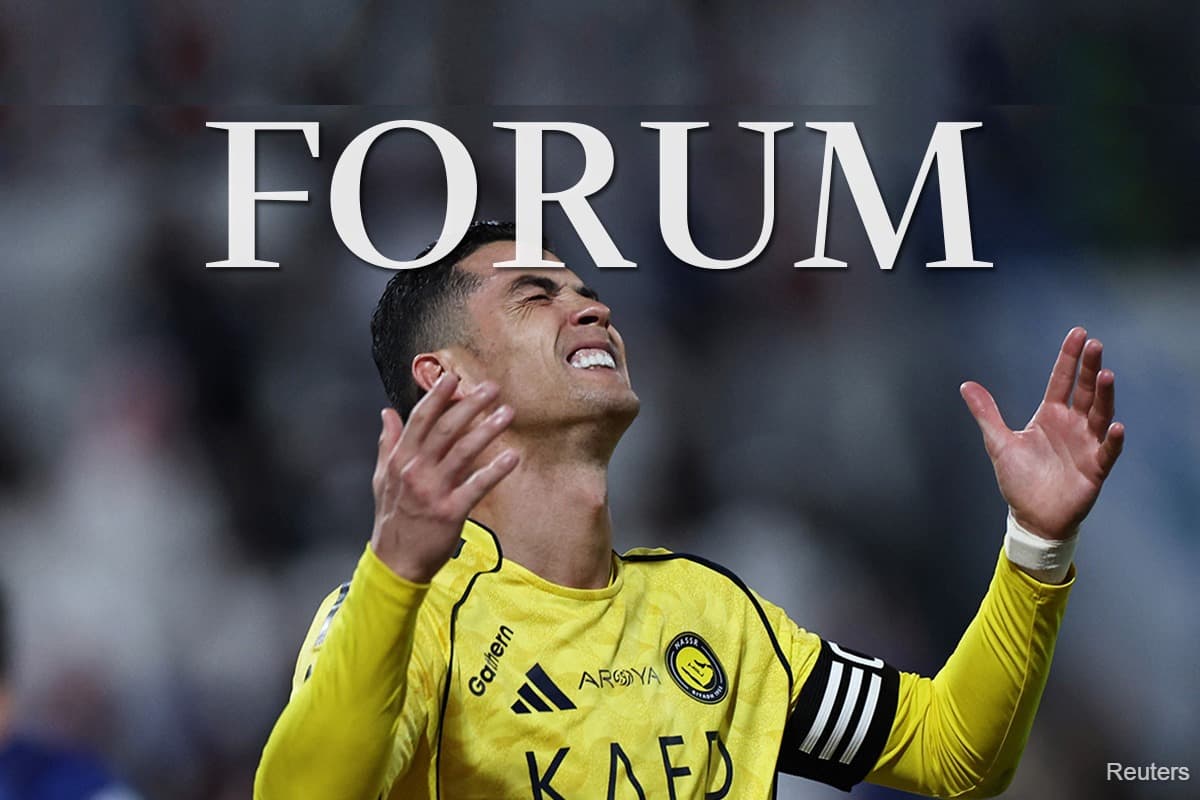
When you are being paid £500,000 (RM2.6 million) a day, you wouldn’t think there would be much to moan about. But Cristiano Ronaldo, who always keeps a tantrum within throwing distance, went on strike this month in the Saudi Pro League (SPL). It was not about his salary and lasted only two matches, but it was just another reason to wonder if the Saudi sporting bubble might be about to burst.
CR7’s whinge was about his club, Al-Nassr, not competing in the transfer market with other Public Investment Fund (PIF)-owned members of the SPL. The focus of his ire was Al-Hilal, which signed his former Real Madrid teammate Karim Benzema from Al-Ittihad. Ronaldo, who is also an ambassador for Saudi Arabia’s 2034 Fifa World Cup, was put in his place by a statement that did not mince words: “No individual, however significant, determines decisions beyond their club.”
This minor tiff might have remained in its teacup had it not coincided with Bryson DeChambeau expressing dissatisfaction about LIV Golf’s switch from 54 holes. “Is it what we ultimately signed up for?” asked the American. “No. So I think we’re supposed to be different. So I’m a little indifferent to it right now. Things have changed. Things have got to improve.” With Patrick Reed following Brooks Koepka out of LIV, DeChambeau’s position as its biggest drawcard has strengthened, and he is not the type to let such an opportunity slip. Expect a ransom demand any time soon.
For its two biggest captures to question policy at the same time in different sports was enough to set tongues wagging in both the kingdom and wider sporting world. But closer scrutiny reveals that they are not the only dissenting voices.
Last month, Athletic Club Bilbao captain Inaki Williams complained about the Spanish Super Cup being played in Saudi Arabia. “Taking a national competition out to another country does not make things easy for [fans] to move and follow the games,” he said. “When we play there, it feels like we are the away team.” Teammate Unai Simon backed him up, adding that “instead of 40,000 fans attending, just 2,000 will be travelling from Spain”.
Such sentiments are not new, of course, but are becoming louder as supporters tire of being sacrificial pawns in a game of higher stakes. The kingdom tries hard to be the perfect host, pouring billions into its Vision 2030 project, but the one thing money cannot do is replicate the bear-pit atmosphere of home.
Big-time boxing has become even richer from Saudi hospitality, with huge purses leaving more traditional venues out for the count. But waiting for the top of the bill in the early hours of the morning is a turn-off for ardent fans and traditionalists. Big fights need venues to be heaving cauldrons, and this is where the desert falls short.
After a few years of lining their coffers, sports are beginning to reassess the entire concept. British heavyweight Tyson Fury’s return to the ring will be staged in Tottenham Hotspur’s 61,000-capacity football stadium in London, and the response suggests it could sell out several times over.
But a sure sign that the climate has changed is that the hosts are also feeling, if not a chill, a whiff of reality. The cause is falling oil prices. Many projects were conceived when money seemed to be coming from an unlimited pipeline. Fuelled by oil revenues of more than US$100 billion (RM391 billion) a year, Vision 2030, which began in 2016, sparked a massive wave of construction.
Multibillion-dollar investments in sport, tourism, education and entertainment — known as giga projects — were meant to prepare the population for the time the oil runs out. Some were also intended to be a challenge in both design and construction. None more so than the venue for the 2034 World Cup final, perched 300m above the ground. Now that is not the only thing that may be coming back to earth.
Recent cancellations have included a plan to stage the 2029 Asian Winter Games (yes, with real snow) and the Olympic Esports Games. Dr Kristian Coates Ulrichsen, fellow for the Middle East at the Baker Institute for Public Policy, a US think tank, and author of Kingdom of Football, says: “It is likely that the Saudi authorities will want to see more of a financial return on investment going forward.”
But it is in football where the change has had the most impact. According to Transfermarkt, Al-Nassr’s spending has dropped from £141 million in 2023/24 to £69 million this season, Al-Ittihad’s from £109 million to £64 million, Al Hilal’s from £324 million to £115 million and Al- Ahli’s from £156 million to £42 million. When they shook the football world in the summer of 2023, SPL clubs lavished £750 million on 97 signings.
But Saudi Arabia is making sure there will be no repeat of the meltdown that occurred in the Chinese Super League. In golf as well as football, it is proceeding with caution. Indeed, there are similarities in the way PIF chairman Yasir Al-Rumayyan has prevaricated in both sports, exemplified by his dealings with the PGA Tour and the Newcastle United stadium project.
If spending on the team is limited by the EPL’s Profit & Sustainability Rules (PSR), there is no such excuse for the dilly-dallying over the ground. The Saudis still can’t decide whether to revamp the iconic St James’ Park or build an entirely new stadium.
SPL director of football Michael Emenalo declared at the end of last season that 30-somethings Mohamed Salah and Kevin De Bruyne were “the sort of players” that the league would target in the summer window. But they got neither, with Manchester City’s De Bruyne opting for the lure of Naples and Salah staying with Liverpool.
However, the latest news has the Egyptian back in talks with Al-Ittihad, who were willing to pay £150 million for him two years ago. He preferred to stay, but after a recent spat with Liverpool boss Arne Slot and a decline in form, he is now more likely to move on. A deal for around a third of that fee may see Al-Ittihad finally get their man. No doubt much to Ronaldo’s disapproval.
Recently, there has been a shift away from ageing stars to younger players. A typical example was Al-Nassr’s hiring of Hayder Abdulkareem, a 21-year-old Iraqi midfielder, who arrived in January. What annoyed the Portuguese was that the Iraqi was Al-Nassr’s only signing in the transfer window.
His club trails Al-Hilal by a single point at the top of the SPL after 21 games. Ronaldo, now 41, with 19 goals, is also second in the scorers’ table, one behind Al-Hilal’s Ivan Toney. Closing on 100 games, he has bagged a goal in almost every one of them.
Confirmation of the new reality came with the scaling down of the futuristic city of Neom, once priced at US$8.8 trillion. Several of Vision 2030’s projects appeared to have been dreamed up by sci-fi fantasists, not real architects, with The Line being the pièce de résistance. It is difficult even to imagine a 198m-wide skyscraper, half a kilometre high and stretching for 168km! Oh, and it would be all covered by a mirrored glass exterior. Spades did enter the ground, but the costs soon spiralled from US$1.6 trillion to US$4.5 trillion.
Economists used to say that when America sneezed, the rest of the world caught a cold. The sporting world must think of what to do now that Saudi Arabia is having a trillion-dollar trim.
Bob Holmes is a long-time sportswriter specialising in football
Save by subscribing to us for your print and/or digital copy.
P/S: The Edge is also available on Apple's App Store and Android's Google Play.