

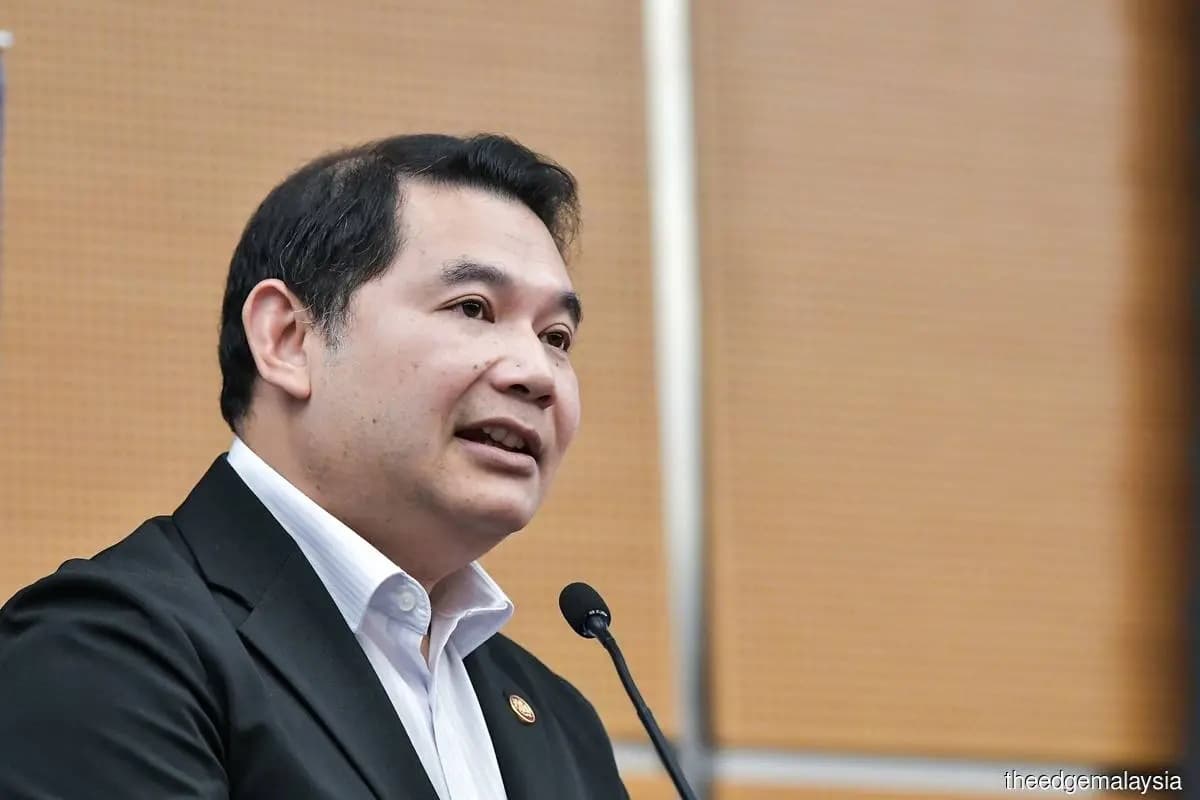
KUALA LUMPUR (Feb 17): Former minister of economy Datuk Seri Rafizi Ramli had come up to deny that the US$250 million (RM1.11 billion) deal with Arm Holdings for access to the company’s intellectual property in chip design was rushed and signed in haste.
In response to reports that the Malaysian Anti-Corruption Commission (MACC) has opened an investigation paper into an agreement involving the federal government and a foreign company valued at RM1.1 billion, Rafizi said that the collaboration with Arm went through various cabinet meetings and approvals.
According to the reports, the billion-ringgit deal was said to be signed in haste, and it did not receive the agreements from the Ministry of Investment, Trade and Industry (Miti) and the Ministry of Finance (MOF).
It was also alleged in the reports that several individuals were appointed to high positions within the foreign company after they resigned from the Ministry of Economy (MoEcon).
In an exclusive statement to The Edge, Rafizi said that the proposal for the deal was brought to the Cabinet three times, involving meetings co-chaired and comprising the three ministries involved in the negotiations with Arm.
These are the MoEcon, Miti and the MoF.
“To say that it was rushed is to accuse the Prime Minister, MOF II and Miti ministers too because they were all part of the process. In fact, they negotiated directly with Masayoshi Son without MoEcon,” said Rafizi when contacted by The Edge.
Earlier on Feb 16, the media reported that the MACC had opened an investigation paper into the agreement. The reports were confirmed by MACC deputy chief commissioner (operations) Datuk Seri Ahmad Khusairi Yahya.
In a statement, Rafizi told The Edge that the proposed collaboration with Arm was brought to the cabinet three times due to disagreements from Miti, who felt that anything involving semiconductor investments should be spearheaded by the ministry.
This led to a committee comprising the then Miti minister Datuk Seri Tengku Zafrul Aziz; Second Finance Minister Datuk Seri Amir Hamzah Azizan; himself as the then minister of economy; and officials of the respective ministries to be formed to thrash out all the details, on the behest of the Prime Minister Datuk Seri Anwar Ibrahim himself, who wanted to see the collaboration take off, claimed Rafizi.
“The committee (with senior officials from the three ministries) in fact sat down and negotiated with Arm,” he said.
Miti’s input had been taken into account and some of the deliverables and conditions were reflected in a new draft agreement, said Rafizi. “However, Miti continued to express reservation, stemming from its position that anything on semiconductors should be initiated and led by them.”
Then another meeting was called by the PM to moderate and come to an agreement, said Rafizi.
The meeting was attended by the Chief Secretary Tan Sri Shamsul Azri Abu Bakar, Tengku Zafrul, MOF II Amir Hamzah and the Treasury secretary-general Datuk Johan Mahmood Merican.
In between these meetings, Arm’s leadership met the prime minister, claimed Rafizi. Anwar and Tengku Zafrul also had a video call with Masayoshi Son, the owner and CEO of SoftBank Group, the biggest shareholder of Arm, as well as the Arm CEO Rene Haas to negotiate further, he said.
“Out of that meeting, the PM agreed that the paper be resubmitted to the Cabinet for approval. It was re-tabled, I think for the third time, and it was passed because the government wanted to honour the date that has been agreed with Arm for signing,” said Rafizi.
He also pointed out that the signatory of the deal with Arm is not MoEcon but Mida, while the control of the money is with the Miti agency and MOF. He also pointed out that the committee to decide who gets the token from Arm is co-chaired by the three ministers.
He said that the MoEcon was responsible for leading the development of the concept and programme and for ironing out the details with the other ministries. The final draft agreement was vetted and cleared by the Attorney General Chambers before it could be tabled in the cabinet, claimed Rafizi.