

This article first appeared in The Edge Malaysia Weekly on February 16, 2026 - February 22, 2026
Like most Malaysians, Yap Mei Xin noticed a growing pile of plastic containers in her house during the Covid-19 movement control order from food delivery orders. Unlike most people though, Yap found it concerning and set about trying to find a solution to this problem.
At the time, she was studying for a supply chain management degree at Sunway University, with little exposure to sustainability topics, other than the many posters on Sustainable Development Goals plastered around the campus.
“They’re literally everywhere, even in the toilets,” Yap jokes.
She took the initiative to conduct research into possible solutions, and soon decided on one: a container rent-and-return system that reduces packaging waste from takeaways. She pitched the idea to Sunway iLabs, the innovation lab of Sunway Group, and received a RM5,000 grant for the project.
Yap started by working with canteen operators in the campus. The seed grant was used to buy food containers, which she then placed in various locations within varsity grounds for students and lecturers to use for free. For two weeks, she monitored usage and had planned to collect the used containers to wash.
“The result was surprising. Nobody used the containers. At first, it was thought that concerns would be over the hygiene of the containers or that they might be stolen. But no, people just didn’t care about them,” says Yap.
Convenience, she realised, was more important to them.
After graduation, Yap took on a corporate job in logistics, putting this dream aside. But opportunity knocked at her door.
An event organiser for a car boot sale in Sentul Depot invited her to set up a stall at the market, offering rent-and-return food containers and cups. Those who used her service would receive a RM1 voucher to spend in the market.
The experience was positive. Yap and her Opack team then began reaching out to other markets, utilising the same model.
But they soon hit a roadblock.
“We thought it was going quite well. But somehow, we couldn’t go beyond a certain number. The best we could get was just 100 [transactions] a day, and that’s not really sustainable. We collected deposits from customers that we then refunded when they returned the containers, so we didn’t earn anything, and we still needed to wash the containers and have manpower on-site,” she points out.
This was her other lesson: awareness of rent-and-return systems or reusable containers is low in Malaysia, and this made it difficult for the team to scale its business.

More sustainable food catering
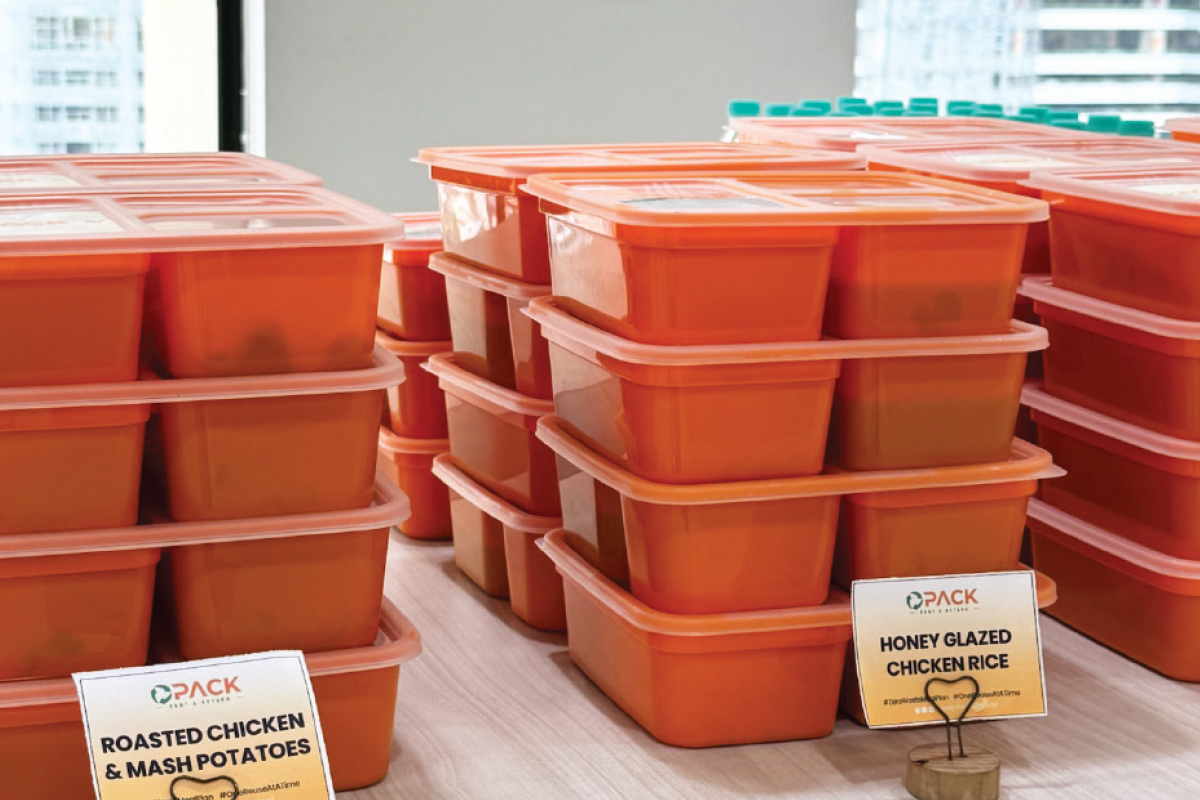
Luckily, another opportunity presented itself to the Opack team — this time, from corporations that wanted zero waste when catering for internal events. KPMG was its first corporate customer, Yap recalls. Opack provided the containers, cups and cutlery for the company’s events and collected them after use to be washed.
With more demand from corporations for catering services, Yap began working with social enterprises such as Bake with Dignity, Graze Eatery and the Autism Café Project to prepare zero-waste meal plans and catering menus, with the food served using Opack’s foodware. Post-event, Opack would send the client an ESG report, which highlights how much single-use plastic and waste were avoided.
She only works with halal-certified or Muslim-friendly food providers, and the foodware items are washed using commercial-grade dishwashers, ensuring cleanliness.
Since Yap quit her corporate job and began running Opack as a company full time in 2024, it has deployed over 40,000 reusable containers and served more than 20 clients, some of whom are repeat customers.
Two years ago, she received another interesting challenge. Pos Malaysia Bhd (KL:POS) reached out to ask if Opack could provide reusable cups for its run.
“There’s no way we would say no to this as a start-up. Pos Malaysia wanted to make its run more sustainable. We had quite a few meetings because we didn’t know anything about marathons then, like how many water stations to set up, where to put the bin and all that,” says Yap.
Her team did its best to learn about the event and observe how water stations are organised in other running events. The cups have to be lightweight and easy to hold, and the bin must be placed optimally, so runners do not simply discard the cups.
“The first year we did the run with Pos Malaysia, we used around 5,000 plastic cups. The second year, we used 10,000. After that, we worked with the Subang Jaya Half Marathon organisers, the Selangor Eco Run organisers and a few more. There was an opportunity here and people were willing to give us a try,” she says.

Reusable solutions for airlines, theme parks and cinemas
While Opack has come a long way since it started, Yap and her team are eager to tap into new markets, particularly those that serve food and beverages. Catering for events is impactful, but it is often a one-off transaction. To achieve more scale, Yap hopes to work with businesses from the theme park, cinema and airline industries, which have high footfall in an enclosed environment.
“For example, in the cinema, all the food and beverages are just given to you, and after the movie, you throw them away. You can change that to reusable packaging and not much education is needed. The operators can provide the soft drinks in a reusable cup and tell customers to throw it into a bin after they exit the cinema,” she explains.
No deposit is needed because the Opack team has observed over the years that the return rate tends to be higher without it.
“In Malaysia, when you collect deposits, people think they’ve already paid for it … When we don’t collect deposits, the return rate is higher,” says Yap.
Instead, companies purchase the reusable foodware and Opack will customise a solution for them, including by setting up a collection and washing system.
“For instance, a theme park might require different rental mechanisms because it has many food providers,” says Yap.
This will be the focus for Opack this year. A high-hanging fruit, though, is the problem that first triggered Yap to start Opack: single-use plastic packaging from food deliveries.
“I don’t think this is in our plans at the moment, because it requires a lot of education. Through the food delivery app, you can’t speak to the customer and ask him/her to return the container, and the logistics cost to collect from every household would be very high,” Yap points out.
“You cannot trust the customers to send the containers back themselves … That goes back to my very first failed pilot project. We learnt along the way that B2C (business to consumer) doesn’t really work.”
Save by subscribing to us for your print and/or digital copy.
P/S: The Edge is also available on Apple's App Store and Android's Google Play.