

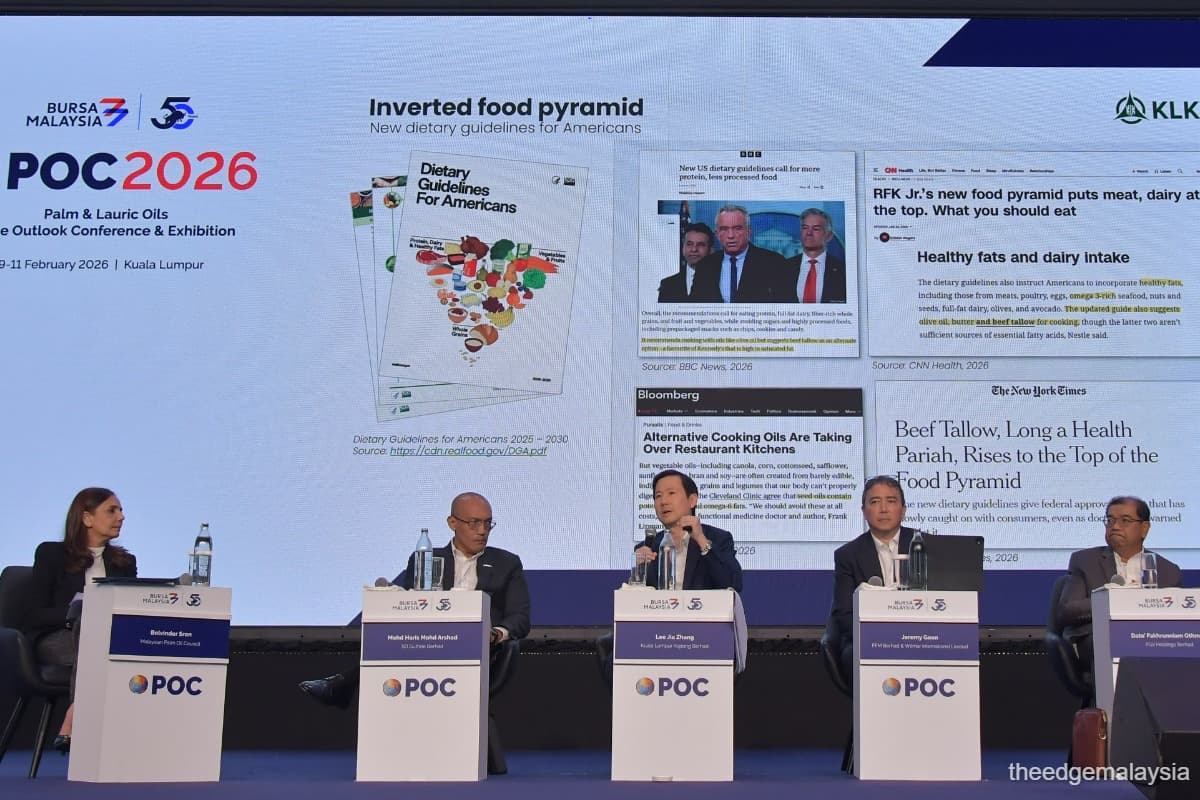
KUALA LUMPUR (Feb 10): Improving replanting rates is critical to sustaining Malaysia’s palm oil industry’s productivity and long-term competitiveness, with industry players saying smallholders need to band together to overcome rising costs and income disruptions linked to estate renewal.
Speaking during a panel discussion at the 37th Palm & Lauric Oils Price Outlook Conference (POC) 2026 on Tuesday, SD Guthrie Bhd (KL:SDG) group managing director Mohd Haris Mohd Arshad said difficulties faced by smallholders in renewing ageing oil palm trees are emerging as a key supply bottleneck for the industry.
He said replanting has lagged as many smallholders are unable to absorb the costs involved or the loss of income during the period, particularly at a time when Malaysia’s palm oil yields have stagnated while productivity in competing vegetable oils, such as soybean oil, continues to improve.
Analysts have reportedly forecasted that palm oil may drop below RM4,000 a tonne by April as competition with soybean oil in price-sensitive markets like India — Malaysia’s largest palm oil buyer — heightens.
To ease the bottleneck, panellists said better organisation among independent smallholders is needed. Replanting is more cost-effective when carried out at scale, as larger and more coordinated areas are more attractive to contractors and help lower costs, said FGV Holdings Bhd group chief executive officer Datuk Fakhrunniam Othman.
By contrast, smallholders managing small plots have limited bargaining power when acting individually, he said.
Mohd Haris pointed out that older smallholders are less inclined to replant given the long time needed for returns to materialise, as replanting requires land to be taken out of production for several years before new trees begin to yield, which infers limited access to labour and rising operating costs.
As a result, many smallholders continue harvesting from ageing, lower-yielding trees, gradually weighing on overall productivity, Mohd Haris said.
Fakhrunniam added that government policy support or larger market shareholders would be required to enable smallholders to replant collectively, whether through cooperatives, associations or other coordinated frameworks, warning that Malaysia could otherwise face tighter palm oil supply in the years ahead despite continued global demand growth.
The panel was moderated by Malaysian Palm Oil Council CEO Belvinder Sron and also featured FFM Bhd group CEO and Wilmar International Ltd chief sustainability officer Jeremy Goon, and Kuala Lumpur Kepong Bhd (KL:KLK) chief operating officer Lee Jia Zhang.