

This article first appeared in The Edge Malaysia Weekly on February 9, 2026 - February 15, 2026
WHEN asked if the Malaysia Competition Commission (MyCC) tends to pursue less critical cases, as detractors have suggested, its CEO Datuk Iskandar Ismail chuckles. “That’s not true at all. We go after the big issues.”
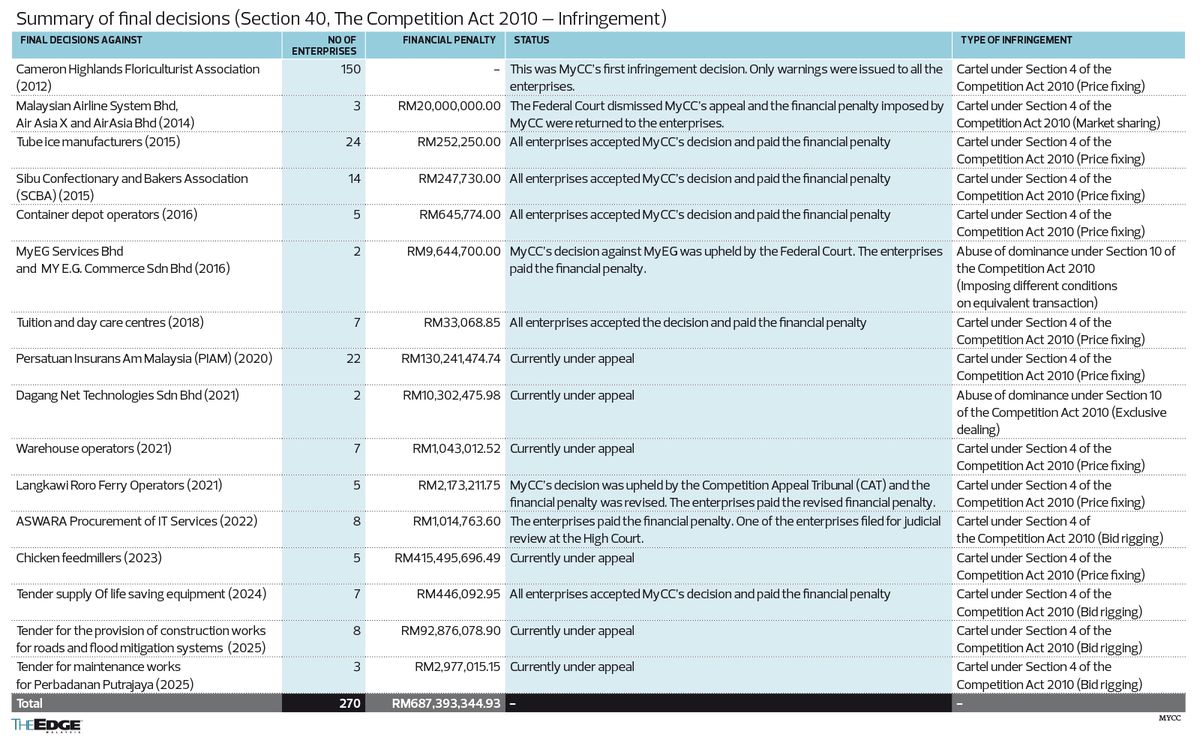
Since the commission was established about 15 years ago, it has imposed fines totalling RM687 million in decisions against hundreds of companies, he points out. Of the 16 cases it has opened against various industries, six are under appeal and one was dismissed by the Federal Court, while the rest accepted MyCC’s decision.
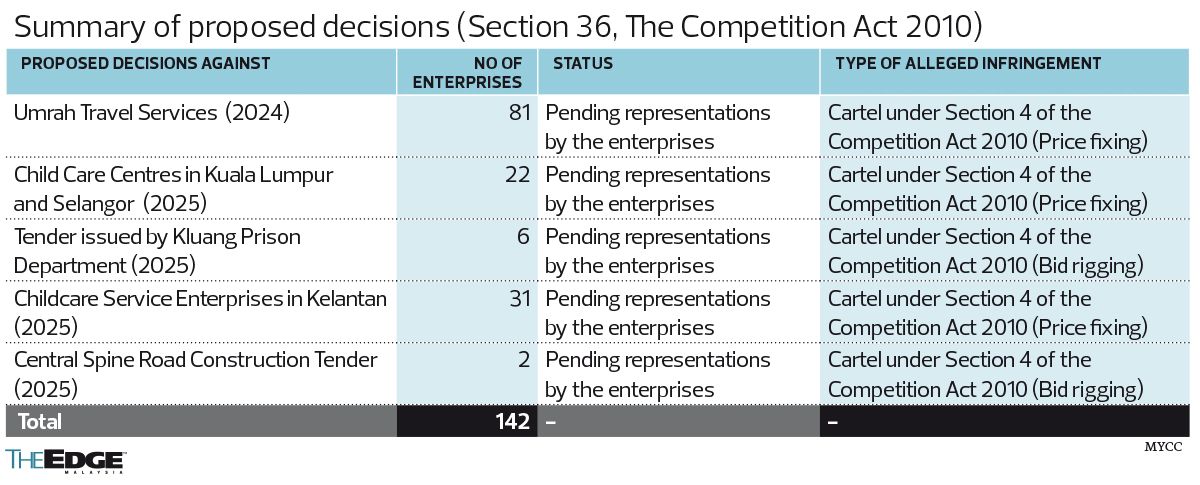
The competition regulator issued a total of five proposed decisions in 2024 and 2025, involving more than 140 businesses, however the penalty cannot be disclosed at the moment as the cases are pending representation by the companies.
Iskandar says the majority of anti-competition commissions globally, including Malaysia, tend to focus their resources on cartels, given their overall impact on the economy. He relates an earlier case that MyCC took up on tube ice manufacturers in the Klang Valley in 2015.
“When they [tube ice manufacturers] fixed prices, they raised the prices of ice, tube ice and block ice. It affected the whole of Selangor, Kuala Lumpur and Putrajaya, where almost a third of Malaysia’s population live,” he says.
While you may think that ice is a very basic and cheap item, it is used in our food supply chain. For example, fresh fish in wet markets or in grocery stores are placed on ice. So, when the price of ice goes up, the price of fish goes up as well,” he points out.
The tube ice manufacturers were investigated and eventually slapped with a RM252,250 fine in 2015 for price fixing.
Another case pursued by the commission with a significant impact on consumers in Malaysia was the “chicken feed cartel”, where it found feedmillers had colluded to fix poultry feed prices.
In 2023, MyCC imposed its largest fine ever, totalling RM415 million, on five feedmillers, three of which were subsidiaries of Bursa Malaysia-listed companies. The three Bursa-listed players were Leong Hup International Bhd (KL:LHI), operating via wholly-owned subsidiary Leong Hup Feedmill Malaysia Sdn Bhd; Malayan Flour Mills Bhd (KL:MFLOUR), via partially owned Dindings Poultry Development Centre Sdn Bhd; and PPB Group Bhd (KL:PPB), through 80%-owned FFM Bhd.
The fourth feedmiller fined was non-listed Gold Coin Feedmills (M) Sdn Bhd, which comes under Gold Coin Group, while the fifth was PK Agro-Industrial Products (M) Sdn Bhd, under Charoen Pokphand Holdings (M) Sdn Bhd, a subsidiary of Thai conglomerate Charoen Pokphand Group Co Ltd.
MyCC’s probe found that the feedmillers had entered into anti-competitive agreements and concerted practices to increase the price quantum of poultry feed, which contains soybean meal and maize as its main ingredients, between early 2020 and mid-2022.
The probe revealed that the five feedmillers commanded about 40% of the total market, which has 29 feedmillers. Poultry feed constitutes 72% of overall expenses, a significant cost factor in poultry farming, and higher cost essentially means an increase in prices of the staple meat.
The case is still under appeal.
MyCC has not won all the battles it initiated, though.
In 2014, the commission ruled that Malaysian Airline System Bhd (MAS) and AirAsia Bhd’s 2011 collaboration agreement had violated the Competition Act 2010 and fined each airline RM10 million. It found that the airlines had breached the Act by entering into an agreement which saw them share markets in the local air transport services sector.
The airlines appealed against the decision and the Competition Appeal Tribunal (CAT) overturned MyCC’s ruling. Following that, the commission sought a judicial review of CAT’s decision, resulting in the fines being reimposed by the High Court in 2018.
The legal battle was long drawn out, but ended with the Federal Court dismissing MyCC’s appeal. The fines imposed were then returned to the airlines.
The commission also lost its case against Grab Holdings Inc last year after the Federal Court rejected MyCC’s bid to appeal against lower court decisions that overturned a RM86.77 million fine imposed on Grab in 2019.
Iskandar says MyCC’s job does not end with a fine. The commission continues to monitor these sectors that have been investigated to ensure the players stay within the lines of the law. Nevertheless, he emphasises that MyCC is not just about investigations.
“The thing is, people see enforcement only through investigation. They say it is the best approach. But there are many other ways to solve the issues at hand. Investigation and enforcement of the law is one method. There is also advocacy, engagement and market reviews,” says Iskandar.
He adds that MyCC also helps businesses to come up with compliance programmes as a means to support them, especially small and medium enterprises, which often lack the resources to do so.
MyCC hopes that its actions will have a significant positive impact on the market. Competition is vital to ensuring the robustness of the nation’s economy, Iskandar stresses, so competition law is not anti-business.
“We are pro-business. The MSME (micro, small and medium enterprises) sector makes up 98% of our businesses in Malaysia, contributing about 40% to GDP (gross domestic product) — that is a lot. Our focus is protecting them. We want them to grow and reach the next level,” he says.
He adds that MyCC is always open to businesses that want to engage with the agency on how they can improve their compliance.
Ideally, when there are many businesses in the market, consumers are provided with choices and competitive pricing. Subsequently, those who continue to stay in the market will then be compelled to provide quality products at a cheaper price to win over customers, and that will result in businesses pushing themselves to be more innovative and efficient.
“We need competition and healthy competitive practices to produce a better economy. Competition law is derived from economics principles. So, we’re here to ensure that business toe the line in accordance with economic principles,” says Iskandar.
“We’re not here to find fault with businesses. In fact, 90% of the complaints come from consumers, competitors and government agencies.”
Save by subscribing to us for your print and/or digital copy.
P/S: The Edge is also available on Apple's App Store and Android's Google Play.