

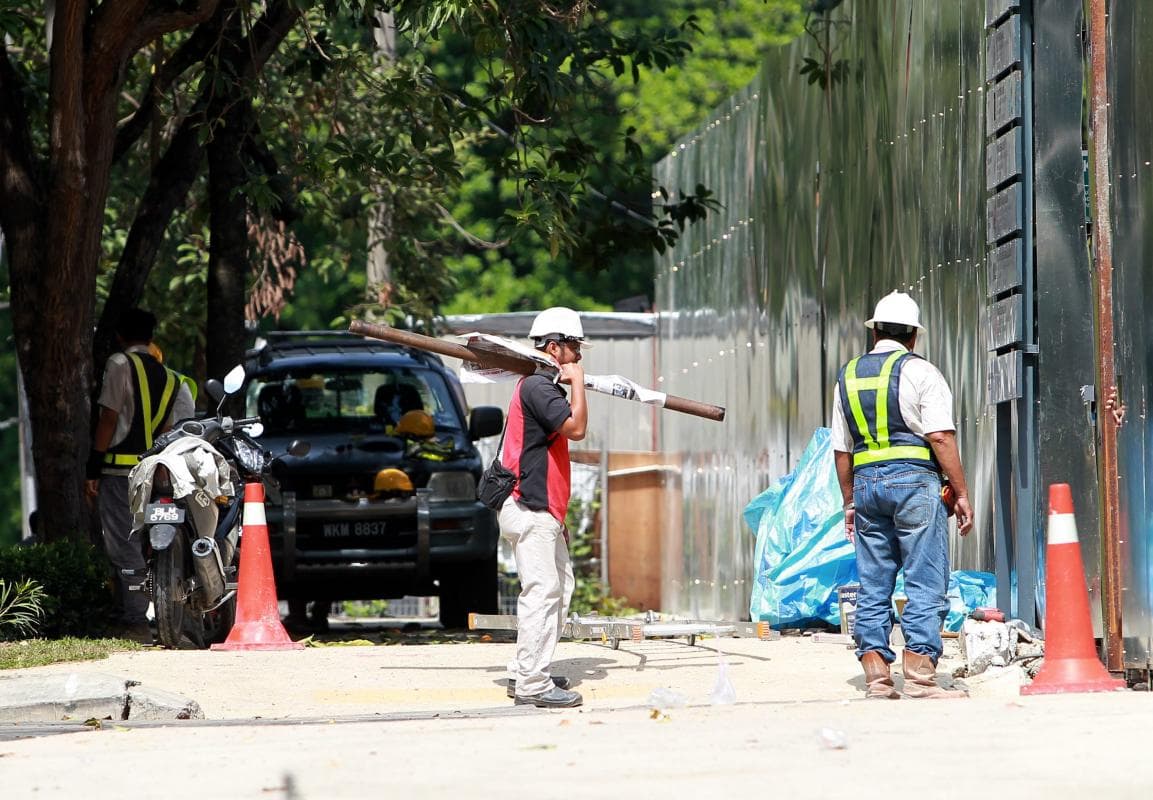
KUALA LUMPUR (Feb 10): Human Resources Minister Datuk Seri Ramanan Ramakrishnan said on Tuesday that the government will roll out a multi-tier levy mechanism this year, with higher rates and penalties targeting companies that remain heavily reliant on foreign workers.
Under the proposed mechanism, the government intends to channel levy collections into a dedicated trust fund, with the proceeds returned to employers to support automation in production processes and reskilling programmes for local workers.
Companies that fail to reduce a dependence on foreign workers will risk penalty and steeper levy costs, Ramanan said, when winding up the debate on the motion of thanks for the royal address in the Dewan Rakyat.
However, he did not elaborate on details of the levy or the timeline for its implementation.
Malaysia has set sights on reducing its reliance on foreign workers to 10% of the total workforce by 2030, and further to 5% by 2035 under the 13th Malaysia Plan (2026–2030), which was approved by Parliament in August last year.
Currently, foreign workers make up about 15% of the workforce, reflecting the existing cap on foreign worker employment of 2.5 million.
Ramanan added that higher levies are intended to encourage employers to adopt alternatives such as greater automation and increased hiring of local workers.
HRD Corp Levy
Meanwhile, Ramanan said the ministry has no immediate plans to reduce the Human Resource Development Corp (HRD Corp) levy imposed on companies.
Currently, companies in specified sectors are required to register with HRD Corp and contribute a monthly training levy equivalent to 1% of employees’ monthly wages, fully borne by employers without deductions from workers’ salaries.
He said any adjustment to the levy must be carefully assessed as it could affect the continuity of national human capital development programmes.
Addressing cost concerns faced by micro, small and medium enterprises, Ramanan stressed that the levy is not a tax, but a training fund that employers can claim back for employee training, adding that active users of the fund should view the contribution as an investment in human capital.
In 2025, HRD Corp disbursed RM766.58 million in financial assistance to MSMEs, while RM739.12 million in approved claims supported upskilling and reskilling programmes involving 806,165 training places nationwide, he said.
Ramanan added that HRD Corp has expanded self-directed training initiatives and strategic collaborations with public universities and local education institutions to offer more affordable training without compromising quality or effectiveness.
For more Parliament stories, click here.