

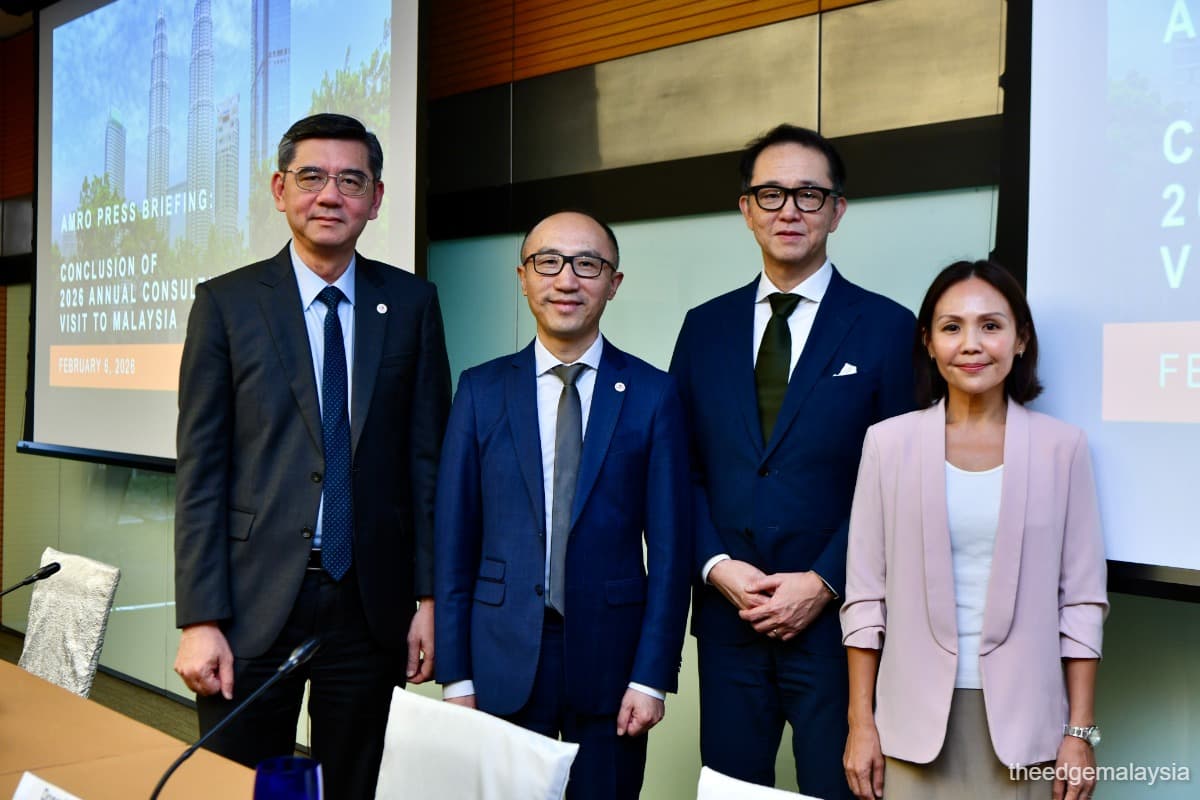
KUALA LUMPUR (Feb 6): Investments in data centres and semiconductors in Malaysia remain resilient despite uncertainties stemming from US tariffs and tighter technology controls, according to the Asean+3 Macroeconomic Research Office (Amro).
Its chief economist Dong He said the global technology upcycle is likely to persist, offering Malaysia a window of opportunity to attract sustained foreign direct investment (FDI) into data centre and semiconductor-related industries.
While acknowledging the risk of financial market corrections — particularly if valuations become stretched or an external shock materialises — Dong stressed that "market volatility does not necessarily translate into a pullback in investment".
“Personally, I think the global tech upcycle will continue for at least a year or two. Another couple of years seems quite possible,” he said.
Dong, however, acknowledged that there are some potential risks.
“If there is a sharp pullback, it is important to avoid excessive leverage built up during the boom. If significant borrowing is used to finance these investments and a downturn occurs, the financial sector could be exposed,” he said at a press conference on Friday following Amro’s annual consultation visit to Malaysia.
Nonetheless, Amro continues to see strong FDI inflows across the region, and these investments are long-term in nature.
“The Malaysian economy has been performing very well and is among the best-performing economies in Asia. It has remained resilient, with electronics exports staying strong and data centre-related investments accelerating.
“These trends highlight Malaysia’s solid position in global semiconductor and electronics supply chains and its gains from the ongoing tech upcycle. Greater stability and clearer government policies have also strengthened credibility and boosted investor confidence. The strong capital inflows into Malaysia, as reflected in the firmer ringgit, are a sign of that confidence,” he remarked.
Amro, which projects Malaysia’s growth to ease to 4.6% this year from an estimated 4.9% in 2025, said the country must safeguard financial stability, deepen domestic capabilities and navigate rising global economic fragmentation to turn the current investment momentum into lasting growth.
Meanwhile, Amro lead economist Peh Kian Heng is of the view that Malaysia should maintain a supportive monetary stance to sustain domestic credit and economic growth, while remaining vigilant on inflation and financial stability risks.
He added that policymakers should continue strengthening foreign reserve buffers and ensuring ample liquidity in the financial system to cushion against potential foreign exchange and credit shocks.
Regular reviews of macro-prudential measures, alongside the continued development of digital finance, would help safeguard stability and promote financial inclusion.
On fiscal policies, Peh called for more ambitious fiscal consolidation to reduce public debt and rebuild fiscal space. This includes broadening the tax base and revisiting the RON95 fuel subsidy framework to redirect resources towards productivity-enhancing investments and targeted social assistance.
Besides, governance reforms and improved tax administration would further improve spending efficiency, he said.