

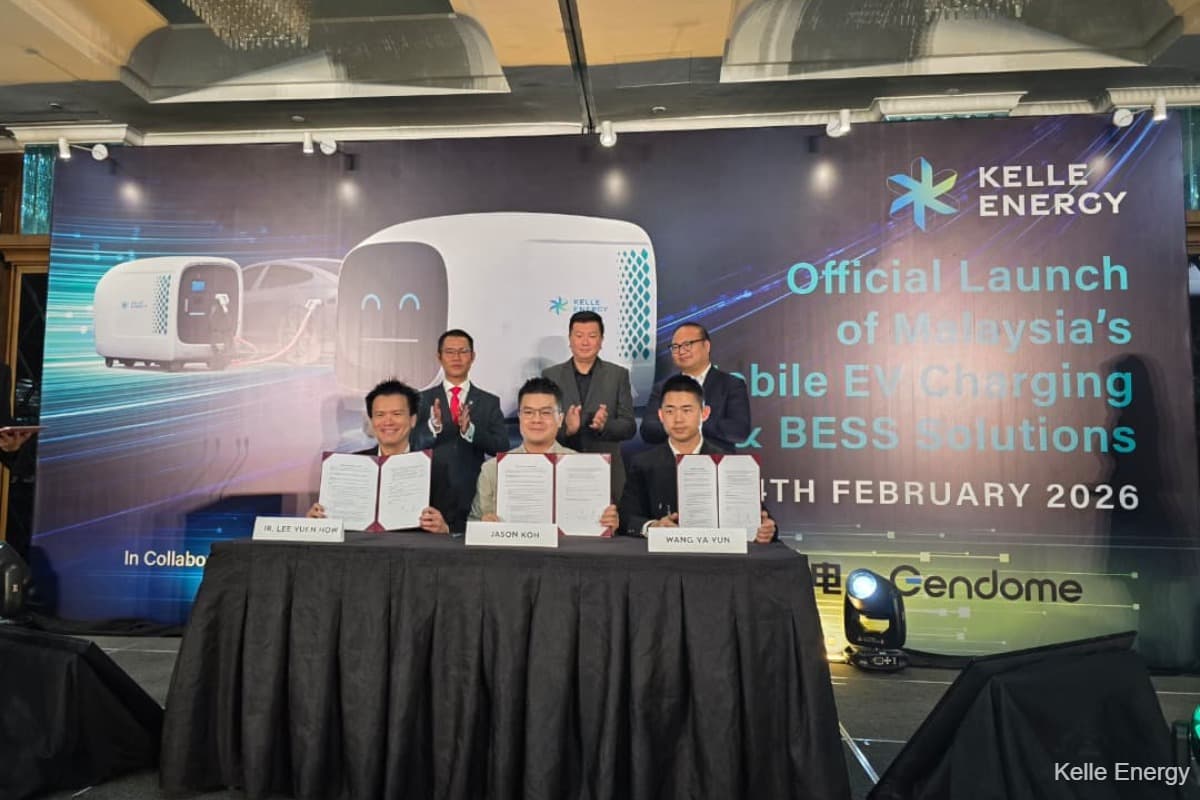
KUALA LUMPUR (Feb 4): Singapore-based clean energy technology company Kelle Energy launched mobile electric vehicle (EV) chargers integrated with battery energy storage systems (BESS) in Malaysia on Wednesday, which it claims to be the first in the country.
Jason Koh, CEO of Kelle Energy, said the mobile EV chargers are meant to complement the existing EV charging system in Malaysia, while providing flexibility in reaching areas where the infrastructure to build new charging stations is not available.
This will help Malaysia increase its share of EVs on the road and meet its target to install more EV chargers. The target to reach 10,000 EV chargers by 2025, according to Low-Carbon Mobility Blueprint 2021-2030, was not achieved last year.
“When you look at the charging infrastructure in Malaysia today, it currently has about 5,360 public chargers nationwide as at November last year... This market gap proves that deploying a fixed charging infrastructure will take time, from site acquisition, grid upgrades to approvals and constructions,” said Koh at the launch, which was held at Mandarin Oriental Kuala Lumpur.

To build an EV charger, there must be sufficient grid capacity at the area, and the operators face high upfront costs and uncertainty around utilisation rates. It is also challenging to allocate dedicate spaces for EV charging in urban areas. These challenges make the deployment of public EV chargers slower than expected, said Koh.
On the other hand, EV adoption is still growing gradually in Malaysia. But once a charger is fixed in a location, it can be difficult and costly to move it if the demand shifts.
“So, over time, we realised that charger count alone can be a misleading metric. What truly matters is not how many chargers exist, but where and when charging capacity is actually available,” said Koh.
He gave the example of highways. Many EV chargers sit underutilised for most of the year, but there is a bottleneck during festive seasons when many people travel long distances.
“This mismatch creates queues and frustration, leading to a perceived shortage of chargers. But in reality, we don’t suffer from a pure charger shortage. It suffers from a misallocation of capacity across time and location, despite having an adequate charger to EV ratio on paper. This utilisation challenge is exactly what we are set up to address,” said Koh.
“Rather than overbuilding upfront, capacity is added gradually, allowing charging infrastructure to go in with real demand... Because these assets are mobile, capacity can move to where demand is and ensure charging is available where and when it is needed the most.”
The mobile EV charger is equipped with a 184kW BESS, can charge EVs at 60kW, and meets the required safety and operational standards by the Energy Commission of Malaysia, according to the company. It can be integrated with solar panels and store energy to be deployed during peak periods, when demand is highest.
Over time, the company plans to integrate charging and battery diagnostics onto the platform so it can generate detailed battery health reports and detect early signs of degradation.
Koh elaborated on a few use cases for the mobile charger, including for fleets that operate in short-term lease properties or locations where installing fixed chargers is not possible. It can also be used by companies to test EV adoption, and offer route-based charging for vehicles that follow a certain route.
For the public, it can be deployed in rest stops, dense urban areas, highways or places where the substation is already heavily loaded.
“It’s important to emphasise that our goal here today isn’t to replace fixed chargers. There is still a significant need for them. Instead, we are positioning ourselves as a complementary solution addressing the gaps,” he said.
Kelle Energy’s technology partner is China-based Anhui Yijianeng Digital Technology Co Ltd, the subsidiary of Gotion High-Tech Co Ltd, with whom it signed a memorandum of understanding (MOU) at the event. It also signed a MOU with EV Connection Sdn Bhd, an EV charging point operator in Malaysia, to deploy and expand its mobile EV charging solution nationwide.
The event was officiated by Tan Hong Pin, Member of Parliament for Bakri and a member of the Special Select Committee on Infrastructure, Transportation and Communication.