

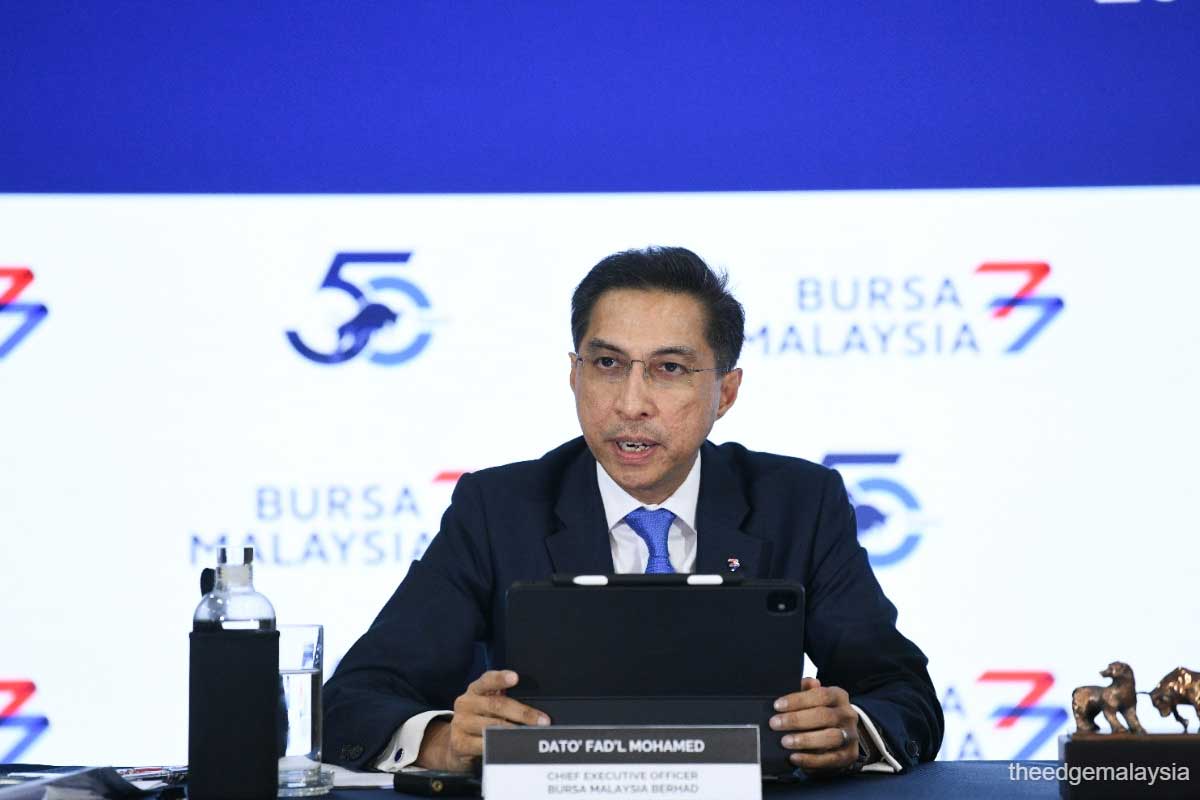
KUALA LUMPUR (Jan 29): Bursa Malaysia Bhd (KL:BURSA) is sharpening its focus on market vibrancy, data and digital services, and new revenue frontiers as it lays the groundwork for growth beyond 2026.
Presenting the stock exchange’s outlook for 2026 and beyond, chief executive officer Datuk Fad’l Mohamed said Bursa Malaysia’s first strategic priority is to strengthen vibrancy across all markets by expanding product offerings and deepening investor participation.
This includes developing a robust initial public offering (IPO) pipeline and broadening access through thematic exchange-traded funds (ETFs).
“Our first key strategic priority is to strengthen vibrancy across all markets,” he said, adding that the exchange continues to enhance its product breadth, including the listing of new thematic ETFs, while prioritising a “robust and quality IPO pipeline”.

Bursa Malaysia is also intensifying efforts to scale up small and medium enterprises (SMEs) via capital markets through strategic partnerships, while encouraging large IPOs — defined as listings with a market capitalisation of RM1 billion and above — to boost market depth and trading interest.
“These large IPOs are key to enhance market vibrancy and broaden interest and trading participation in our market,” Fad’l said.
A parallel focus is being placed on enhancing the market ecosystem through a multi-year, multi-programme initiative aimed at strengthening corporate performance and visibility of Malaysian public listed companies.
Data, digital services to drive non-trading revenue
Accelerating growth in data and digital services forms Bursa Malaysia’s second key priority, underpinning its strategy to expand non-trading revenue streams.
Over the past five years, revenue from Bursa Malaysia’s data business grew at a compound annual growth rate of 11%, rising from RM48.2 million in 2020 to RM81.4 million in 2025, Fad’l said.
“Going forward, we will continue to scale our data business beyond traditional market data into newer domains such as sustainability,” he said. This includes building a marketplace offering sustainability tools and solutions, as well as further monetising proprietary datasets using artificial intelligence (AI).
Connectivity is also being positioned as a growth lever, with Bursa Malaysia exploring potential strategic partnerships and merger and acquisition opportunities in 2026 to acquire new distribution channels and technology capabilities.
Looking further ahead, Bursa Malaysia plans to explore new opportunities as part of its 2027–2030 strategic roadmap, which will be developed this year.
“Exploration and evaluation of new opportunities for Bursa Malaysia will be an integral part of our new strategic roadmap for 2027-2030,” Fad’l said, citing potential expansion into the post-trade ecosystem as one example.
Strategic partnerships will continue to play a central role in unlocking new opportunities and accelerating market development.
Meanwhile, technology resilience and innovation readiness are described as “mission critical”, with Bursa Malaysia planning to modernise core systems, strengthen cybersecurity and build internal AI capabilities through proof-of-concept initiatives with strategic partners in 2026.
Fad’l also unveiled Bursa Malaysia’s headline key performance indicators (KPIs) for 2026. These include a new return on equity (ROE) target of between 27% and 30%, and non-trading revenue growth of more than 10% from financial year 2025 — up from a previous target of 5%-7%.
The local bourse is also aiming for total IPO market capitalisation of RM28 billion in 2026, while it has pledged to cut Scope 1 and 2 emissions by at least 25% from FY2022 levels, having already achieved a 22% reduction last year.
On the macro front, Fad’l said the economic outlook for 2026 remains positive, supported by improving indicators, resilient bond yields and ringgit performance, as well as the government’s commitment to fiscal consolidation, with a targeted deficit of 3.5% in 2026.
The FBM KLCI continues to trade at a valuation discount, with a forward price-earnings ratio of 14.7 times compared with its 10-year average of 17 times, while foreign buying sentiment is expected to remain favourable amid Malaysia’s strong current account position and resilient exports, he said.
“These factors collectively support a constructive outlook for our marketplace as we move into 2026 and beyond,” Fad’l said.