


This article first appeared in Wealth, The Edge Malaysia Weekly on January 26, 2026 - February 1, 2026
Kyno Primary Care Sdn Bhd (KPC), the holding company of Poliklinik Amalmedik’s 14-clinic network, is raising funds through licensed equity crowdfunding (ECF) operator Leet Capital for a period of three months ending April 24.
Founded in 2017, the clinic chain that specialises in non-surgical and minimum invasive pain management and rehabilitation treatment is seeking RM1.5 million to RM2 million from investors for a 7.5% to 10% stake, valuing it at RM20 million pre-money.
According to its pitch deck, the company has been expanding rapidly since the pandemic. From 2021 to 2024, Amalmedik expanded to 14 clinics from just three. Its revenue climbed 592% to surpass RM18 million while net profit came in at RM986,236.
According to its pitch deck, Amalmedik clinic chain had served more than 100,000 patients and treated more than 50,000 pain cases as at 2024.
Among them, more than 80% of cases were diagnosed by ultrasound, mostly musculoskeletal pain, which, according to online information, includes aching, stiffness or soreness in muscles, bones, joints, tendons and ligaments due to injuries or other reasons.
The clinic chain provided more than 30,000 interventional injection treatment to patients guided by ultrasound. Its customer satisfaction index also shows positive signs, with 85% feeling happy after treatment.
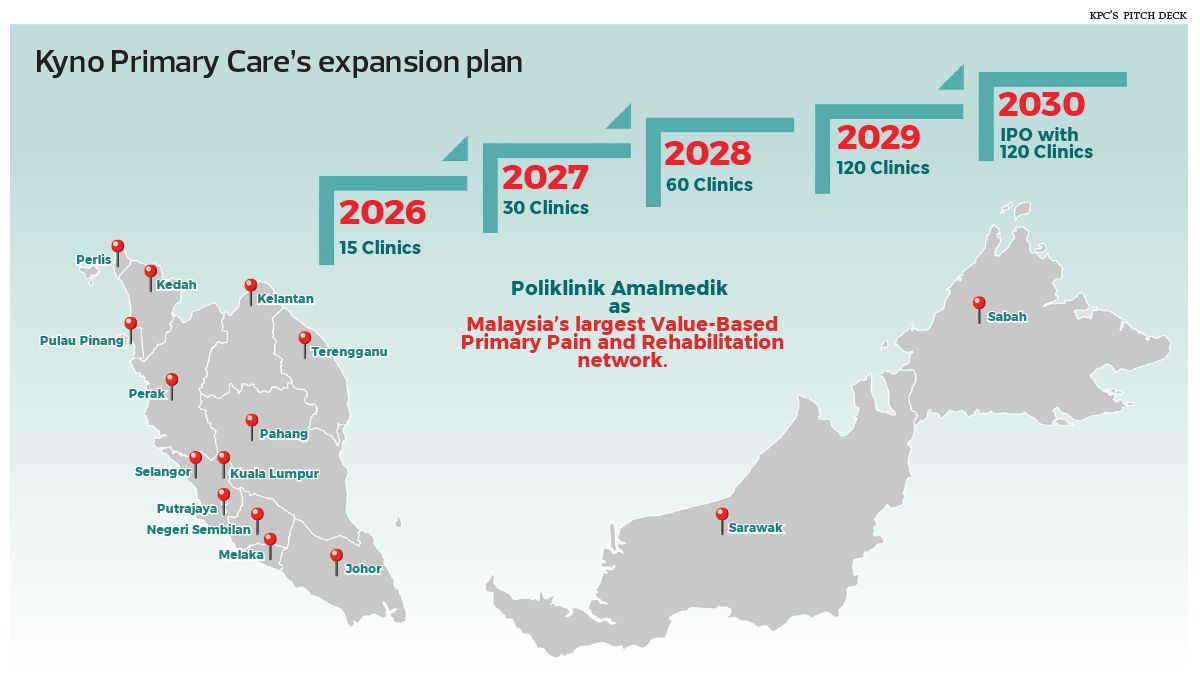
Expanding clinics to 120 by 2029
KPC has an ambition to add one clinic this year and to double the figure each year in the next three years to achieve 120 clinics by 2029.
The company aims for an initial public offering in 2030, according to the pitch deck.
Based on its forecast, KPC’s revenue is projected to hit RM10.17 million in 2025 (15 clinics), RM13.88 million in 2026 (16 clinics) and RM24.09 million in 2027 (30 clinics).
Forecast net profits in the corresponding period are RM424,631, RM562,905 and RM1.64 million, respectively.
The company’s vision is to be “Malaysia’s largest value-based primary pain and rehabilitation network”.
According to its term sheet, KPC intends to use 33% of the funds raised for working capital and growth buffer and 17% for enterprise systems and operational scaling. The remaining 50% will be allocated for new clinic expansion.
Breaking it down further, assuming the group successfully raised RM2 million, it plans to allocate between RM750,000 and RM1 million to scaling its network and covering set-up costs, equipment procurement and initial staffing for new branches.
At least RM495,000 to RM660,000 will be allocated to strengthen operational liquidity, including inventory management, ramping up staffing, marketing and contingency.
The remaining RM255,000 to RM340,000 will be invested in digitisation to implement an enterprise resource planning system to centralise finance, human resources, procurement and clinic performance monitoring.
The company’s core team consists of founder and president Dr Saifulhaziq Noorman, CEO Dr Mohd Firdaus Musa and chief operating officer Dr Khairul Afnan. Its pain medical specialist adviser is Dr Anwar Samhari Mat Arshad and its corporate adviser is Fadzillah Ahmad Tajuddin.
Pros and cons
Commenting on the company’s pitch deck, Tradeview Research analyst Tan Jia Hui says KPC’s business model is skewed towards value-based care and operates in a niche market, specialising in pain management.
On average, its clinics generate revenue of RM450 per patient, more than four times the industry norm of RM100 for a standard general practitioner.
“Based on the financial performance, the group recorded robust revenue growth of 59% in 2024 at RM18.7 million (14 clinics) from RM11.8 million (13 clinics) from the previous year,” says Tan.
Tradeview Research is the independent sell-side research arm of boutique asset management firm Tradeview Capital.
Despite strong top-line growth, she says the group’s profitability remains under pressure, owing to high operating expenses of RM9.8 million in 2024 — well above the cost of goods sold of RM7.9 million — reflecting a continued heavy administrative or marketing burden.
Tan adds that the group successfully executed a turnaround, posting a net profit of RM990,000 in 2024 compared to a loss of RM100,000 in the previous year.
She says, however, that KPC’s net profit margin is thin at roughly 5.3%, falling below the typical industry benchmark for specialist and general practices of 10% to 35%.
“We are cautious about [KPC’s] capital management, which paid out RM269,000 in dividends, exceeding its attributable net profit. This payout ratio of over 100% depletes the working capital needed for future expansion,” she says.
While the group is underleveraged, Tan says its operational liquidity risk is high, as cash is being diverted to related parties and shareholders.
“If the ‘amount due from related companies’ is not recoverable, the group may face a cash crunch that could trigger a default on its term loans or overdraft facilities,” she adds.
Investing in RCPS with at least RM5,000
According to the term sheet, investors can invest in KPC with a minimum amount of RM5,000.
The company’s ECF investors will hold redeemable convertible preference shares (RCPS) with a three-year tenure and are entitled to a cumulative, non-compounding dividend yield of 3% per year, payable only if the company has sufficient distributable profit.
Investors have the option to redeem their shares for cash at 10% above the issue price at the end of the third year.
Alternatively, if the company’s valuation climbs substantially, investors can convert their RCPS into ordinary shares at a bonus ratio of 1:1.1.
As an incentive, investors are granted access to Pulsed Electromagnetic Field (PEMF) therapy and significant treatment discounts: Silver Card holders (RM5,000 investment) receive 10 PEMF therapy sessions and a 20% discount on joint and knee-related treatments and Golden Card holders (RM50,000 investment) receive a larger allocation of 30 sessions and enjoy the same 20% discount on joint and knee-related treatments, valid for three consecutive years from the date of issuance.
Save by subscribing to us for your print and/or digital copy.
P/S: The Edge is also available on Apple's App Store and Android's Google Play.