

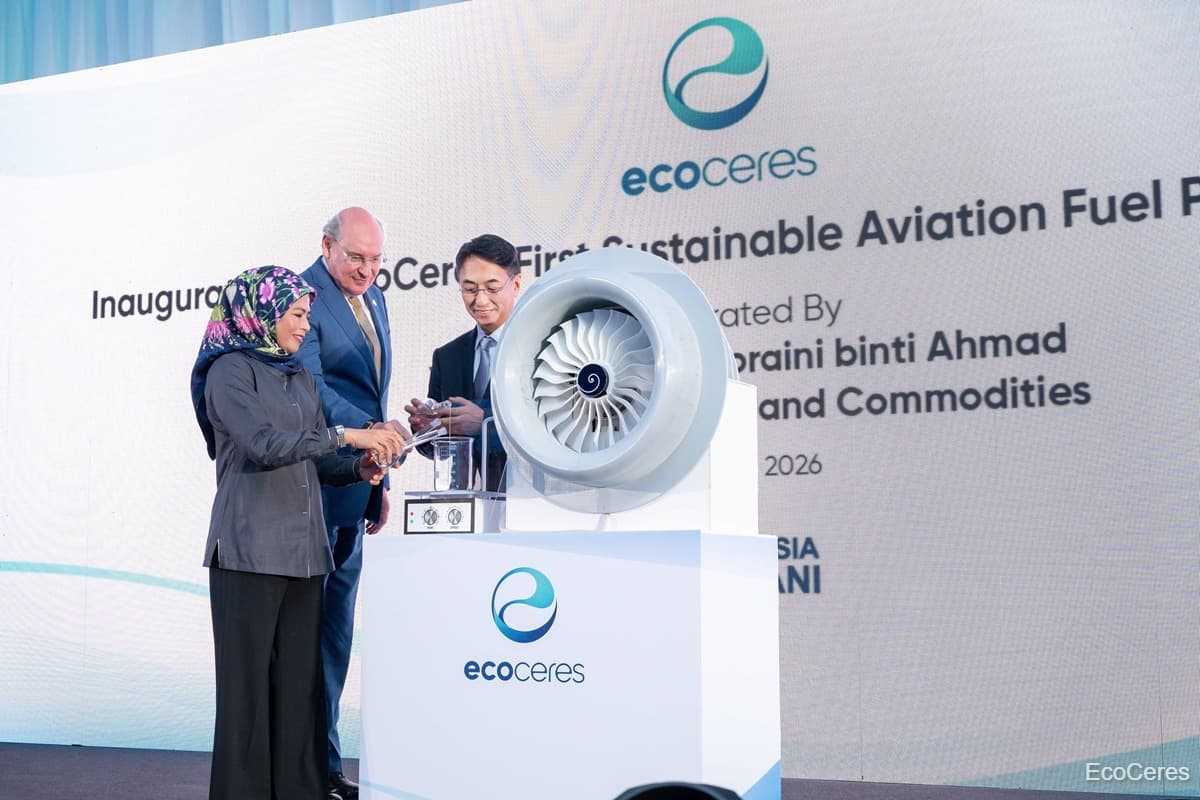
PASIR GUDANG (Jan 27): While the majority of sustainable aviation fuel (SAF) demand comes from Europe, where current mandates reach about 2% SAF blending (1.8 million tonnes) with goals for a minimum of 6% by 2030, nations across Asia are in discussions to increase their own mandates.
For EcoCeres Renewable Fuel Sdn Bhd CEO Matti Lievonen, the launch of a SAF plant in Malaysia is strategic to capitalise on this growing market. He noted that, currently, in Asia, countries such as Singapore, South Korea, Malaysia, Indonesia, Hong Kong, and China are
aiming to increase their SAF mandates. Japan is aiming for 10% blending by 2030.
“More than 50% [of EcoCeres’ SAF output] is in Europe because the market is there, but we are also building markets like in South Korea, Singapore, Japan, Hong Kong and China,” said Lievonen during a media press conference after the launch of EcoCeres’ SAF plant in Tanjung Langsat.
Today, Singapore and South Korea’s SAF mandates are only at 1% and are the main regional markets for EcoCeres.
“Johor is excellent because we get feedstock from Malaysia and other Southeast Asian countries. There is also a great seaport for global deliveries, and a really good workforce in Malaysia. We are very fortunate that we decided to come here to Johor,” said Lievonen.
Lievonen noted that the feedstock to produce SAF for the Tanjung Langsat plant — such as used cooking oils, animal fats or palm oil — is sourced from Malaysia, Southeast Asia and China, including 350,000 restaurants in China.
Though he was unable to disclose how much feedstock will come from local or overseas sources, Lievonen added that the goal is for all feedstock to come from the Southeast Asia region.
He assured that the sourcing of these feedstock remains transparent to retain its International Sustainability and Carbon Certification, which he noted SAF producers are not allowed to sell without one.