

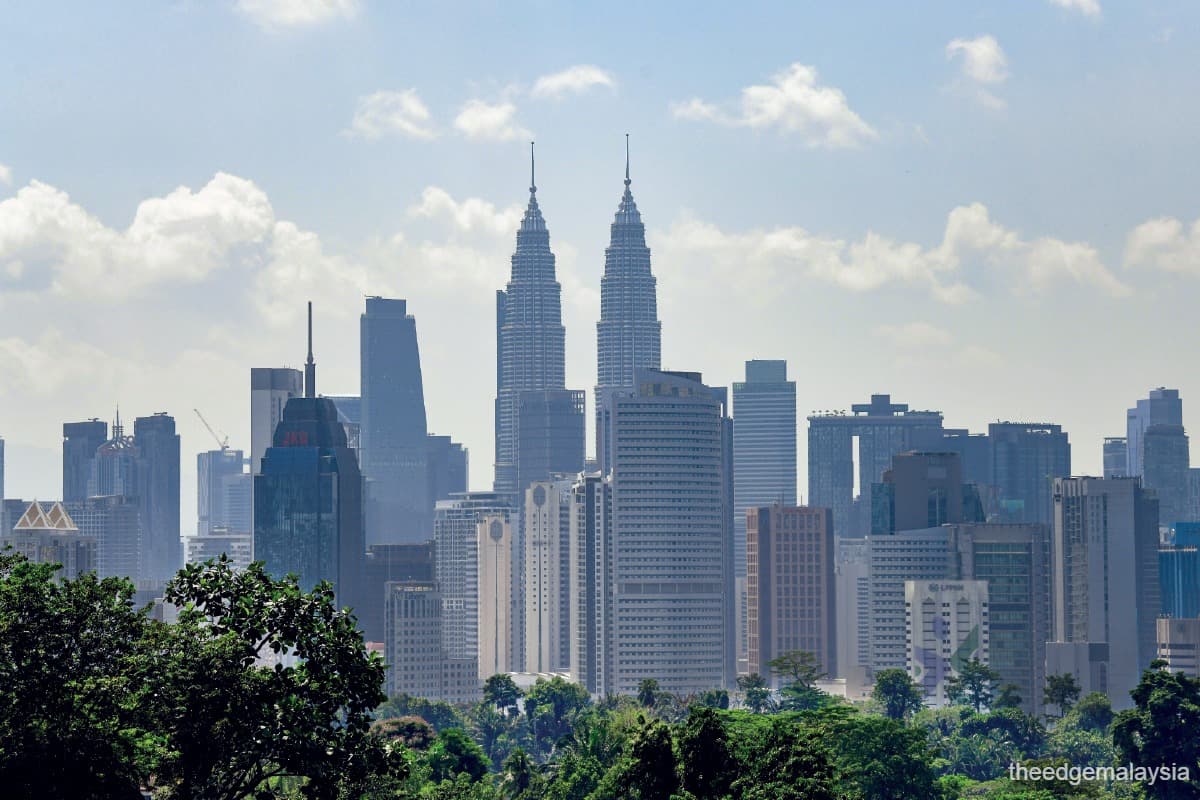
After 2024’s record-setting momentum, 2025 marked a turning point for Malaysia’s property market as transaction volumes moderated, says Rahim & Co Research Sdn Bhd’s Property Market Review 2025/2026 report.
Launched on Jan 8, the report shows that total property transactions declined marginally by 2.1% year on year (y-o-y) to 304,482 units in the first nine months of 2025 (9M2025); yet, it still marked the second-highest performance in more than a decade. Total transaction values rose 5.6% to RM172.06 billion.
“The change reflects a market adjustment, following the exceptionally high base of the previous year, as fundamentals remain strong, albeit in a continued challenging environment. The total number of transactions in 2024 was the highest in more than a decade, and the y-o-y gradual decline in 2025 is appreciated in that comparative context,” says Rahim & Co executive chairman Tan Sri Abdul Rahim Abdul Rahman in his foreword at the report’s media briefing.
For 2026, he notes that the Malaysian property market is expected to maintain a positive, yet moderate, performance, shaped by stable financial policies, evolving homebuyer preferences and rising environmental, social and governance (ESG) consciousness.
The consultancy firm also notes that residential growth will continue to be driven by local owner-occupier demand, particularly for transit-linked, sustainable and lifestyle-integrated developments.
Meanwhile, the industrial segment will remain strong, supported by logistics, high-value manufacturing and expansion of data infrastructure. Commercial property, on the other hand, will become increasingly polarised, favouring ESG-compliant, hybrid-ready and service- and experiential-focused formats, while placing pressure on older, less adaptable stock.
The report says: “While key states continue to hold significance as familiar destinations for both domestic and international real estate interest, several other states have stepped up their market traction — surpassing peak levels of the early 2010s and setting new benchmarks. Notably, Kedah and Melaka are expected to sustain transaction momentum through 2026, driven by strategic positioning and spillover benefits from neighbouring states’ industrial expansion. In addition, the East Coast states, with the upcoming ECRL (East Coast Rail Link) and highway infrastructure projects, have also seen rising investor interest among these decentralised hubs.”
Decentralisation of interests beyond core states
Beyond the country’s largest markets, the report highlights a broader decentralisation of interests, with several states posting stronger activity and moving more within the radar as places to live, work and invest.
Among them are Melaka and Kedah, along with Negeri Sembilan and East Coast states such as Kelantan and Terengganu. In a side interview with City & Country after the launch of the report, Rahim & Co International Property Consultants director of research Sulaiman Saheh notes that activity levels in these states have been higher than average since 2010.
For Melaka, he points out that transaction activity in 2024 and into 2025 has been the highest in more than a decade, supported by improving sentiment and tourism activities.
“While the state has historically ranked among the most affordable markets, prices are also rising steadily as interest increases, though it remains relatively affordable compared with other states,” he explains.
In Kedah, the pull is driven by spillover from Penang, where land scarcity and industrial congestion continue to push attention outward. “Kedah’s advantage lies in its land availability and relatively lower land prices, strengthened by connectivity via the North-South Expressway and the broader northern industrial ecosystem.”
Meanwhile, on the East Coast, Sulaiman highlights that property activity was consistently strong over the past three to four years, with Kelantan in particular recording high transaction numbers in 2024 and showing an overall growth trend.
Part of this demand, he adds, comes from Kelantanese working in major cities such as the Klang Valley, Penang and Johor who return home with higher purchasing power.
Looking ahead, he says infrastructure connectivity, particularly the ECRL, will be a game changer in supporting both residential and industrial interests nationwide.
Beyond the Klang Valley core, the report frames Negeri Sembilan as a state increasingly benefiting from decentralised demand, fuelled by value-seeking buyers and the expansion of economic activity beyond traditional centres.
Residential performance in the state strengthened in 1H2025, with transaction volume rising 7.6% y-o-y to 6,945 units, while total residential transaction value increased 5.6% to RM2.4 billion. The numbers suggest steady occupier-driven demand, consistent with the report’s wider observation that affordability and product fit are increasingly decisive factors for buyers.
Negeri Sembilan also stood out for the pace of industrial expansion. Rahim & Co recorded a 27.6% and 90.3% increase in industrial transaction volume and value to 250 units and RM769.41 million respectively. While the market is smaller than Selangor’s industrial ecosystem, the growth rate reflected rising confidence in Negeri Sembilan’s role as an emerging industrial and logistics corridor.

Kuala Lumpur: High-rise dominance, but value remains resilient
In 1H2025, Kuala Lumpur recorded 6,460 residential transactions, a 2.8% y-o-y contraction. Total residential transaction value rose 5.3%, however, to RM5.97 billion.
The top three districts that contributed more than 20% of market activity were Batu, Kuala Lumpur and Petaling.
In terms of price range, 22.8% of transactions were for homes priced above RM1 million, reflecting strong demand in the upper segment. Nonetheless, affordability remains a key driver, with 54.3% of total transactions involving properties worth less than RM500,000.
On the supply side, Kuala Lumpur saw residential stock expand by 2.7% to 567,469 units. Similar to transactions, supply concentrations were highest in the districts of Petaling, Batu and Kuala Lumpur.
High-rise developments accounted for half of the residential stock in each district. Looking ahead, the report expects that the dominance of high-rise units will continue, as less than 1% of the 56,953 incoming residential units comprise other housing types.
Selangor: Softer residential while industrial continues to anchor growth
In 1H2025, Selangor recorded 25,015 residential transactions worth RM14.13 billion, representing declines of 7.9% in volume and 6.7% in value y-o-y. The report attributed the broader moderation in housing activity to a market transitioning to a more cautious phase, noting that buyers have become more value-conscious while developers have adopted a more disciplined and phased approach in response to absorption and cost considerations.
The industrial segment served as a key stabiliser and growth engine, reflecting the state’s position as Malaysia’s primary logistics and manufacturing hub. Selangor’s industrial transaction volume rose 10.1% y-o-y in 1H2025, while industrial transaction value increased 4.1%, totalling 1,433 transactions worth RM6.82 billion.
The report noted that 61.8% of industrial transactions in Selangor were valued above RM1 million, reinforcing the sustained appetite for higher-value industrial assets even as buyers became more cautious in the residential space.
On the supply side, Selangor’s industrial stock stood at 43,295 units as at 1H2025, up 1.6% y-o-y, with 1,472 units under construction, concentrated primarily in Klang and Kuala Langat. This continued expansion points to an industrial-led growth narrative, aligned with the report’s broader view that industrial real estate remains supported by investment flows, supply chain requirements and the evolution of Malaysia’s production and logistics landscape.

Penang: Mixed sentiment
In Penang, 1H2025 transaction volumes declined across the board, with residential falling 2.6% y-o-y, commercial dropping 2.3% y-o-y and industrial dipping 2.7% y-o-y. Value movements were more mixed, however, with residential transaction value falling 4.2% and industrial value rising 1.7%, signalling that industrial assets remained comparatively resilient even as sentiment cooled slightly.
For Penang, the durability of industrial demand remains important, given its role as a long-established manufacturing and technology hub. At the same time, Sulaiman notes that Penang’s limitations, including congestion in the industrial segment, have led to spillover interest into neighbouring states such as Kedah, where land opportunities are greater and land prices are lower than in Penang.
Johor: Spillover and speculative risks
Johor remained one of Malaysia’s strongest performing states in 2025, underpinned by cross-border momentum and improving infrastructure connectivity.
In 1H2025, 732 industrial transactions were recorded, of which 51% were terraced and semi-detached factories/warehouses. These transactions amounted to RM3.63 billion, with an average transaction price of RM4.95 million.
While the transaction value increased 12.3% y-o-y, overall volume remained unchanged. Johor Bahru continued to dominate the industrial market, with 426 transactions, or 58% of the state’s total industrial activity.
“One of Johor’s biggest strengths is its proximity to Singapore,” says Sulaiman, citing land availability and spillover demand as key growth drivers.
“This has been most evident in technology-related industrial services. [Johor has] always had the capacity, but this opportunity became glaring when Singapore faced constraints in space and power for data centres.”
He cites the rise of Sedenak Tech Park in Kulai as a direct outcome of this spillover, and he expects the maturity of Johor’s data centres to rise further with approvals for facilities of Tier 3 and above.
Meanwhile, demand remains strongest for transit-oriented developments (TODs), particularly along the Rapid Transit System (RTS) corridor, which is slated to commence operations by December 2026, alongside the Senai-Desaru Expressway upgrade due for completion in April 2026.
Sulaiman cautions, however, against over-speculation. “The growth today is real and infrastructure-led, but there is a risk that it becomes more of a property play than economic or skill-driven growth.”
The state’s residential market remained measured in 2025, with unsold completed stock declining to 12,910 units valued at RM10.9 billion. Infrastructure-led growth and initiatives such as Visit Johor 2026 are expected to support housing demand in prime locations, although Sulaiman stresses that supply discipline will be critical to prevent renewed imbalances.

Sabah: Tourism recovers as industrial activity gains ground
In 1H2025, Sabah’s hotel sector saw gradual recovery, recording a 5.7% y-o-y increase in the number of rooms to 25,388 across 437 hotels. Of these, 28 hotels were rated four- to five-star and 49 as three-star.
At the same time, Sabah’s industrial sector maintained moderate growth, with 186 transactions worth RM327.79 million, representing an increase of 16.3% y-o-y in volume, despite a 3.1% decline in value.
Industrial stock stood at 6,432 units, with a significant portion of these transactions involving terraced factories/warehouses, industrial vacant plots and detached factories/warehouses. In the pipeline, 291 units of incoming supply are under construction, mainly at Kota Kinabalu and Lahad Datu.
“Tourism plays a huge role in Sabah’s economy,” says Sulaiman, noting that rising visitor arrivals have supported hospitality and related property segments, although the mid-tier market continues to face competition from serviced apartments and short-term accommodation platforms.
He adds that tourist arrivals have increased consistently over the past three years, but have yet to return to pre-pandemic levels.
Infrastructure remains a key catalyst, with the upcoming Pan Borneo Highway and upgrade to Tawau Airport expected to improve connectivity and investment accessibility into 2026.
Industrial and agro-based development also gained traction, with the Sabah Agro-Industrial Park in Kimanis entering a new operational phase and manufacturing emerging as the largest investment contributor in early 2025.

Sarawak: Energy transition supports industrial market strength
In 1H2025, Sarawak’s industrial sector recorded an improved performance, with transaction volume rising 28.5% y-o-y to 361 units and transaction value increasing 20.6% to RM298.86 million. Industrial activity was largely centred in Sibu and Miri, while semi-detached factories and warehouses accounted for the bulk of industrial purchases.
Industrial stock expanded marginally by 0.7% to 7,641 units, with semi-detached factories and warehouses dominating and accounting for more than two-thirds of total stock, followed by detached and terraced units — the highest concentration of such property remained in Kuching, Sibu and Miri. Looking ahead, 199 industrial units are under construction, mainly in Bintulu, Kapit, Kuching and Miri, with semi-detached units forming the bulk of the pipeline.
The industrial segment continues to benefit from Sarawak’s energy-driven development strategy, as the state is one of the major producers of fuel, oil and gas in Malaysia, and is currently transitioning towards renewable and low-carbon energy.
“The shift to renewable green energy and zero-carbon hydropower has put Sarawak on the map,” Sulaiman says, highlighting the Sarawak Gas Roadmap’s role in promoting gas-based industries.
Industrial demand has been supported by land availability, lower operating costs and incentives in Samalaju Industrial Park. Sulaiman expects greater market interest in Sarawak’s industrial sector, particularly from energy-intensive users aligned with the state’s focus on hydrogen and renewable energy.
Several major infrastructure and energy projects remain underway, including the RM2 billion combined-cycle gas turbine power plant, scheduled for completion in late 2027, and the Electric Autonomous Rail Transit (e-ART), which is expected to improve urban and industrial connectivity.
Looking ahead
Malaysia’s property market is expected to sustain a positive but moderate trajectory, with decentralisation emerging as a key structural theme. While core markets such as Kuala Lumpur, Selangor, Johor and Penang continue to anchor activity, growth momentum is increasingly distributed across secondary and emerging states, supported by infrastructure investment, industrial spillovers and value-driven demand.
“We expect market growth to be more gradual, but we must always be aware of the foundational laws of supply and demand,” says Sulaiman, emphasising a need to curb speculative activity and better align price growth with income levels.
Buyer and investor behaviour has also become more selective, with greater emphasis on connectivity, ESG considerations, energy efficiency and long-term financial viability. At the same time, he notes that challenges remain, including the existing overhang and the need for better targeted incentives.