

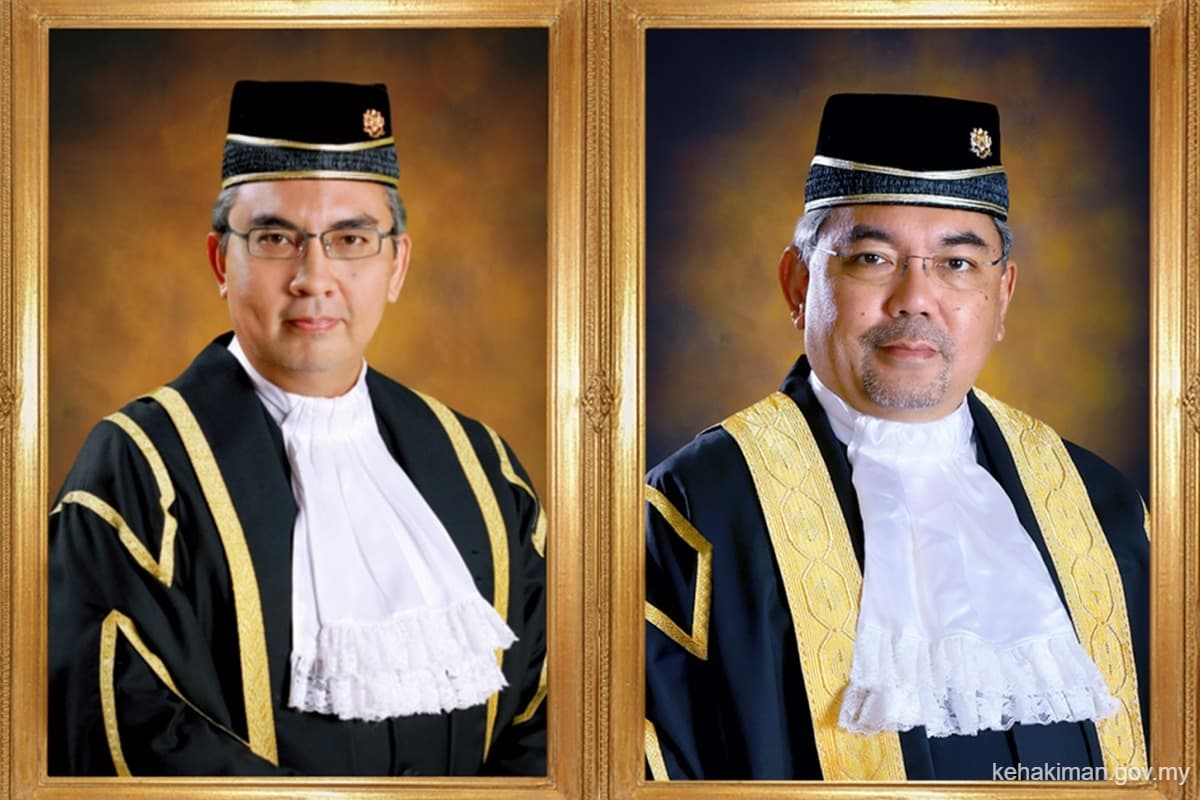
PUTRAJAYA (Jan 16): Federal Court judge Datuk Mohd Nazlan Mohd Ghazali has been appointed as the managing judge for the Kuala Lumpur criminal and civil courts.
Datuk Ahmad Fairuz Zainol Abidin, a Court of Appeal judge, has been retained as the managing judge for the commercial division. The appointments, made by newly minted Chief Judge of Malaya Datuk Hashim Hamzah, are effective Jan 15, according to people familiar with the matter.
Nazlan is replacing another Federal Court judge, Tan Sri Ahmad Terrirudin Mohd Salleh, as the managing judge.
A managing judge does not preside over trials but manages administrative and procedural aspects of the designated courts to ensure case flow, registry coordination and judge support. The appointments come at a time when the judiciary is grappling with a surge in number of cases.
In Kuala Lumpur alone, there are more than 80 courts across magistrates, Sessions Court and High Court levels. The Kuala Lumpur Courts Complex is touted as the second largest in the world.
Nazlan will be managing the Civil High Courts, Family High Courts, Special Powers Division Courts and Criminal High Courts while Ahmad Fairuz would handle the administration of the Commercial High Courts, Constructions High Courts and the subordinate civil courts.
Their appointments were also mentioned in a Kuala Lumpur Bar circular to its members.
Both Nazlan and Ahmad Fairuz have experience presiding over highly complex cases, such as those involving SRC International Sdn Bhd.
Nazlan presided over the criminal trial involving former prime minister Datuk Seri Najib Razak while Ahmad Fairuz is the sitting judge in SRC’s civil lawsuit involving RM4 billion (US$1.18 billion) against Najib now pending a decision.
The need to properly manage the cases follows a rise in the number of cases as noted by Chief Justice Datuk Seri Wan Ahmad Farid Wan Salleh in his inaugural Legal Year 2026 launch earlier this week.
Wan Ahmad Farid said there is an urgent need to increase the number of judicial officers, especially those serving the lower courts, amid a spike in criminal and civil cases that reflects a structural trend rather than a temporary surge.
Between 2021 and November 2025, criminal case registrations rose 63% to nearly 2.5 million cases. Civil case registrations, meanwhile, jumped 60% over the same period to 483,933 cases
“Looking at it positively, a more litigious society is a society that has faith in its judiciary,” Wan Ahmad Farid said. However, the limited number of judicial officers has resulted in heavy caseloads, contributing to delays and uneven workload distribution across states and districts, he said.