

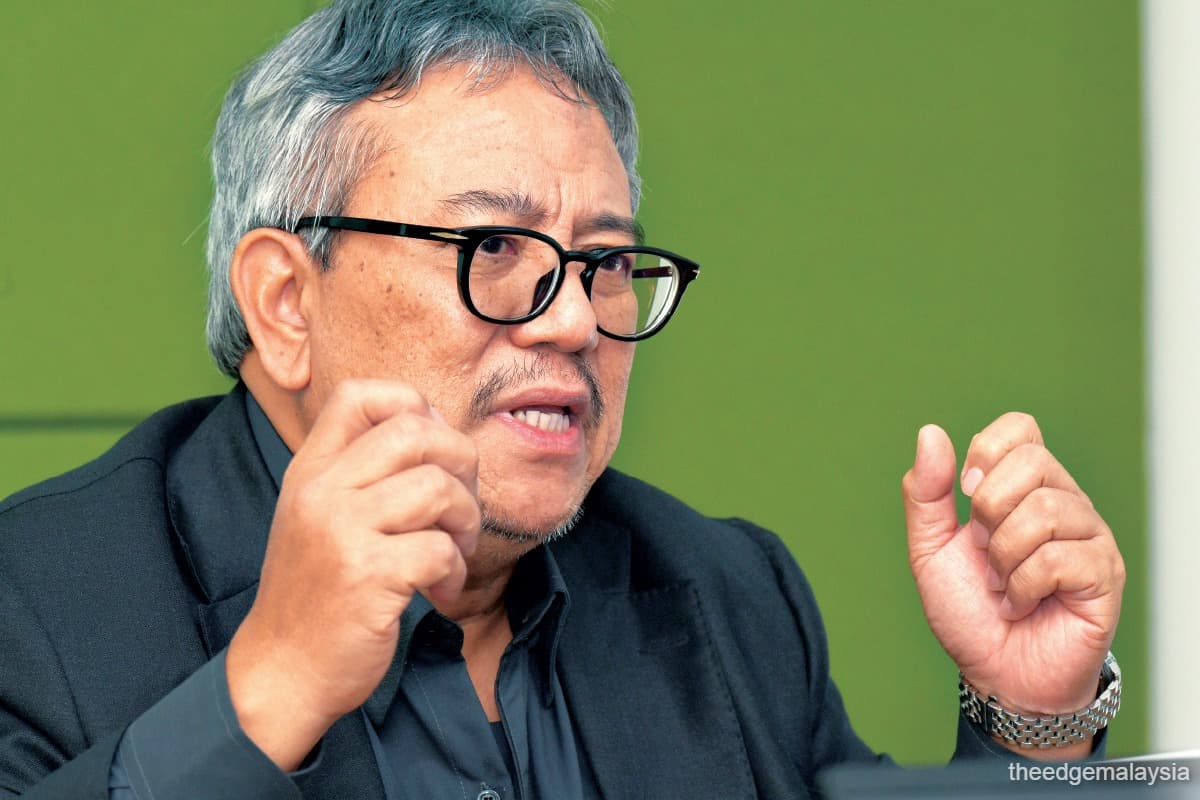
This article first appeared in The Edge Malaysia Weekly on January 12, 2026 - January 18, 2026
IF we don’t do this, people will forever look at Malaysia, look at Perodua, and say, ‘Oh, you only accept whatever your partner tells you to do’. No, we are actually doing this now, and we will have the technology in the future.”
That quote by Datuk Seri Zainal Abidin Ahmad, president and CEO of Perusahaan Otomobil Kedua Sdn Bhd (Perodua), encapsulates why the carmaker decided to develop its own electric vehicle (EV) from the ground up.
The QV-E marks the first step in probably a long journey that the Rawang-based carmaker is embarking on to develop its own EV technology and platform, as it seeks to be more independent of its technology partner and 25%-shareholder Daihatsu Motor Co Ltd.
But the market that Perodua is stepping into with the QV-E is not one where it has a price advantage, unlike most of its models, which is why the RM800 million that it has invested in the development of the EV platform has come under scrutiny.
For years, the national carmakers have been insulated from the tough competition among global brands due to the punitive excise duty structure that Malaysia imposed on completely built-up (CBU) imported models in order to nurture, develop and sustain its automotive industry.
Nevertheless, in the EV space, Perodua will have to compete head on with Chinese imports, including locally assembled ones such as those by Proton Holdings Bhd and Chery Auto Malaysia Sdn Bhd. BYD Auto, XPENG, Stellantis’ Leapmotor and SAIC Motor’s MG have also announced plans to set up local assembly operations in the country.
The Chinese brands not only enjoyed almost five years of import tax and excise duty holiday between 2021 and 2025, but are also backed by China’s mighty industrial complex. State subsidies cannot be discounted, as Beijing sees the automotive sector, especially EVs, as a way to upgrade China’s technological prowess — which neither Perodua nor Malaysia’s automotive industry possesses.
Although aware of the challenges ahead, Perodua is unperturbed. However, it asks for understanding as to why it had to invest so much and price the QV-E at RM80,000 (on the road, without insurance and battery), which is its priciest model so far.
“We are building the ecosystem, meaning that we have to build the vendor system in the country, which before this, maybe they [vendors] have never been into EVs,” Zainal Abidin tells The Edge in a recent interview.
“Some of the investment is to support them in terms of development, in terms of tooling management and all that. So, the moment these vendors start to supply, and are in full production, I believe we can eventually get slightly better prices for future models,” he adds.

RM800 mil investment a ‘learning fee’, no return expected
Developing a car is expensive, let alone a platform where the technology is not widely available in Malaysia. Perodua has admitted to spending RM800 million on the development of the QV-E, perhaps its biggest investment in platform development.
At RM80,000 for this model, Perodua may not see a return on investment, says Zainal Abidin. But the capital expenditure (capex) is more than just the cost of this particular model, he points out.
“Yes, this is the model that we sell at RM80,000. Maybe Perodua won’t make money, because this model is more about our learning process, of trying to get the technology to the people, to do the R&D and so on,” he says.
Zainal Abidin likens the investment to a “learning fee” that Perodua has to pay to master the development of EVs. Similarly, when it develops an internal combustion engine model with Daihatsu’s assistance, it incurs a development cost of between RM600 million and RM700 million.
On top of that, the national carmaker has to pay royalty for the model, he says. “So, this [not having to pay royalty to Daihatsu] is where the saving comes from.”
With Perodua owning the intellectual property (IP) for the QV-E platform, it will be able to develop future models that are more competitively priced, so that it can get the volume it needs to justify the investment, says Zainal Abidin.
“So, the strategy is to invest now at a slightly higher price, develop the platform, save on royalty because it is our own, but then gain the knowledge, get the technology, then develop a future model using the shared platform,” he explains.
Zainal Abidin says for a capex of RM800 million on a completely knocked-down (CKD) model, Perodua will have to sell about 2,500 units a month over a lifecycle of seven years to see a return on investment.
That means the carmaker will have to sell 30,000 units of the QV-E a year, or a total of 210,000 units over seven years, for the investment to bear fruit. The initial investment for subsequent models on the QV-E platform, however, will be lower.
Naturally, Perodua’s shareholders, which include Permodalan Nasional Bhd, Sime Darby Bhd’s (KL:SIME) UMW Corp Bhd, MBM Resources Bhd (KL:MBMR), Daihatsu and Mitsui & Co, will want to see the development cost pay off. Zainal Abidin says the shareholders are supportive of the group’s endeavours as the QV-E platform is not for a one-off model, but also for future models, including hybrid or plug-in hybrid EVs.
Nevertheless, selling 30,000 EVs a year is a daunting task in a market as small and competitive as Malaysia. This means Perodua will have to look outside its home turf to drive up its sales volume.
Where the carmaker can carve out a significant market share is still unclear, although Zainal Abidin hints at Kenya and Mozambique as potential markets for the company to expand into.
For comparison, Proton Holdings managed to sell 7,740 units of its e.MAS 7 — its first EV model in collaboration with Geely Auto — from January to November 2025. The e.MAS 7 is priced at RM105,800 (on the road, without insurance).
Meanwhile, the most popular EV model in Malaysia so far — the BYD Atto 3 — has seen fewer than 10,000 units sold since it was launched in late 2022.
This means Perodua will have to promote its model aggressively in other markets. However, it will not be able to sell many if it does not export to large markets and do so competitively against the automotive giants from China, Japan, South Korea and Europe.
Having its own platform will allow Perodua to sell the QV-E in more markets than for its Daihatsu-based models. This is because it requires the Osaka-based carmaker to certify the models that were co-developed before it can export to those markets.
Although the notion that Perodua requires Daihatsu’s “consent” to export its products is rejected by Zainal Abidin, it is observed that the national carmaker has been exporting to markets like Sri Lanka, Fiji, Brunei, Bangladesh, Mauritius and Seychelles — hardly considered major automotive markets.
“Not to say we need their consent, but if we want to export, for example, the Ativa to Fiji, Daihatsu will require to test the ASA (advanced safety assist) system in Fiji, to see whether it can work, because it is actually guaranteed by them,” he explains.
“Then they have to spend on the manpower to risk-test it. If they don’t have the manpower, then they don’t [test and certify the system]. So they say, ‘Okay you cannot export [the model] since they didn’t do any testing in Fiji.”

Deeper collaboration with Daihatsu for export models
Perodua has studied the markets that it wants to enter. Zainal Abidin says it would be better for the carmaker not to enter markets where similar cars are being sold at lower prices, and that it should only choose those where it can potentially grab a major share of the market. He cites Sri Lanka, where Perodua is the largest new car brand, and Fiji, where the carmaker has the largest market share in the sport utility vehicle (SUV) segment.
While Perodua will be able to export the QV-E to any country it wants to without Daihatsu’s involvement, the collaboration with the Japanese car manufacturer will not only continue for its future models but also deepen, says Zainal Abidin.
With Malaysia being the largest foreign market for Daihatsu via its shareholding in Perodua, it allows the developer of the Myvi and Bezza to have some leverage with its Japanese technical partner.
Zainal Abidin says for the models co-developed by Daihatsu and Perodua, the prospects of the export market, in terms of the materials used as well as the homologation (certification process) of the models, will be taken into consideration.
“That means for future models, Daihatsu will ask us which country we want to be in, and they will include the requirements for that country in the model development — for example, a country that uses left-hand drive,” he explains.
“Then they will do the development for left-hand-drive countries. Based on that, in the future, if we want to export, we don’t have to do this kind of after-thought kind of thing [for homologation of the model in specific countries],” he continues.
“Before this, the testing and homologation was … they would do based on what they want, based on the Malaysian market. So, before this, we never included the requirements of export markets — for example, in cold climates. What can happen? Well, your plastic parts can crack because of the cold weather.
“So now, the material that we use, because we want to export to, say, Türkiye, we would choose materials that can go below a certain temperature.”
Therefore, instead of Perodua getting what Daihatsu or Toyota developed and localising it for the Malaysian context, it will develop its own model and get Daihatsu’s help to match that with the target export markets.

Sales target of 500,000 units by 2030
Perodua’s medium-term objective is to sell 500,000 units with three models by 2030. The company planned to sell 359,000 units in 2025, from 358,102 units sold in 2024. This year, it aims to sell 363,000 units.
The group is targeting between 5% and 10% growth in sales volume every year from 2026 onwards to achieve the 500,000 units by 2030 target — 50% of the projected total industry volume (TIV) of one million units.
“On this point, I have a slightly different view from analysts. They say the TIV at 800,000 is almost saturated, but I still believe the one million TIV can be achieved by 2030. Why? Because I’ve seen some countries, like Mexico, that could actually hit one million TIV when their population was almost the same as Malaysia’s,” says Zainal Abidin.
“So, with the right perspective, the right pricing, of course, and also the right models, I think Malaysians will continue to buy vehicles. And for us, at least 50% of the volume, we are okay in the sense that they are actually buyers of replacement cars.”
The Malaysian automotive industry achieved its highest TIV in 2024, when it breached 800,000 units for the first time in history to end the year at 816,747 units. The volume is expected to dip slightly in 2025, but still be above 800,000 units.
To achieve its target by 2030, Perodua will need to come up with better products to meet the demands of the local market, which has seen the influx of Chinese cars with top specifications that rival those from Europe, at prices of less than RM200,000.
In the five years to 2030, Perodua needs to develop a replacement model for its long-running Myvi, which was the brand’s best-selling model between 2006 and 2014 and between 2018 and 2022, before being supplanted by the Bezza A-segment sedan.
“Because the Myvi is already ageing. Its volume is going to drop this year [2025] and maybe next year [2026]. So, we have to do something to make sure there is full management between now and 2030,” says Zainal Abidin.
As at Nov 30, 2025, Perodua had sold 322,867 units, with 91,275 units being the Bezza, followed by the A-segment hatchback Axia with 77,073 units. The Myvi came in third at 64,486 units sold, but was still more than other non-Perodua models.
Myvi’s sales peaked in 2013, with 98,936 units of the hatchback sold, which at the time made up half of all Perodua cars sold during the year. When the Bezza overtook the Myvi in 2023, Perodua sold 89,265 units of the compact sedan, or 27% of its total annual sales.
As part of its model line-up management, Perodua recently launched the Traz, a B-segment SUV aimed at more discerning buyers than those who buy the Ativa, also a B-segment SUV, which was launched in March 2021.
This raises the question of whether the Traz will cannibalise its sibling, the Ativa, considering its similar segment, although targeting different buyer profiles. The Ativa starts at RM62,500 (on the road without insurance), while the Traz starts at RM76,100.
“We know that some cannibalisation will happen, but we have to manage the risk in the sense that some customers may choose Ativa while others may migrate to Traz. But for us, essentially, as long as the customers stay with Perodua, we’re okay. Because Ativa will also come to the end of life very soon. So, it’s good that we have an initial overlap,” says Zainal Abidin.
Perodua will invest about RM2 billion over the next five years as it develops three models — the Myvi replacement and two new models using the QV-E platform. It will also invest in a new body and paint facility for RM1 billion and a stamping line that costs RM300 million.
These investments will increase the production capacity at Perodua’s Sungai Choh plant as it is already operating at a utilisation rate of more than 100%. The plant has the capacity to produce 350,000 units a year, whereas the carmaker’s 2024 sales exceeded that number.
As big as Perodua is in Malaysia — and Southeast Asia, where it is the second-largest carmaker after Toyota Motor Corp — it is still rather small when competing against the likes of BYD, SAIC, Chery Auto, Geely and Great Wall Motor, which have sold millions of units globally.
Established European and Japanese carmakers such as Volkswagen, Toyota, Honda, BMW and Peugeot have already felt the heat from the tough competition coming from the Chinese giants. So, can the Malaysian “kancil” defend its turf from the onslaught of the Chinese dragons?
Save by subscribing to us for your print and/or digital copy.
P/S: The Edge is also available on Apple's App Store and Android's Google Play.