

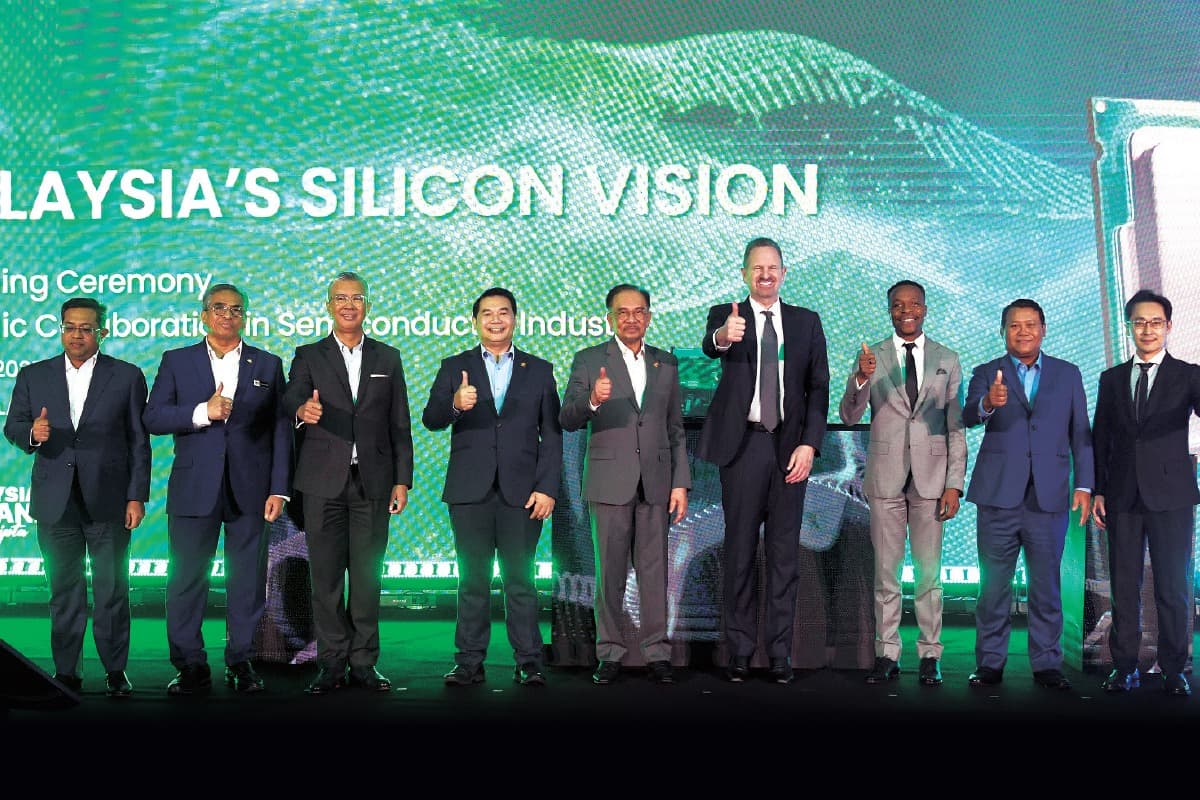
This article first appeared in The Edge Malaysia Weekly on January 5, 2026 - January 11, 2026
FOR Malaysia, 2025 was supposed to be the year it decisively climbed the semiconductor value chain, moving beyond assembly lines and establishing itself as a regional artificial intelligence (AI) and chip design hub. Instead, the journey unfolded amid intensifying geopolitical crosswinds, as Washington’s and Beijing’s deepening tech rivalry repeatedly pulled Kuala Lumpur into the spotlight.
The year began with a jolt. Just days before leaving office, then US president Joe Biden unveiled the controversial AI Diffusion Rule, placing Malaysia in Tier 2 of a global access framework that capped the country’s ability to import advanced AI chips such as graphics processing units (GPUs) at 50,000 units over two years. For a nation positioning itself as a regional AI hub, the message was unmistakable: Malaysia was welcome in the supply chain, but not yet trusted at its cutting edge.
The AI Diffusion Rule, which faced heavy criticism from the US-based Semiconductor Industry Association and US tech giant Nvidia Corp, was eventually scrapped in May by the Trump administration for being “overly complex” and “overly bureaucratic”.
Still, technology stocks, data centre plays and AI proxies on Bursa Malaysia experienced knee-jerk reactions, amid growing scrutiny over the movement of high-performance AI chips in Southeast Asia.
That unease intensified when Singapore charged three individuals — Singaporeans Aaron Woon Guo Jie and Alan Wei Zhaolun, and Chinese national Li Ming — in March over alleged fraud involving Nvidia-powered servers from Super Micro and Dell. The equipment was reportedly routed through Singapore before being exported to Malaysia. The investigations, coinciding with Washington’s scrutiny of possible export-control circumvention in Southeast Asia, sent shockwaves through the region’s tech ecosystem.
One immediate casualty was electronics manufacturing services (EMS) provider NationGate Holdings Bhd (KL:NATGATE), Nvidia’s sole contract manufacturer for AI servers in Southeast Asia. Its shares plunged nearly 30% to RM1.30 on March 3, forcing management to publicly distance the company from the case. The group’s co-founder and managing director Datuk Ooi Eng Leong clarified to The Edge that the court case involved a company that was an Nvidia Cloud Partner (NCP) and had nothing to do with NationGate.
Delicate balancing act
Yet amid these tensions, Malaysia pressed ahead with its ambitions.

In March 2025, the government announced a landmark US$250 million (RM1 billion), decade-long deal with British chip architect Arm Holdings plc, owned by SoftBank Group Corp, to secure semiconductor licences and technical know-how. The aim: to seed 10 local chip companies expected to generate up to US$20 billion in annual revenue, and to produce Malaysian-designed chips in five to seven years.
Prime Minister Datuk Seri Anwar Ibrahim described the Arm partnership as the “second semiconductor wave” and “one of the most ambitious technological plans Malaysia has ever seen”. For policymakers, the Arm deal was about more than technology; it was about escaping the middle-income trap by owning intellectual property rather than merely assembling it.
But geopolitics refused to stay in the background.
In April, the Trump administration imposed a 24% reciprocal tariff on selected Malaysian exports — later postponed, then revised — adding fresh uncertainty to global trade flows. While semiconductors remained exempt, US President Donald Trump repeatedly floated the idea of punitive sector-specific tariffs, threatening rates as high as 300% for countries without US-based chip manufacturing.
At the same time, Malaysia’s deepening ties with China drew renewed attention.
On the evening of April 15, Chinese President Xi Jinping arrived in Kuala Lumpur for a three-day state visit to Malaysia, his first in 12 years, as part of his Asean tour.
Malaysia and China had established diplomatic relations on May 31, 1974, and marked the 50th anniversary of this historic moment in 2024.
At a time when Trump was imposing tariffs around the world, Xi seemed to be winning over friends by stressing the importance of mutual respect and beneficial cooperation.
He remarked that both China and Malaysia were major developing countries and members of the Global South. Therefore, deepening high-level strategic cooperation was good for the common interests of both China and Malaysia, and for peace, stability and prosperity in the region and the world.
“Together, we will open up a new chapter in the annals of our good neighbourly ties and mutually beneficial cooperation, and begin another 50 golden years in China-Malaysia relations,” he said during the state visit.
The Trump administration, meanwhile, maintained pressure from afar. In letters dated July 7, the White House formally notified the King of Malaysia and Putrajaya that a sweeping 25% import tariff would be imposed on all Malaysian products entering the US effective Aug 1. Semiconductors were not specifically mentioned in the letter notifying Malaysia of the tariff.
Malaysia, the world’s sixth-largest semiconductor exporter, found itself balancing between two superpowers while remaining indispensable to both. The country commands 13% of the global market for semiconductor packaging, assembly and testing, a segment that contributed 40% to the nation’s exports.
The US is Malaysia’s third-largest destination for semiconductor exports. In 2024, the country shipped US$16.2 billion worth of chips to the US, making up almost 20% of all US semiconductor imports.
On July 31, the White House announced that the reciprocal tariffs on Malaysian goods would be lowered to 19%. The rate was later formalised in the Agreement on Reciprocal Trade, signed between the US and Malaysia on Oct 26 during Trump’s historic visit to the country.
As it stands, Malaysian semiconductors remain exempt from US tariffs. However, Trump repeatedly threatened sector-specific tariffs on semiconductor imports from countries without US-based manufacturing.
That balancing act became more precarious in May, when a casual remark by Deputy Communications Minister Teo Nie Ching suggesting that Huawei Ascend chips would anchor Malaysia’s AI ambitions, triggered a backlash in Washington. She also claimed that Malaysia would be the first to use Huawei’s AI servers on a national scale.
The comment was swiftly amplified by David Sacks, a close ally of Trump known for his outspoken views on AI and cryptocurrency, on social media. Sacks used Malaysia as an example of how China was trying to push its Huawei-related tech stack internationally.
This led the Ministry of Investment, Trade and Industry (Miti) to clarify that Malaysia had no involvement in the Huawei AI project. Teo also retracted her statement.
The geopolitical risks continued to manifest domestically, when a report by The Wall Street Journal (WSJ) in June claimed that four Chinese engineers had flown to Malaysia from Beijing, each carrying a suitcase with 15 hard drives containing 80 terabytes of spreadsheets, images and video clips for training an AI model.
According to WSJ, the engineers’ employer had rented about 300 servers containing advanced Nvidia chips to feed the data, build the AI model and bring it back home, a plan that took months of preparation.
Miti stressed that “Malaysia stands firm against any individual or company that attempts to circumvent export controls or engage in illicit trade activities”.
In mid-July, the ministry announced that Malaysia would immediately subject all exports, transshipments and transits of high-performance AI chips of US origin to a strategic trade permit.
Then minister of investment, trade and industry Tengku Datuk Seri Zafrul Abdul Aziz noted, however, that Malaysia had found no evidence of high-performance chips being smuggled out of the country.
He reiterated that Malaysia supported rules-based trade and the country was “in compliance with the international standards and obligations”.
In October, The New York Times reported that a little-known firm called Megaspeed, which had set up a unit in Malaysia to buy nearly US$2 billion worth of Nvidia chips, was under investigation by the US and Singapore.
The newspaper alleged that the Singapore-based company funnelled the chips to data centres in Malaysia and Indonesia that appeared to remotely serve customers in China.
It was reported that Megaspeed’s Malaysian subsidiary Speedmatrix Sdn Bhd had, between June 2024 and June 2025, received more than 200 shipments of restricted Nvidia technology barred from being sent to China.
Building chips and credibility at home
Despite the ongoing regulatory challenges, domestic advancements accelerated. On Aug 25, home-grown chip design house SkyeChip Sdn Bhd, which is planning a Main Market listing, unveiled the MARS1000, Malaysia’s first edge AI processor.
Although SkyeChip’s edge AI chip is not as powerful or complex as Nvidia’s advanced GPUs, it still represents an important step for the development of advanced local technological capabilities.
On Oct 31, it was announced that Malaysia’s first Nvidia-powered AI data centre in Kulai, Johor — developed by YTL Power International Bhd (KL:YTLPOWR) and powered by Nvidia’s latest liquid-cooled NVL72 Grace Blackwell (GB 200) GPUs — had become operational.
The announcement followed a meeting between Prime Minister Anwar, Nvidia CEO Jensen Huang and YTL Power managing director Datuk Seri Yeoh Seok Hong during the Apec Leaders’ Economic Summit 2025 held in Gyeongju, South Korea.
Huang had previously joked that Anwar is the only prime minister in the world with “AI” in his name. The two first met in December 2023.
The year closed with another vote of confidence. Intel Corp announced an additional RM860 million investment to anchor Malaysia as its global assembly and test hub. The company is led by Malaysian-born CEO Tan Lip-Bu — a reminder of the country’s deep human capital ties to Silicon Valley. Tan met with Anwar in Putrajaya on Dec 1, 2025.
He then visited Penang on Dec 3 to meet Chief Minister Chow Kon Yeow and InvestPenang CEO Datuk Loo Lee Lian.
Taken together, 2025 was an eventful year for Malaysia, marked by high-profile visits from Xi, Trump and Intel’s Tan, as well as the strategic meeting between Anwar and Nvidia’s Huang.
While these engagements highlight Malaysia’s growing prominence in the global semiconductor and AI landscape, the country will continue to face increasingly complex challenges in maintaining its neutral stance amid the intensifying US-China chip rivalry. Its challenge is no longer simply to climb the value chain.
See also "Ministerial reshuffle raises questions over NSS and Arm deal, but industry worries run deeper"
Save by subscribing to us for your print and/or digital copy.
P/S: The Edge is also available on Apple's App Store and Android's Google Play.