

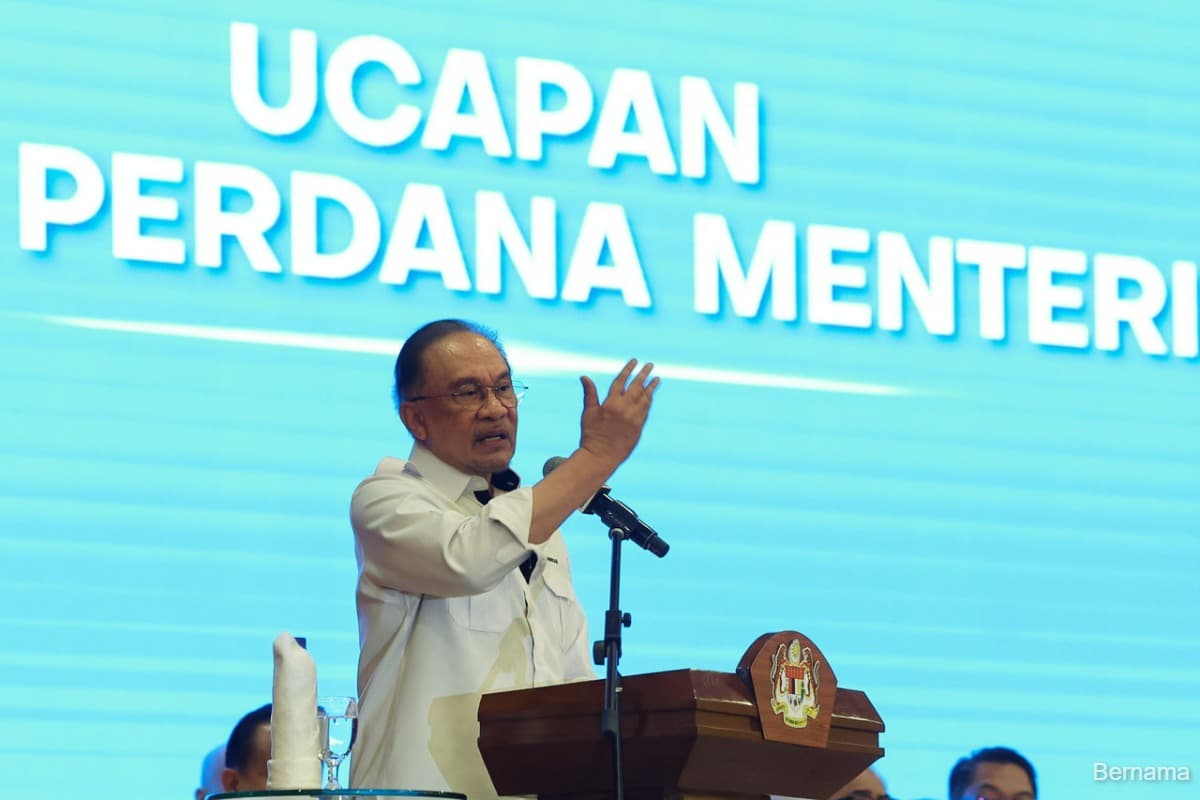
KUALA LUMPUR (Jan 5): Prime Minister Datuk Seri Anwar Ibrahim announced steps to fulfil some long-promised reforms as he reaffirmed the government’s fiscal and administrative commitments.
In his New Year address on Monday, Anwar framed 2026 as a test of execution rather than mere policy intent, stressing that current political stability must now translate into tangible improvements in governance and service delivery as well as improvements to cost-of-living pressures.
Decisive action must be taken to fix long-standing governance weaknesses while the administration still holds power, he said.
“That is when we must do everything we can to cleanse the country of rot and the entrenched culture of corruption,” Anwar said during the Prime Minister’s Department’s monthly assembly in Putrajaya.
The measures announced on Monday, including a bill to limit the country’s chief executive term to two terms or 10 years, follow overwhelming losses suffered by Pakatan Harapan coalition, which Anwar leads, at the recent Sabah state polls.

While the 16th general election is not due until February 2028, the reform push outlined on Monday comes against a tightening electoral calendar. Melaka’s state legislative assembly is due to expire in December 2026, followed by Sarawak’s in February 2027, potentially shaping the timing of the national polls.
Governance and institutional reform


Anwar said legislative reforms would remain a central priority when Parliament reconvenes on Jan 19, beginning with a bill to separate the powers of the public prosecutor and the attorney general.
He confirmed plans to table legislation to impose a 10-year term limit on the prime minister, alongside similar tenure limits for senior civil service positions, arguing that leadership renewal was necessary to sustain reform momentum.
An Ombudsman Bill, aimed at strengthening public accountability and creating an avenue for citizens to lodge complaints against public authorities, will also be tabled, he said.
Further, the government also plans to introduce a freedom of information law, with safeguards for national security, to improve transparency in public procurement, contracts and government decision-making.
Anwar reiterated his call for tougher enforcement against corruption across politics, the civil service and enforcement agencies, while stressing that investigations must continue to adhere to due process and the rule of law.
Civil service delivery and digitalisation
A major theme of the speech was the performance of the civil service, with Anwar warning that public expectations had risen following recent wage adjustments.
He said the government’s decision to raise civil service salaries, at an estimated additional cost of RM18 billion, must be matched by faster approvals, reduced bureaucracy and improved service quality.
“This was not driven by demands from the civil service. It was because we saw the increase in responsibilities, and the fact that salaries had not been reviewed for 12 years. This is simply about fulfilling their rights, and as head of the government, I must begin by ensuring fairness to our civil servants," he said.
Anwar called for an accelerated shift towards digital government, directing ministries and agencies to expand online services and begin integrating artificial intelligence tools into administrative processes.
The 2026 General Expenditure Warrant was issued on Dec 31, 2025 to speed up project implementation and reduce delays, he noted. Small-scale infrastructure projects, including rural roads, schools and clinics, were singled out as priorities for immediate execution.
Cost of living and household support
Addressing cost-of-living concerns, Anwar said targeted assistance programmes would continue in early 2026, including cash aid and in-kind support for lower-income households.
Monthly assistance under the Sumbangan Asas Rahmah programme of up to RM200 will be credited in stages beginning Jan 9, while the first phase of Sumbangan Tunai Rahmah payments will begin later on Jan 20.
The government will also expand price-controlled sales initiatives under the Jualan Rahmah Madani programme, with thousands of events planned nationwide to offer basic goods at discounted prices.
Tax relief measures for small and medium enterprises, including exemptions and transition periods for e-invoicing and service tax adjustments, were also outlined to address sore points raised by many trade associations and industries.
Read also:
E-invoicing: Govt grants businesses with up to RM5 mil turnover another year to comply
Malaysia expands Sara programme: Monthly payments from Jan 9, one-off RM100 on Feb 9
Service tax on rentals for Malaysian MSMEs reduced to 6%
Expenditure warrant issued, PM orders fast-tracking of small projects
RM800m allocated for one-off early schooling aid — PM
PM directs ministries to expedite shift to online processes
Anwar: Govt may relax import conditions to keep construction costs low