

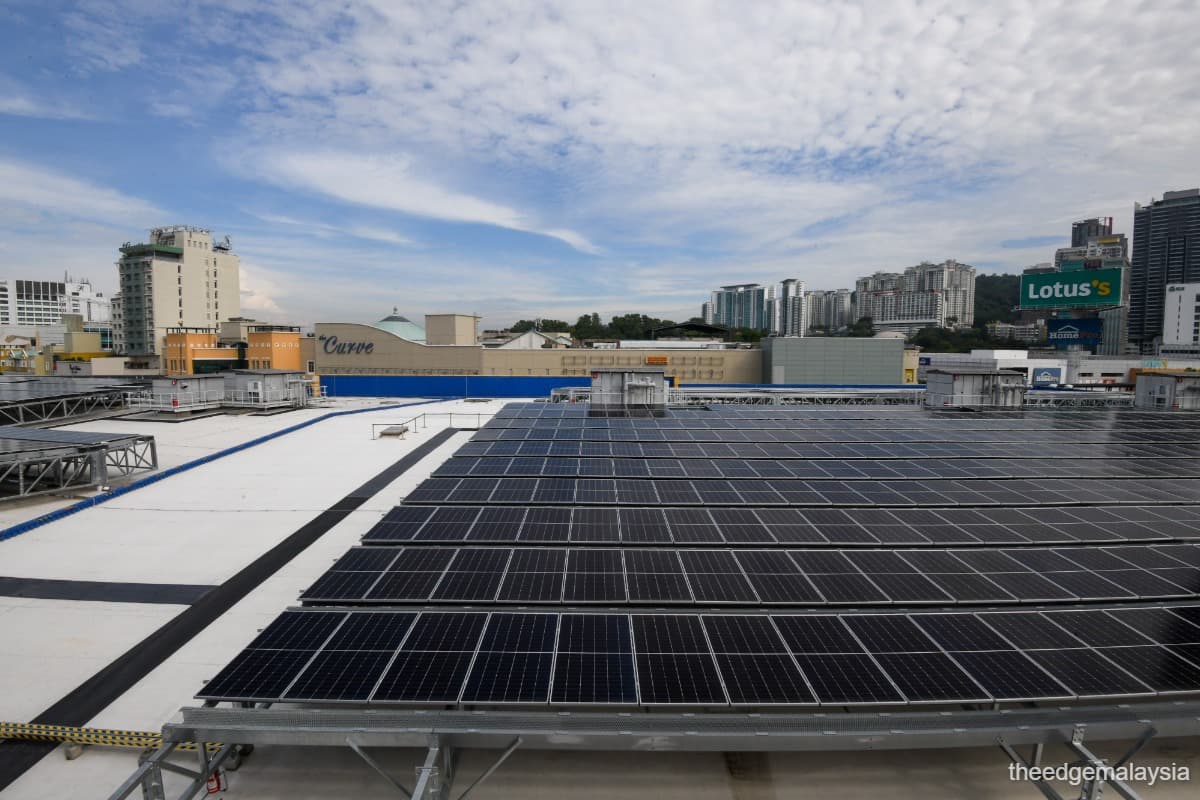
KUALA LUMPUR (Jan 5): Malaysia's impending solar-led wave of power infrastructure development is expected to drive strong order books and earnings, a research house said, while urging investors to position themselves in contractors with direct solar exposure to the upcoming build-out.
The combined pipeline of about 4GW from Large Scale Solar 5 (LSS5) and LSS5+ programmes will generate incremental demand across both Tenaga Nasional Bhd’s (KL:TENAGA) interconnection facilities and solar power producers’ interconnection works, Hong Leong Investment Bank (HLIB) said.
"We highlight MN Holdings Bhd (KL:MNHLDG), Jati Tinggi Group Bhd (KL:JTGROUP), and ES Sunlogy Bhd (KL:SUNLOGY), all of which have an established track record executing interconnection facilities works for Tenaga," HLIB said in a research report on Monday.
Interconnection facilities typically account for about 30% of solar engineering, procurement, construction and commissioning (EPCC) contract value.
Based on this, HLIB estimated an addressable power infrastructure market of approximately RM3.6 billion from LSS5 and LSS5+ in 2026 alone.
Separately, the research firm estimated that LSS5 and LSS5+ could generate about another RM1.6 billion of cable demand, broadly comparable with Tenaga’s current RM1.9 billion 1+1 long-term cable contract.
On the EPCC front, HLIB expects robust order books to translate into downstream wins for power infrastructure players, notably Kee Ming Electrical Sdn Bhd via Solarvest Holdings Bhd (KL:SLVEST), ES Sunlogy via Solarvest, and MN Holdings via Samaiden Group Bhd (KL:SAMAIDEN), ERS Energy Sdn Bhd and Leader Energy Group.
Overall, the bank noted that 2026 is shaping up to be "a particularly strong year", which will further expand demand for grid and substation works.
It said call-ups from Tenaga are expected to increase in 2026 as deferred 2025 capital expenditure normalises following the tax overhang.
HLIB’s top picks for the power sector are MN Holdings and Southern Cable Group Bhd (KL:SCGBHD).
Across the value chain, HLIB views that mechanical and electrical contractors and cable manufacturers are expected to see their earnings momentum extend into 2026, while mechanical, electrical and plumbing players are likely to remain near-term laggards.