

This article first appeared in Capital, The Edge Malaysia Weekly on December 29, 2025 - January 4, 2026
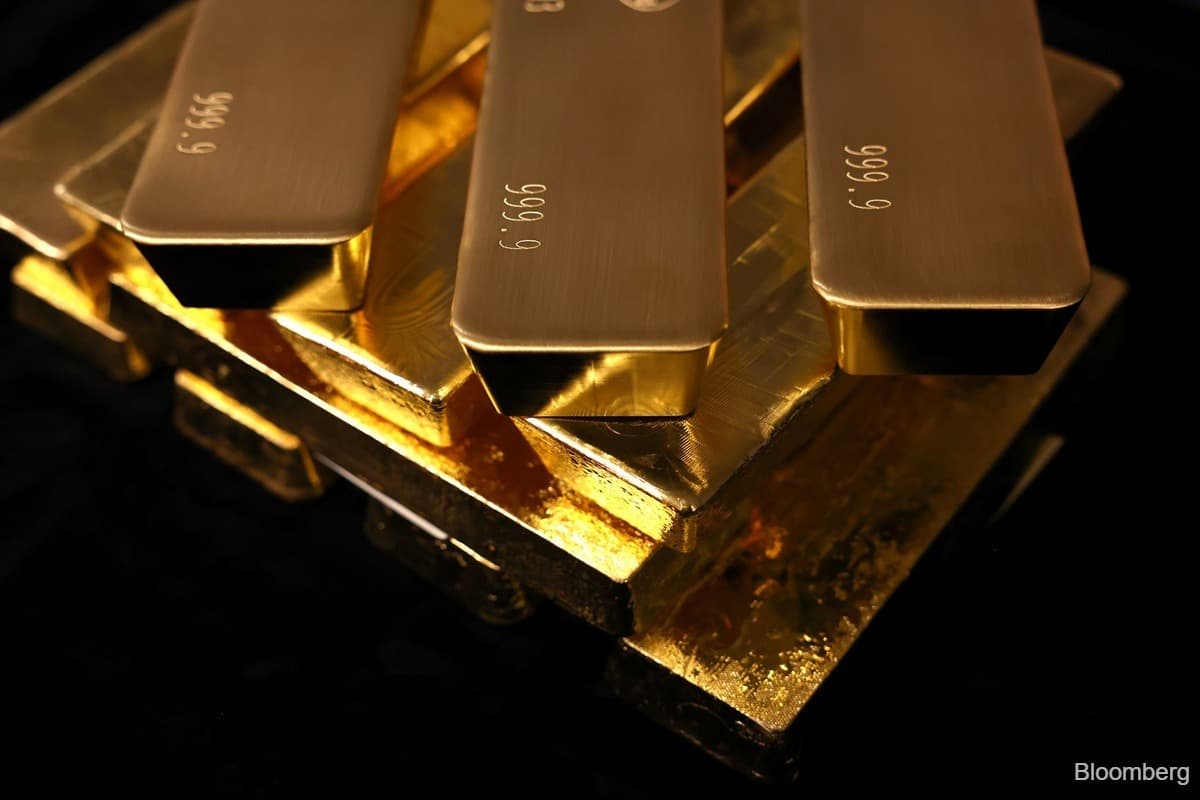
GOLD has been a standout asset class this year as it surged to record highs, extending a rally driven by geopolitics, expectations of US interest rate cuts, central bank accumulation and US dollar weakness to keep bullion firmly on investors’ radar screens throughout 2025.
“Gold has thrived on strong safe haven flows, with 2025 offering plenty of uncertainty; central bank purchases, motivated by a desire to diversify away from the US dollar; and ETF (exchange-traded fund) inflows combined with a softer US dollar and growing expectations of the US Federal Reserve easing drove prices to fresh highs,” BIMB Securities director of research Redza Rahman tells The Edge.
For the year to Dec 19, spot gold rose by 64.8% to US$4,326 per oz after tapering from a peak of US$4,356.30 on Oct 20. This coincides with the Fed cutting the policy rate by 25 basis points (bps) three times this year, bringing the federal funds rate down to a range of 3.5%-3.75% in December.
As the US dollar loses strength, with lower interest rates, central banks diversified away from the greenback, particularly those of China, Brazil, Turkiye, India, Kazakhstan and Poland, which have been accumulating gold at a pace not seen in years.
According to the World Gold Council in a Dec 2 note, central bank demand for gold remained robust in October, totalling 53 tonnes (+36% month on month) and continuing the strong trend seen throughout the year.
“A familiar set of buyers, led by a resurgent National Bank of Poland, drove the gains [in October],” said the council, adding that the National Bank of Poland (83 tonnes) continues to be largest official-sector gold buyer, with double the purchases of the next largest buyer, Kazakhstan (41 tonnes).

Meanwhile, the People’s Bank of China (PBoC) reported gold purchases 12 months in a row. It added 0.9 tonnes in October, lifting the total to 2,304 tonnes, making up 8% of the country’s foreign exchange reserves. China alone has boosted its official reserves for 18 consecutive months, reflecting a global shift towards de-dollarisation and diversification of national holdings.
The World Gold Council estimates that central banks purchased over 1,000 tonnes of gold in 2024 and are on track for another strong year, reinforcing the undercurrent beneath bullion’s climb.
At the time of writing, the Central Bank of Russia was the only bank to report a decline in gold reserves in October as it fell by three tonnes to 2,327 tonnes.
“For gold, October was a tale of two halves. The metal initially soared, setting successive records on various risks and strong ETF buying, before cooling later in the month as geopolitical concerns eased and profit-taking emerged,” notes the World Gold Council.
In October, HSBC forecast that gold’s bull rally would drive prices as high as US$5,000 per oz in the first half of 2026, supported by elevated risks and the impact of new entrants in the market, while Deutsche Bank in November raised its 2026 gold price forecast to US$4,450 per oz from US$4,000.
ING, in its 2026 Gold Price Outlook published on Dec 8, predicted the gold rally will continue in 2026, with prices to average US$4,325 per oz, while Goldman Sachs said on Dec 12 that it sees significant upside to its year-end gold price forecast of US$4,900 per oz for 2026.
“Several investors have recently called for positive gold allocations,” say the firm’s analysts, citing the current low levels of gold positioning and the potential shifts in diversification trends, which could bolster the precious metal’s appeal.
ETF surge reflects gold’s impact in portfolios
As bullion prices soared, gold-backed ETFs worldwide experienced a powerful resurgence as investors turned to paper gold for ease of access and exposure without storage risk.
Globally, gold-backed ETFs have seen some of the strongest inflows in years — more than US$8 billion in October alone, according to the World Gold Council. Its data shows that these ETFs saw inflows for five months in a row, with “global ETFs just two months away from recording what looks to be their strongest year on record”.
“The inflows this year were not simply a geopolitical hedge,” OCBC FX strategist Christopher Wong tells The Edge. He explains that they reflect a broader re-risking of gold in institutional portfolios as the real-rate cycle turns.
“If volatility in rates and geopolitics persist, then ETF demand should remain healthy, though perhaps not at the same pace seen in 2025’s breakout. The bigger shift is that gold is slowly moving from a ‘nice-to-have’ to a core strategic allocation for investors, who view it as a hedge against policy and currency uncertainty, not just inflation.”
Data from the World Gold Council shows that global physically backed gold ETFs registered their sixth consecutive monthly inflow, adding US$5.2 billion in November (see Chart 1) to sit above the 2024 monthly average of US$292 million despite a narrower flow compared with previous months. Total assets under management (AUM) reached US$530 billion (RM2.1 trillion), up 5.4% on the month and marking another month-end peak, thanks to continued inflows and a stronger gold price. The council noted November’s trend was mainly driven by Asia, where investors continued to buy gold ETFs at pace, while North American inflows slowed significantly from October as European demand flipped positive.
For Malaysian investors, the conversation inevitably extends to the question of ETFs’ convenience and safety versus physical gold.
BIMB Securities’ Redza points out that ETFs offer a more efficient and liquid way to gain exposure to global gold prices and indirectly to the US dollar without dealing with storage, security or wide buy-sell spreads.
Physical gold still appeals to those who prefer tangible assets, but comes with higher dealing spreads and storage constraints.
“The challenge is changing people’s mindset on investing in physical gold and choosing ETFs as a safer alternative,” he says. In practice, he emphasises a balanced approach — ETFs for efficiency and physical gold for long-term preservation — as the most practicable strategy for local investors.
US dollar’s impact on gold
Notably, the US dollar remains the single most important factor driving demand for gold. Most of the foreign exchange experts The Edge spoke with expect the greenback to weaken as expectations of the US Federal Reserve’s easing cycle next year will erode the dollar’s carry advantage.
Cedric Chehab, chief economist at business intelligence firm BMI (a unit of Fitch Solutions), believes the US dollar is unlikely to strengthen or weaken significantly next year. He tells The Edge that the US Dollar Index will likely trade within a range of 100 to 95 points, driven by a combination of bullish and bearish dynamics.
“On the bearish side, interest rate cuts, concerns about the Fed’s independence, still sticky inflation and a pickup in growth in Germany could see some slight downside pressure on the currency. On the bullish side, the US economy has proved to be more resilient than we had expected and the fiscal deficit narrowed slightly in 2025, which is a positive for the US dollar. Lastly, the corporate sector remains strong, and we expect robust earnings growth next year,” he says.
Sideways trading for the US dollar means there is limited impact on the broader commodity complex, and as such, performance will predominantly be driven by underlying supply and demand fundamentals for the commodity in question.
BMI also stands out for its bearish call on gold, predicting an average of US$3,700 per oz in 2026, meaning prices could fall below US$4,000 as the easing cycle loses momentum and global economic conditions stabilise. With tariff uncertainty receding and most US dollar downside “behind us”, BMI argues that the precious metal’s historic rally is likely to fade by the third quarter of 2026.
Meanwhile, BIMB’s Redza expects the US dollar to weaken on further interest rate cuts and forecasts the ringgit to strengthen to 4.10 against the greenback.
“Assuming one cut, we forecast the ringgit to strengthen to the 4.10 level against the US dollar. With gold, its inverse correlation with the dollar plus its role as an inflation and real-rate hedge means a softer US dollar. Lower real yields should keep gold supported at around the US$4,100 to US$4,300 per oz level,” he predicts.
OCBC’s Wong believes a softer US dollar, combined with accommodative financial conditions, would be a tailwind for both gold and silver (see accompanying story on commodities).
OCBC has been bullish on gold, projecting it will reach US$4,600 per oz by mid-2026 and US$4,800 by year end, supported by easier financial conditions, a softer dollar and ongoing policy and geopolitical uncertainty.
“Think of 2026 as a year when two regimes overlap: Gold responds to geopolitics, US policy uncertainty and a softer dollar while industrial metals respond to China’s capex momentum, global manufacturing stabilisation and green energy transition,” says OCBC’s Wong.
“The key is not to treat these markets as contradictory. Historically, periods of US dollar softness and easier financial conditions can support both safe-haven and industrial metals. In short, gold is a volatility hedge and store of value while silver may offer asymmetric upside if global activity continues to hold up, Fed easing cycle stays on while artificial intelligence investment and green transition demand stay firm.”

What will move the metals market next year
Precious and industrial metals outperformed this year, leaving other commodities such as oil and gas, grains and soft commodities in the dust.
Commodities entered rare territory in 2025 as precious and industrial metals rallied for different reasons. Safe-haven flows and lower real yields lifted precious metals, while industrial metals rode supply disruptions, energy-transition demand and pockets of Chinese recovery.
Foreign exchange (FX) experts and economists have collectively described a commodity landscape where both segments can rise, but for different reasons.
“Silver has been an outperformer, soaring 111% year to date. This was one of its strongest in recent decades and the outperformance also outpaced other precious metals, including gold. The surge reflected severe market tightness, strong macro tailwinds and spillover strength from gold,” OCBC FX strategist Christopher Wong tells The Edge.
“We believe the story is still constructive for silver but do mind the volatility. Silver benefits from its dual role as a precious and industrial metal. Its safe-haven appeal mirrors gold’s drivers, while the green transition doesn’t stop in 2026 [as] solar and electric vehicle (EV) build-out will continue to support industrial demand. The US Federal Reserve’s easing cycle, alongside a softer US dollar, is generally a friendly backdrop for precious metals, including silver. And silver resides in a sweet spot within the commodities complex that’s supported by tight supply, firm industrial demand, exchange-traded fund (ETF) inflows while on the other hand, global growth still holds up and the Fed easing expectations stay intact.

“The same set of drivers driving gold is also supportive of silver, but silver has higher volatility. So as much as silver offers more upside, it can also see greater drawdown than gold.”
Cedric Chehab, chief economist at BMI, highlights a second major theme, which is industrial use accounting for about 60% of the total silver demand and a large part of that are electronics and photovoltaics. He notes that the other big surprise has been around industrial metals, which are up about 20% this year.
“These metals do not typically benefit directly from central bank buying and are typically vulnerable to geopolitical risks as this can negatively impact final demand. However, this year, metals like copper have risen by about 33%, driven in large part by four trends,” he says.
First, the continued focus on the green transition. Second, EV production is rising rapidly, creating another major source of demand for industrial metals. Third, major investments in data centres also place upside demand on copper consumption. Lastly, there has been a significant shift towards greater industrial policy in many developed economies, and particularly the Trump administration, which is boosting demand for industrial metals, says Chehab.
Amid global mine disruptions and strong momentum on the demand side, UBS in a Nov 25 note lifted its copper price forecasts for successive quarters of 2026, beginning with US$11,500 a tonne for March, followed by US$12,000 and US$12,500 for June and September respectively. It also introduced a first target for December at US$13,000 a tonne.
Meanwhile, nickel and other battery-metal inputs underperformed relative to other base metals this year due to persistent oversupply especially from expanded Indonesian output and weaker EV battery demand, keeping prices around multi-year lows.
Major analysts, including UBS and Wood Mackenzie, forecast the nickel market will remain in surplus through 2026, with price expectations largely subdued in the US$15,400 to US$16,000 per tonne range this year. In 2021, nickel averaged around US$18,500 to US$20,000 per tonne, supported by strong stainless steel demand and early EV momentum.
“Top commodities to watch in 2026 include gold and silver amid continued flow dynamics and silver’s industrial and investor demand; copper as supply disruptions make the metal a top structural story; and battery-related metals like nickel, lithium and cobalt. Pay close attention to preference metals by EV makers and demand dynamics to chart price movements. For oil and gas, keep your eyes peeled for energy security and restocking dynamics. And platinum group metals, for which demand will be driven by auto fleet choices, emission rules and substitution economics,” says BIMB Securities director of research Redza Rahman.
He notes that as the global outlook brightens, spending picks up and inventories tighten, the industrial side of the market will gain momentum. Commodities like copper, oil and aluminium start moving on real economic demand, while gold becomes more of a passive defensive holding.
“In this situation, the recommended approach is to treat gold as your stabiliser and industrial commodities as your opportunity engine, adjusting the mix depending on whether you expect 2026 to be driven more by caution or by growth,” says Redza.
Save by subscribing to us for your print and/or digital copy.
P/S: The Edge is also available on Apple's App Store and Android's Google Play.