

This article first appeared in The Edge Malaysia Weekly on December 22, 2025 - December 28, 2025
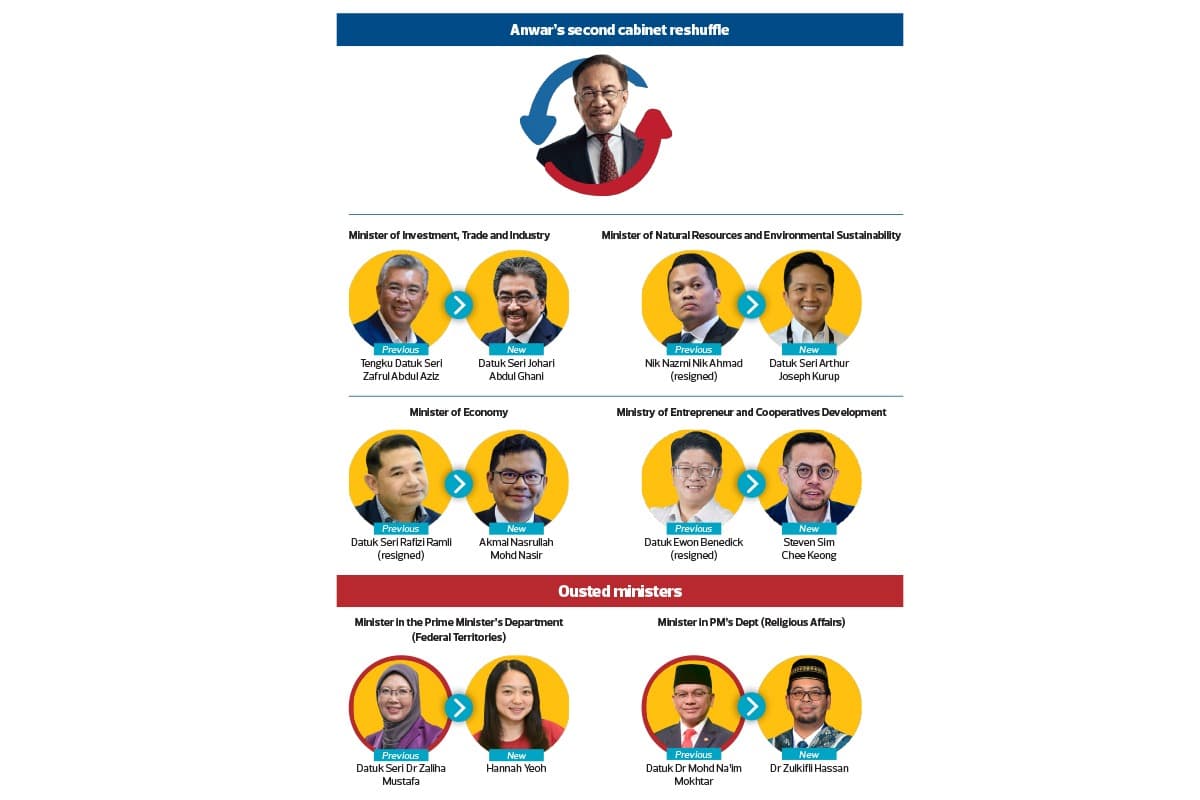
THE recent cabinet reshuffle by Prime Minister Datuk Seri Anwar Ibrahim, following the sobering outcome of last month’s state election in Sabah, reflects the growing influence of regional parties in the country’s political equation. The cabinet spruce-up also shows Anwar’s ability to negotiate and contain the political turmoil that has rocked the Madani government over the past seven months, when key leaders had a falling out over its reform agenda and quit.
Political pundits The Edge spoke to agree that the second reshuffle of Anwar’s three-year-old cabinet steadies the ship without rocking the boat, in preparation for three upcoming state elections, as well as the general election that must be called by Feb 17, 2028.
“Anwar Ibrahim stayed consistent with his style — incremental reshuffle, not a shock overhaul,” says Datuk Dr Sivamurugan Pandian, professor of political sociology at Universiti Sains Malaysia. “It’s about stabilising the coalition, fixing performance gaps and keeping political balance, rather than signalling a major policy reset.”
The much-anticipated reshuffle shows Anwar responding to the disaffection of the Chinese and urban voters — a core vote bank of his Pakatan Harapan (PH) coalition — over the unsatisfactory handling of a laundry list of issues ranging from access to education to pervasive corruption to impunity. At the same time, readings of the Malay political pulse have made it imperative to turn back the conservative tide that swept across the Malay heartland in the 15th general election.
A key move to placate non-Malay voters, whose unmet expectations of political and institutional reforms may prove costly in the elections, can be seen from the appointment of two rising stars — Hannah Yeoh as Minister in the Prime Minister’s Department (Federal Territories) and Steven Sim Chee Keong as Minister of Entrepreneur and Cooperatives Development.
Both ministers were part of Anwar’s previous cabinet. Segambut MP Yeoh was the minister of youth and sports while Bukit Mertajam MP Sim was the minister of human resources.

Both Yeoh and Sim are deputy secretaries-general of the Democratic Action Party (DAP). Their new appointments — especially that of Yeoh — allows DAP to play a more significant role in addressing the issues of the Chinese middle-class and business community.
This follows the DAP’s disastrous showing during the 17th Sabah state election in November, where it lost all the seats it contested, including incumbent seats such as Luyang and Likas, which the party won with overwhelming majorities in 2018 and 2020.
“The DAP must be empowered to play to its own gallery — the Chinese and urban voters. While DAP ministers hold senior positions in Anwar’s cabinet, these portfolios are not skewed towards DAP vote banks,” says a political observer.
The party’s secretary-general Anthony Loke Siew Fook is transport minister while its national chairman Gobind Singh Deo is digital minister. Minister of Housing and Local Government Nga Kor Ming is deputy national chairman of the DAP.
With the massive loss in the Sabah elections, as well as the belligerent stance of populist leaders like Umno youth chief Dr Akmal Salleh, DAP’s own “champions” feel compelled to match their rhetoric to win the hearts and minds of their steadfast supporters. If left unchecked, this game of one-upmanship could lead to rockier conditions within the Madani government.
DAP elder leader Lim Guan Eng, a former Penang chief minister and finance minister in the first PH government under Tun Dr Mahathir Mohamad, urges the government to implement a 10-step agenda to turn the tide of ebbing Chinese support for PH.
This includes channelling a 10% allocation to non-bumiputera groups to balance the bumiputera allocation without reducing the existing provisions for the latter, as well as reviewing the expansion of the sales and service tax’s (SST) scope, which is turning into a significant drag on the businesses of the Chinese voter base.
Cabinet minister Nga also urged the government to recognise the Unified Examination Certificate (UEC) qualification, which has drawn criticism from right-wing Malay politicians, making Anwar’s position more precarious in the eyes of the Malays.
After the Sabah voters’ rebuff, DAP was forced to appease its loyal supporters by sending a strong signal that it was ready to take drastic action to limit its political liabilities, announcing a six-month cooling-off period before it reassesses its position within the Madani unity government. DAP could then decide whether to stay in the cabinet, or pull out while still supporting Anwar as PM.
Therefore, Yeoh’s appointment to a senior position within the cabinet could alter the party’s trajectory, as DAP is being given a valuable chance to demonstrate what it can achieve for the party’s die-hard voters, political pundits observe.
As for Barisan Nasional (BN) — and specifically Umno — its role of garnering Malay support for the Madani government is also seen as strengthened with the appointment of Datuk Seri Johari Ghani to the investment, trade and industry portfolio.
Johari, who previously held the plantation and commodities portfolio, is seen as the right choice for his new role in view of his stature as a successful businessman, as well as being a well-liked Umno leader.
It also means that BN has regained the portfolio after Datuk Seri Tengku Zafrul Aziz switched parties early this year from Umno to Anwar’s Parti Keadilan Rakyat (PKR). BN also gained the Ministry of Natural Resources and Environmental Sustainability (NRES) portfolio from PKR this time round.
Meanwhile, Anwar also rewarded Datuk Mustapha Sakmud, PKR Sabah’s state chairman, making him the Minister in the Prime Minister’s Department (Sabah and Sarawak affairs). This is despite the party managing to win only one seat in the Sabah state election.
Critics don’t believe the new appointments will bring change
However, some analysts do not think the new appointments will stabilise the Madani government and regain the people’s confidence in the coalition, especially in Anwar’s PH. They point out that Yeoh’s appointment triggered criticism from right-wing Malay politicians and activists.
“As the first DAP and Chinese FT minister, she would face interconnected challenges — balancing the interests between residents and developers, including issues related to the Urban Renewal Act, as well as reforming City Hall,” says Wong Chin Huat, professor and political scientist at Sunway University. “She will also have to handle the smear campaigns that the opposition and some Malay right-wing groups have ready for her.”
In Wong’s view, Yeoh will either be a great success or a disastrous failure. “She can’t be an unnoticeable mediocre. It’s a risky move by Anwar but I would put my bet on her for now — she has the dedication and tact to carry out her challenging tasks.”
However, some political pundits also observe that appointing Yeoh to the FT portfolio is exactly what is needed for PH to galvanise support from non-Malay voters.
It could also lead to the Malaysian Chinese Association (MCA), which has long been agitating over its position in relation to Chinese representatives, back into the sphere of the Madani narrative, they opine, because it would be counter-productive to join the chorus of attacks against the DAP while the Malay right-wingers are doing so.
On Dec 7, MCA passed a resolution to quit BN should any of its components work with DAP in the next general election. Its party president Datuk Seri Dr Wee Ka Siong said such cooperation would signal that the BN spirit had effectively ceased to exist.
While PH and BN have yet to decide whether they would work together during the 16th general election (GE16), Umno president Datuk Seri Zahid Hamidi said in July that he is confident that cooperation with PH would ensure that they would retain the seats they won in the last general election.
Datuk Seri Puad Zarkashi, an Umno Supreme Council member and the speaker of the Johor assembly, said the party intends to continue working with PH, including DAP, in GE16. Earlier in October, DAP’s Nga said that the Perak chapters of BN and PH would cooperate in GE16.

“Yes, the reshuffle is clearly political as well as administrative. It’s meant to stabilise the PH-BN partnership after the Sabah setback and reposition the government ahead of upcoming state polls and the next general election,” says USM’s Sivamurugan. “The focus now is on a more electable, cohesive cabinet that can deliver and be seen as delivering to voters.”
However, Hisommudin Bakar, CEO of independent research firm ILHAM Centre, begs to differ. He fails to see how the reshuffling will stabilise the Madani government or regain the lost ground in the next two years before the next general election is called.
“In my opinion, Anwar is still confident in his own ability to regain the support of the people, even at a time where we see the people’s mood of rejecting the government is getting stronger,” he says.
He questions the appointment of Marhamah Rosli as deputy minister in the Prime Minister’s Department (Islamic affairs), who courted controversy over her involvement in collecting donations for the family of teenager Zara Qairina, whose death triggered a nationwide condemnation of the police and the Ministry of Education’s handling of the case. Marhamah was appointed as a senator on Dec 17.
He also sees the appointments of Yeoh and Sim as demotions rather than promotions from their previous portfolios. He opines that the appointment of Adam Adli Abdul Halim to the position of deputy minister of higher education opens him to attack from the opposition, as Adam used to be a vocal champion of free tertiary education as well as the abolition of the higher education fund PTPTN.
Internal PKR reconciliation or containment?
The reshuffle also saw the appointment of Akmal Nasrullah Nasir as the minister of economy, replacing Datuk Seri Rafizi Ramli, who resigned in May after losing the deputy president’s post to Nurul Izzah Anwar in the PKR election.
Akmal is known as an ally of Rafizi within PKR, having started his political career as the latter’s executive when Rafizi was chief executive of the Selangor government’s economic policy advisory office in 2009. In the 2025 PKR election, Akmal was part of Rafizi’s “HIRUK” camp.
However, despite Rafizi resigning from the cabinet, Akmal stayed on as the deputy minister of energy transition and water transformation. Akmal’s appointment as the minister of economy came as a surprise, as the role was seen to be reserved for a more senior PKR leader.
“Akmal Nasir is from Rafizi’s camp and a smart young leader in PKR. Promoting him to replace Rafizi is a reasonable choice as Akmal can be expected to do the technocratic task well, as the ministry only manages the EPU (Economic Planning Unit) and DoSM (Department of Statistics Malaysia),” says Sunway University’s Wong.
“It’s more planning than execution, unlike when Azmin (Ali) was the minister. It politically fits a new minister, for him to prove his prowess,” he adds. Unlike during the tenure of the Perikatan Nasional government between 2020 and 2022 when Datuk Seri Azmin Ali was the economic affairs minister, the current ministry only runs the EPU and DoSM.
However, the EPU’s inputs and feedback are required for all government projects. Therefore, the role played by the economic minister would still be central to the government’s agenda.
Anwar also retained Chang Lih Kang as the minister of science, technology and innovation, and appointed Syed Ibrahim Syed Noh, the MP for Ledang, as NRES deputy minister.
The appointments of the PKR MPs from Johor also signifies the party’s intention to close ranks before the state election, which will have to be called by June 20, 2027, which is about 1½ years away. Syed Ibrahim is Johor PKR chairman.
“By retaining Lih Kang and elevating Akmal Nasrullah and Syed Ibrahim, Anwar is signalling inclusivity over factionalism.
“It’s a clear message that PKR’s internal alignment is secondary to unity and stability. Anwar is neutralising post-Rafizi tensions by co-opting, not sidelining, that camp,” says Sivamurugan.
Akmal’s appointment as economic minister could also placate Rafizi by allowing his protégé to continue his programmes, political observers opine. One of Rafizi’s main programmes as minister of economy was the Centralised Database Hub, or Padu, which was supposed to be used as the database for the government’s social assistance as well as subsidy rationalisation. However, after Rafizi stepped down, the Ministry of Finance decided to undertake subsidy rationalisation without using data collated by Padu.
“Appointing Rafizi’s allies does not guarantee that Anwar would be able to regain the confidence of the pro-Rafizi faction who are disillusioned with him. The appointment of a few individuals also opens Anwar to criticism by the people,” says Hisommudin of ILHAM Centre.
Some also see the appointment of Akmal and Syed Ibrahim as Anwar’s move to contain Rafizi’s faction from continuously criticising the administration. Being a full-fledged minister, Akmal might have to toe the line and play the team’s game.
What is certain is that time is short as the new ministers only have about two years to prove to the people that the government is doing its best to improve their livelihood and address pressing issues that have created disunity and mistrust among the people.
Will they succeed?
Save by subscribing to us for your print and/or digital copy.
P/S: The Edge is also available on Apple's App Store and Android's Google Play.