

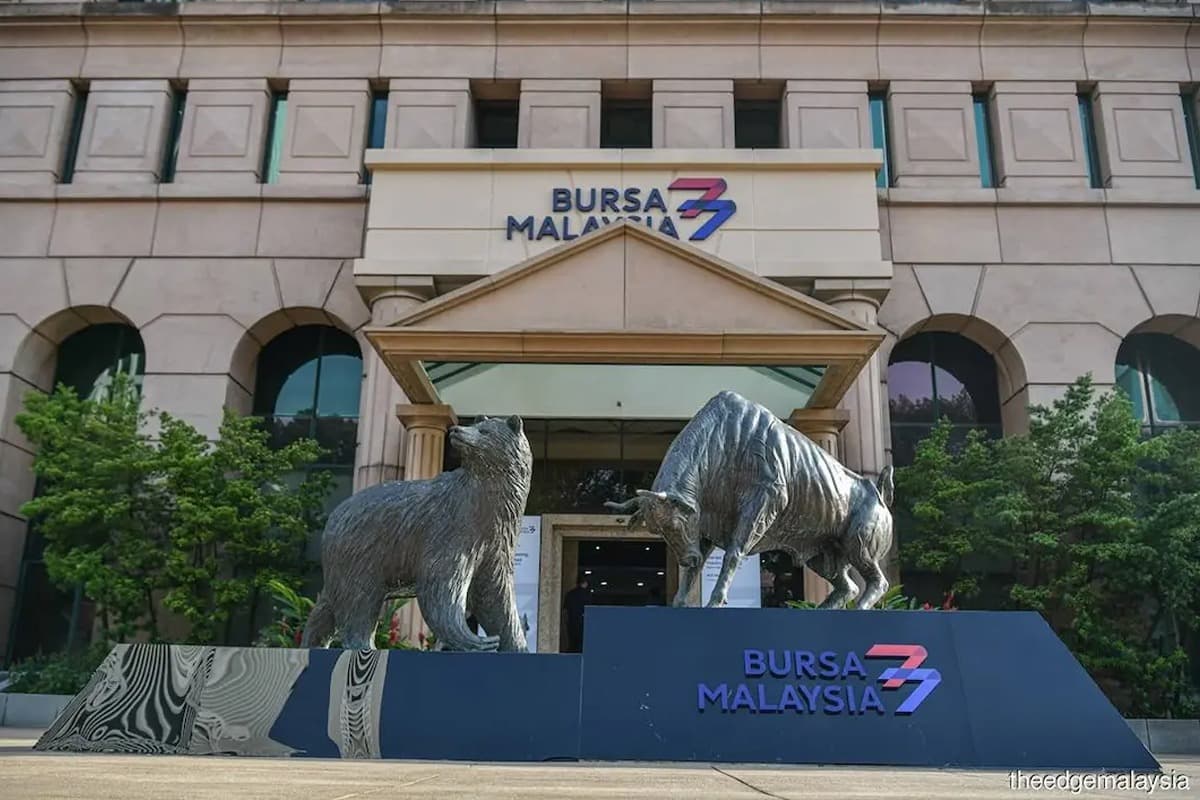
This article first appeared in Capital, The Edge Malaysia Weekly on December 22, 2025 - December 28, 2025
MALAYSIA’S stock market performance has been relatively flat this year, lagging behind the strong rallies seen in regional peers such as Japan, South Korea, Taiwan and Indonesia, whose indices have surged to record highs.
The benchmark FBM KLCI is up only marginally year to date (YTD), weighed down by market uncertainty stemming from US tariffs and lacklustre corporate earnings. The broader Emas Index, which tracks Main Market stocks, is down 4% over the same period, while the ACE Index has fallen 11.3%.
The FBM KLCI has been largely supported by heavyweight banking stocks, with the Financial Services Index remaining stable throughout the year. RHB Bank Bhd (KL:RHBBANK) led the pack with a YTD gain of 23.3%, followed by AMMB Holdings Bhd (KL:AMBANK) (+20.1%), Malayan Banking Bhd (KL:MAYBANK) (+6.9%) and Alliance Bank Malaysia Bhd (KL:ABMB) (+5.3%).
December is typically a month of gains for equities, buoyed by portfolio managers’ efforts to enhance year-end performance through window dressing. The FBM KLCI has gained 2.3% so far this month.
Ng Zhu Hann, CEO of Tradeview Capital Sdn Bhd, observes that the market sentiment this year has leaned more towards profit-taking, amid the net foreign fund outflow of about RM21 billion YTD — the largest since the net outflow of RM24.6 billion in 2020 — against net buying of RM20.3 billion by institutional funds.
“That is a very alarming level. While one could argue that some equity outflows have moved into the bond market, it does not send a very healthy signal to the equity market, and that is my biggest concern,” he tells The Edge.
He says local institutional funds have played their part in supporting the market, but their capacity is limited, while retail participation continues to decline.
“As for local funds, they have done what they can to provide support, but there is only so much they can do. Retail participation also keeps coming down,” he adds.
Foreign investors have remained net sellers of Malaysian equities in the final quarter of this year, with net outflows of RM4.32 billion as at Dec 12, compared with RM4.3 billion in 3Q, according to MBSB Research. In 1Q and 2Q, foreign investors net sold RM9.96 billion and RM2.16 billion worth of equities respectively. In 2024, net foreign selling amounted to RM4.21 billion.
On the prospects of a reversal in foreign fund flows in 2026, Ng says this will largely depend on the US interest rate trajectory, particularly whether cuts exceed current expectations of at least three reductions, which could bring the key policy rate closer to 2.5%. The US federal funds rate is currently in the range of 3.5% to 3.75% after three cuts this year.
“If rate cuts are in line with expectations, I don’t see a significant influx of foreign funds into our equity market in the near term, because if they were going to come in, they would have already done so,” he says.
He notes that the strengthening ringgit also reduces the appeal to foreign investors, unless there is a strategic shift from bonds to equities.
“It comes down to the rate differentials as fund managers seek the highest possible returns with the lowest risk. For now, the US bond market remains attractive, at least until further rate cuts materialise,” he adds.
Among the top-performing large-cap stocks YTD are 99 Speed Mart Retail Holdings Bhd (KL:99SMART) (+45.4%), United Plantations Bhd (KL:UTDPLT) (+45.2%), Press Metal Aluminium Holdings Bhd (KL:PMETAL) (+42.2%), Malayan Cement Bhd (KL:MCEMENT) and Sunway Construction Group Bhd (KL:SUNCON) (32.1%).
99 Speed Mart’s strong share price performance has been underpinned by its solid earnings, which hit a record high of RM160.65 million in the July-to-September quarter on the back of higher sales and store counts. Press Metal is on track to post record earnings in the financial year ending Dec 31, 2026 (FY2026), driven by elevated aluminium prices and easing alumina costs, after posting a 15% rise in 9MFY2025 net profit to RM1.51 billion, according to Hong Leong Investment Bank Research’s Dec 15 note.
REITs are best-performing sector
Amid broader market uncertainty, real estate investment trusts (REITs) have emerged as the best-performing sector on Bursa Malaysia, with IGB REIT (KL:IGBREIT) and Sunway REIT (KL:SUNREIT) chalking up YTD gains of 30.2% and 27.8% respectively. Notably, the Bursa Malaysia REIT Index is up more than 7% over the same period.
On the flip side, selling pressure has weighed on several stocks, including PETRONAS Chemicals Group Bhd (KL:PCHEM) (-31.9%), IJM Corp Bhd (KL:IJM) (-25.9%), YTL Power International Bhd (KL:YTLPOWR) (-24%), YTL Corp Bhd (KL:YTL) (-19.5%) and Genting Bhd (KL:GENTING) (-19.5%).
PETRONAS Chemicals has continued to suffer from margin compression due to ongoing oversupply and weak demand, while IJM’s financials have been dragged down by lower contribution from property development and port operations. YTL and its majority-owned utility arm YTL Power began their new financial year (FY2026) with moderate earnings growth as lower operating expenses and finance costs offset a dip in revenue.
Malacca Securities head of research Loui Low notes that the local bourse has performed reasonably well since the start of the month, in line with historical trends that show the benchmark index typically ends December in positive territory.
“The current FBM KLCI level is within our expectations. We hope it can close at 1,660 points by year end,” he says.
Looking ahead to 2026, Low believes investors will need to wait for more catalysts before trading activity picks up meaningfully.
“Third-quarter corporate results were quite neutral and failed to capture much investor attention. Furthermore, several sectors may be affected by the strong ringgit. So I think for now, trading is rather scattered,” he says.
Low sees opportunities in selected technology stocks such as UWC Bhd (KL:UWC), Malaysian Pacific Industries Bhd (KL:MPI) and ViTrox Corp Bhd (KL:VITROX), all of which recently delivered stronger financial results.
He advises investors to position for the consumer sector to benefit from Visit Malaysia 2026 (VM2026).
“Some consumer stocks could be suitable for long-term strategies. We need to see whether earnings can be sustained going into the first quarter of 2026. With the ringgit’s current strength, input costs should be lower for the next couple of months, which would support earnings,” he says.
Low also prefers companies linked to smart cities and artificial intelligence (AI) technology adoption, including public space networked systems provider ITMAX System Bhd (KL:ITMAX) and intelligent asset management and water technology solutions provider Insights Analytics Bhd (KL:IAB).
TA Securities also expects the FBM KLCI to end the year at 1,660 points, with upward momentum extending into 2026. “Greater clarity on US trade policy, ample liquidity from ongoing monetary easing, and renewed foreign inflows are set to bolster investor confidence and drive further gains in the index next year,” the research house says in a Dec 17 note.
TA Securities highlights that Malaysia’s low foreign shareholding presents upside optionality for substantial inflows when global risk appetite recovers. Foreign shareholding of Malaysian equities stood at 19% in November, not far from the 2003 trough of 18.1%.
The research house’s key investment themes for 2026 are energy transition, digital economy and infrastructure, robust consumption and tourism, fundamentally solid blue-chip stocks, as well as small- and mid-cap growth stocks.
Apex Securities head of research Ong Tze Hern identifies three key themes for the local equity market in 2026, namely tourism, affordable consumption and renewable energy.
“As VM2026 kicks off, this will benefit the aviation, hospitality and REIT sectors,” he says, noting that more than RM700 million has been set aside for tourism under Budget 2026, including RM500 million specifically for VM2026, as well as a tax relief of RM1,000 on individual income tax for entrance fees to local tourism attractions and cultural programmes.
Ong says selected consumer players are expected to benefit from various government initiatives aimed at supporting the low-income group. Nearly RM20 billion has been allocated to assistance programmes this year, including the Rahmah Cash Contribution (STR), the Rahmah Basic Contribution (Sara) and aid from the Social Welfare Department (JKM).
In renewable energy, he favours companies involved in ground-mounted solar panels, as rooftop solar players will need to comply with mandatory battery requirements for self-consumption users from January 2026 onwards, which means higher investment outlay is required.
Overall, Ong believes stronger catalysts — including more robust economic growth — are needed for the FBM KLCI to breach the 1,700-point level.
“I don’t think window dressing alone will push the FBM KLCI above 1,700 points. At best, it may close near that level,” he says.
Areca Capital Sdn Bhd CEO Danny Wong expects selected construction and data centre-linked stocks to outperform in 2026, supported by a healthy job pipeline. He also highlights tourism-related plays that could benefit companies such as Fraser & Neave Holdings Bhd (KL:F&N), Nestlé (Malaysia) Bhd (KL:NESTLE) and Carlsberg Brewery Malaysia Bhd (KL:CARLSBG).
Meanwhile, Tradeview’s Ng is positive on the renewable energy, utility, financial and healthcare sectors, but is cautious about the REIT outlook for 2026 as the withholding tax concession on REIT distributions is set to expire on Dec 31 this year, with no announcement on an extension so far. “If REIT income becomes taxable, that would impact the returns to unitholders,” he points out.
He adds that the local equity market will need to rely more heavily on the domestic economy, rather than global conditions.
“We need to be able to sustain domestic consumption and investment, instead of relying on global macro events to shape our prospects. This means the government needs to look into supporting small and medium enterprises to keep them competitive,” he elaborates.

Save by subscribing to us for your print and/or digital copy.
P/S: The Edge is also available on Apple's App Store and Android's Google Play.