

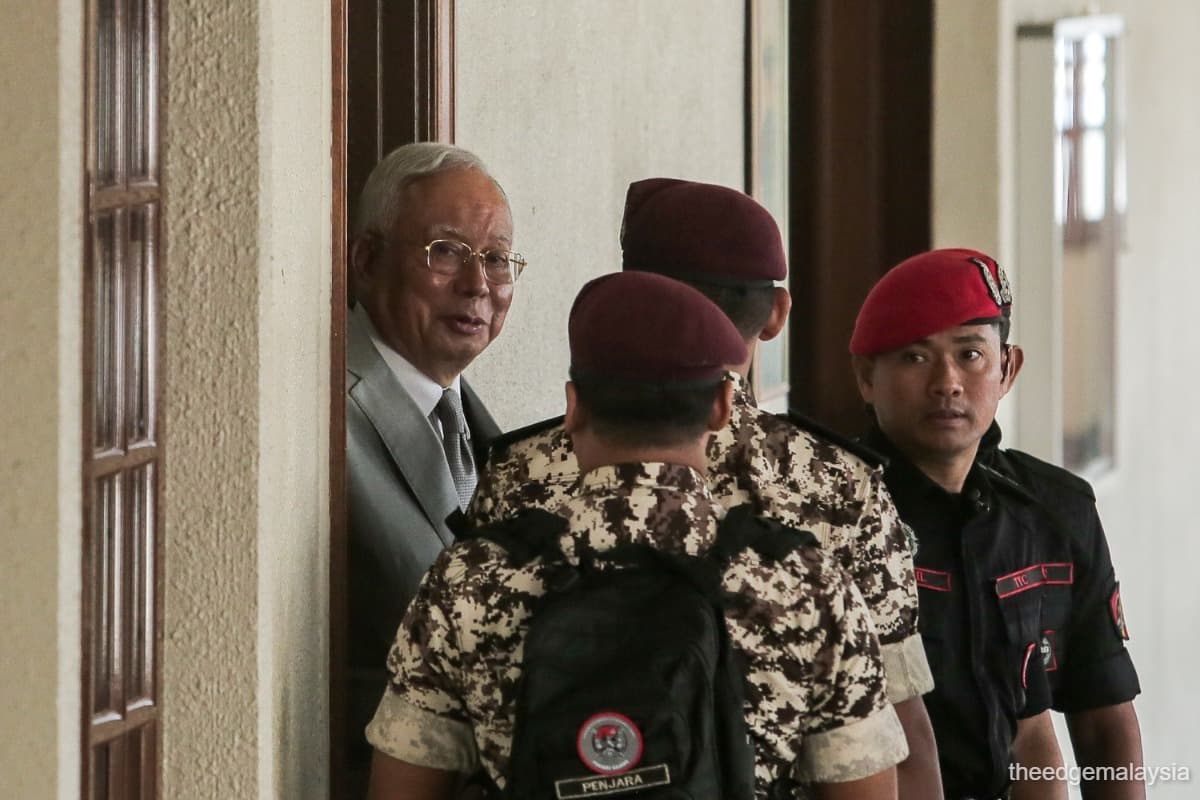
KUALA LUMPUR (Dec 22): Although issues of clemency fall under the Rulers' discretion, it has to be used within the framework enshrined in the Federal Constitution.
The High Court said this on Monday when dismissing former prime minister Datuk Seri Najib Razak's bid to have the royal addendum enforced. The royal addendum would have allowed him to serve the rest of the sentence under house arrest.
"Whilst the power of clemency is a royal prerogative, the Federal Constitution has provided for it to be exercised within the framework of the Constitution," High Court judge Alice Loke Yee Ching said in her judgement.
In 2024, the Federal Territories' Pardons Board had slashed the ex-PM's sentence, which had been meted out for his conviction in the SRC International Sdn Bhd case, to six years in prison and a reduced fine of RM50 million.

The then-King had issued an additional order allowing Najib to serve the remainder of the updated sentence under house arrest. However, as the addendum was made independent of the Pardons Board, it drew into question the legality of such an order.
On Monday, Loke said the then-King "cannot decide on the issue independently of the Pardons Board".
"The Pardons Board, as a constitutional body, has an important function of advising the [King] before a decision is made. The Attorney General (AG), who is the principal legal adviser to the government, is a member of the Pardons Board. It is mandatory for the Pardons Board to consider his views.
"All these requirements, taken cumulatively, does not envisage a decision of the [King] outside the Pardons Board meeting. In other words, the [King] cannot decide independently of the Pardons Board. Undeniably, the house arrest order made in exercise of the powers of clemency is without precedent," she said.
Only one decision made during Pardons Board meeting — reduced jail term and fine

Referring to the declassified 61st Pardons Board's meeting minutes, Loke said that the then-King had suggested a full pardon, but after listening to the Board — where the majority opposed a full pardon — His Majesty decided on the reduced jail term and fine.
The Federal Territory Pardons Board consists of the Federal Territory Minister, the Attorney General, and three members appointed by the Yang di-Pertuan Agong.
"More importantly is the fact that only one decision was made by the [King] during the meeting, mainly the reduction of the imprisonment term and fine. There was absolutely no mention of the house arrest.

"In the light of this evidence [...] it is indisputable that the house arrest was not deliberated at the Pardons Board meeting.
"The fact that it was referred to as a supplementary order confirms it. It then follows that the advice of the Pardons Board was not tendered in respect of the house arrest. The obvious conclusion to draw from this is that the addendum order was not made following the procedure of Article 42," the judge said.
Addendum 'significantly alters' the imprisonment term
Loke added that the addendum "significantly alters" Najib's imprisonment term and therefore there was all the more reason for it to be deliberated.
"To my mind, this significantly alters the nature of the imprisonment term. It is therefore all the more imperative that a proposed house arrest order be deliberated at the Pardons Board meeting, consonant with Article 42," she said.
She also added that according to the Constitution, the Commissioner General of Prison exercises his discretion and can impose conditions for a prisoner's release, and the addendum runs in contrary to that.
"In the case of the addendum order, the duration of the house arrest has already been stipulated, leaving no discretion to the Commissioner General. He is also not given any discretion to recall the applicant to prison. Clearly, the house arrest in the addendum order is at variance with the provisions relating to release on licence.
"In my view, the release on licence is a statutory power given to the Commissioner General alone," she said.
Monday's decision simply means that the ex-PM will continue to serve the remainder of his jail term behind bars in Kajang Prison. He is appealing this decision and has asked for the court to expedite the grounds of judgement to ease the appeal process.
The 72-year-old began serving his sentence in August 2022 and has already served three years and four months.
Read also:
Najib loses bid to serve rest of jail term under house arrest
Decision against Najib’s house arrest bid may remove Rulers' wide latitude over pardon, clemency, claims Shafee
Double-header major court decisions await Najib on Christmas week
Home Ministry can't stall Najib’s house arrest if bid is successful, says his lawyer Shafee
‘Pardon, relief, respite’ — Despite verbiage, King can't issue orders outside of Pardons Board discussion
Najib's house arrest addendum: It's not a pardon but mere 'relief', does not need Pardons Board's deliberation, court hears