

This article first appeared in Forum, The Edge Malaysia Weekly on December 22, 2025 - December 28, 2025
The world obsesses over the US–China rivalry: tariffs reshaping inflation, semiconductors defining sovereignty and the South China Sea signalling strategic strain. Yet beneath these tensions lies a more immediate danger: Washington’s growing reliance on schoolyard bully diplomacy and the deeper political transformation driving it.
Nowhere feels this more sharply than Asia. Supply chains shift abruptly, exporters absorb tariff shocks and financial centres brace for unpredictable swings. But these disruptions mask the true source of volatility: America’s internal reordering, now reshaping global risk more profoundly than China’s rise.
At the centre of this shift is Project 2025 — a blueprint to centralise presidential authority at the expense of the institutional continuity that once underpinned American stability.
The invisible variable in global risk — America’s internal shift
Policymakers follow US sanctions, export controls and defence signals. Far fewer track the domestic machinery reshaping these decisions. Washington’s volatility is no longer improvisation; it reflects a deliberate effort to remodel American governance at its institutional core.
Project 2025, the Heritage Foundation’s initiative launched in 2022 with its main policy document released in 2023, envisions consolidating presidential power, curbing agency independence and remaking the civil service. It promises decisiveness by eroding the institutional safeguards that have long made US policymaking stable and predictable.
This project did not arise because China is rising. It grows from a long conservative campaign against what it sees as an unaccountable administrative state — a conviction reinforced by the belief that bureaucratic resistance and judicial checks frustrated Trump’s first-term agenda.
During the 2024 campaign, Donald Trump denied any involvement. Yet more than 140 officials from his first administration contributed to Project 2025 — including over half of its authors and editors — and many later returned to senior roles in his second term.
Bloomberg Government found that more than 30 of 47 early Trump executive actions matched Project 2025 recommendations. Whatever the campaign claimed, governance and blueprint now move in tandem.
Abrupt tariffs, aid threats and coercive reversals increasingly reflect this approach: bypass agencies, centralise authority and wield state instruments as political leverage. In Asia, these structural shifts often go unnoticed, even as they harden into a lasting feature of American power.
Systemic replacement vs systemic collapse
Global debate often centres on whether the future belongs to a US-led order or a China-led alternative. This framing misses a darker possibility: the US-anchored international system fractures not through replacement but through the internal unravelling of the power that built it.
If China gains primacy, the transition will be disruptive but navigable. History shows that even uncomfortable hegemonic shifts eventually yield new structures with coherent rules to which states can adapt.
Project 2025 offers no such structure. It hollows out professional governance and enables abrupt policy swings. Allies are already confronting an America operating without continuity, memory or restraint — an order defined by anarchy rather than replacement.
The world can adapt to a new hegemon; it cannot adapt to the collapse of the system’s anchor. America’s internal decay, not China’s ascent, may become the defining source of global instability.
Why Project 2025 should worry Asean more than rivalry itself
America’s internal transformation now overshadows its rivalry with China. The erosion of institutional safeguards at the heart of US governance poses a deeper and more durable challenge for Asean than any contest over technology or deterrence.
A presidency empowered to purge civil servants and reverse policy with minimal oversight would formalise patterns already evident: commitments becoming episodic, alliances losing continuity and economic tools being weaponised for domestic politics.
Project 2025 accelerates the subordination of US statecraft to internal political imperatives — for example, tariffs used as leverage and aid tied to ideological loyalty. Asean must prepare for an America whose instruments no longer reflect stable strategic purpose.
The irony is stark: American power — especially its capacity to coerce and project force — may expand even as its reliability contracts. Power without stability is the most destabilising configuration in international politics.
Asean’s fragmenting cohesion
If America’s internal transformation proves as consequential as its rivalry with China, Asean must brace for both. Fragmentation now carries its own strategic risk: it erodes collective bargaining, heightens exposure to asymmetric pressure and leaves the region speaking in divergent — and therefore less persuasive — voices.
This strain is already visible. Malaysia’s Agreement on Reciprocal Trade (ART) with Washington automatically extends to the US any favourable treatment Malaysia grants non-Asean partners. Cambodia’s ART follows the same strategic logic — tariff relief exchanged for alignment — but with far lighter and more contained constraints.
In both cases, strategic alignment matters more than traditional trade reciprocity, signalling a shift from liberalisation towards geopolitical conditioning. Such arrangements narrow future negotiating space and privilege bilateral leverage over regional coordination.
The disparity is telling. Cambodia preserved greater policy autonomy while Malaysia — Asean’s chair — accepted significantly heavier constraints. The disparity underscores how uneven bargaining outcomes are fragmenting what was meant to be a collective regional posture.
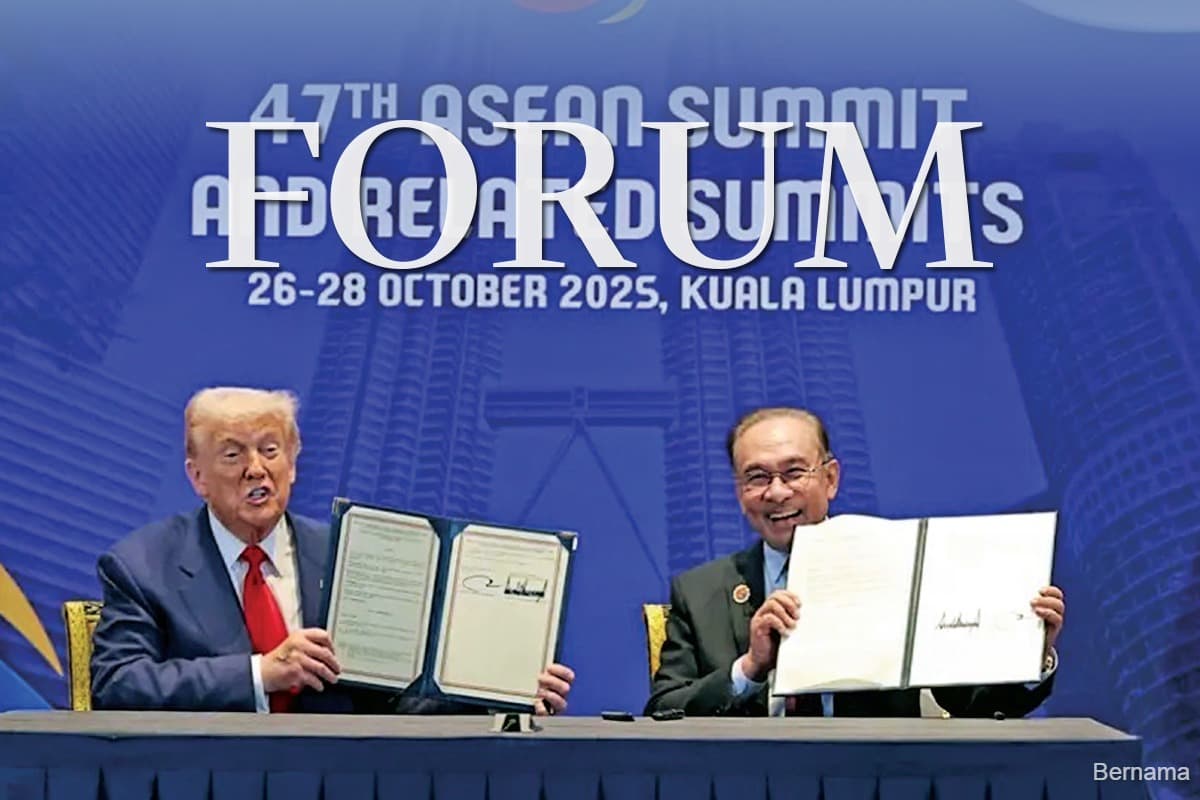
Signed in the same diplomatic setting, the ART deals made Asean appear less like a cohesive bloc than a patchwork of uneven alignments. More troubling, they create openings for a volatile Washington to probe — and potentially weaken — both Asean cohesion and its long held neutrality.
Preparing for a new kind of uncertainty
The real danger is not that America loses to China but that it erodes the institutional stability that once sustained global order. That erosion is driven by a domestic political revolution, not external rivalry — and its consequences are already reshaping global risk.
Many abroad still assume Washington’s volatility will fade once Trump leaves the stage. That hope is misplaced. The forces reshaping US governance now run deeper than any presidency, ensuring that unpredictability will outlast the man who helped unleash it.
China’s rise is steady and predictable. The greater risk is that a more volatile Washington will make any shift in global primacy far harder to manage — not because Beijing is ascendant but because America is becoming structurally less reliable.
For Asean and beyond, the task is clear: stop viewing the world only through US–China rivalry and prepare for a far more volatile America. Each new bilateral ART signed on Washington’s terms nudges the region toward a US geopolitical playbook, eroding neutrality as cohesion frays — a regional warning of a deeper systemic unmooring.
Quah Boon Huat is a former policy analyst with a global intergovernmental institute and a former sovereign credit rating analyst
Save by subscribing to us for your print and/or digital copy.
P/S: The Edge is also available on Apple's App Store and Android's Google Play.