

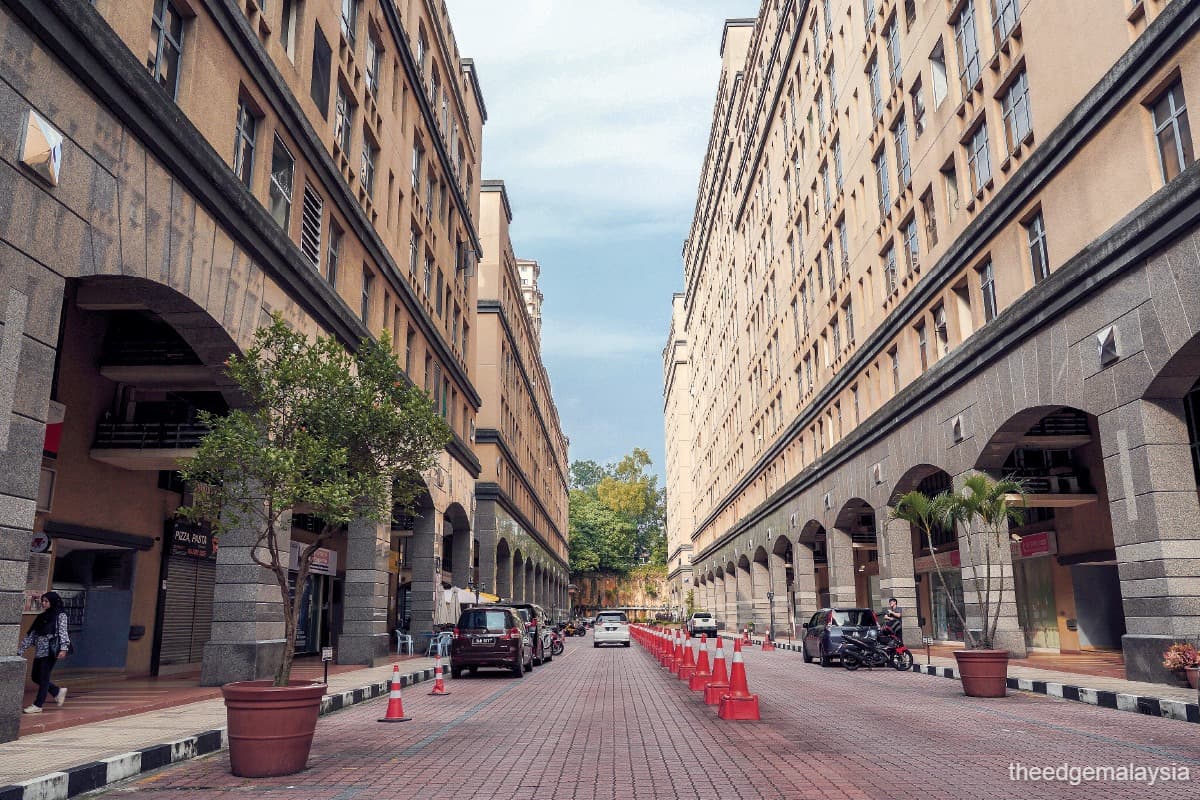
This article first appeared in City & Country, The Edge Malaysia Weekly on December 8, 2025 - December 14, 2025
The Federal Court’s decision to strike out the appeal bid of a management corporation (MC) seeking to impose different rates of management charges for strata property has sparked conversations in the industry.
The apex court struck out an application by the MC of Phileo Damansara 1 (PD1) for permission to appeal against the decisions of the High Court and Court of Appeal to not allow it to impose different rates of maintenance charges for units in PD1.
In a unanimous decision on Nov 25, the Federal Court bench, comprising judges Datuk Rhodzariah Bujang, Datuk Seri Vazeer Alam Mydin Meera and Datuk Mohd Nazlan Mohd Ghazali, quashed the appeal bid of the MC, which had sought to impose different rates of maintenance charges based on usage categories such as offices, shops and car parks. The respondent, SCP Assets Sdn Bhd, which owns all the car parks in PD1, had successfully challenged the MC’s bid to appeal at the Federal Court.
Industry experts whom City & Country spoke to reckon that a review of the Strata Management Act 2013 (SMA 2013) is needed because of the complexities of rapidly growing mixed-use developments in Malaysia.

Chur Associates founder Chris Tan notes that the completion time of a development is important when it comes to the allocation of share units. “Older developments [especially those completed before 2013, such as PD1] did not follow the modern weightage factor system when allocating share units,” he says.
“In contrast, newer developments must assign share units based on specific usage categories such as retail, office and car park, with differing weightage factors that affect the service charge rate. Because this development pre-dates the Act, it is likely that all units were classified simply as ‘commercial’, without further differentiation.”
For properties completed before 2013, two common methods were used to determine share units: (i) the purchase price and (ii) square footage or area. The latter is similar to the formula in the First Schedule of the SMA 2013 that applies a weightage factor.
Tan says that based on his observation, without having read the full written judgment, and the news reports and public information available so far, the argument was that the shoplots, offices and car parks serve significantly different purposes and should therefore be charged differently. The Federal Court rejected this argument, however, stating that a single rate applied because all units were deemed commercial.
“While there is a precedent set by Sodalite Sdn Bhd & Ors v 1 Mont’ Kiara and Kiara 2 Management Corp & Ors [2021], which recognised that MCs can impose different rates if units are used for ‘significantly different purposes’, the judgment did not define what qualifies as a ‘significantly different purpose’,” he points out.
“Instead, the court in that case laid out a two-step test. First, it must examine whether the share-unit allocation already accounts for different uses through weightage factors. Only if it does not should it then assess whether the units serve significantly different purposes,” he explains.
“If share units were already differentiated using weightage factors, the purpose argument may be redundant. But if they were not, as is likely in pre-2013 developments, the second step becomes crucial.”
Therefore, Tan suggests statutory intervention to clearly define what constitutes a “significantly different purpose”, provide guidelines to determine service charge rates and address the application of modern standards to older developments.

Henry Butcher Malaysia (Mont Kiara) Sdn Bhd has managed PD1 for 10 years. Managing director Low Hon Keong says, “First of all, this is a Federal Court decision and we must adhere to the court’s ruling. At the same time, as a property manager, it is important that we assess each strata or mixed-use development objectively and make proper ‘apple-to-apple’ comparisons.
“Section 60(3)(b) of the Strata Management Act 2013 provides that the MC may determine different rates of charges based on significantly different purposes. While this provision has always been in place, the Act may need to evolve to address the complexities of rapidly growing mixed-use developments.”
As mixed-use developments continue to mushroom across the country, particularly in the Klang Valley, he notes that the principle for property managers remains clear — every stratified owner must contribute maintenance fees and sinking funds for the upkeep of the common property. At the same time, stratified owners should contribute based on what they are actually using in the common areas, he adds.
“For example, if a mixed-use development comprises several components and certain services or facilities are not available, accessible or usable by some components, then the maintenance fee for those specific facilities should not be subsidised by the other components. Although the share units under the SMA 2013 already incorporate a weightage factor, this should still be subject to review,” Low explains.
He notes that in PD1, however, the purchase price method was used to determine share units, which led to a disproportionate outcome.
“For example, the development has three floors of basement car parks, covering about 900,000 sq ft in total, with about 2,600 parking bays. Applying a single maintenance rate in such circumstances may not be reasonable,” he says.
“Because the share units were based on purchase price, a shoplot owner who purchased at a much higher per-unit cost ended up bearing a disproportionate share of contributions compared to the actual usage or benefit derived from the common areas and facilities. Further to that, the JMB (joint management body) or MC shall table a resolution at the general meeting for any revision of charges and sinking fund contributions for the floor’s consideration.”
Low explains that in reality, different components in mixed-use developments consume services differently. For example, a resident in the condominium component with facilities requires “pure” residential services, whereas the hotel component may require entirely different services, such as enhanced security, cleaning and maintenance, to operate at a hotel standard.
“Even if share units reflect different weightages, applying a flat rate still results in an unfair allocation … We, as property managers, must respect the court ruling, and I believe that in mixed-use developments, a multi-tiered, usage-based maintenance fee structure is far more equitable practically,” he says.
“As more people invest in property in Malaysia, especially in high-end developments, strata-related issues, particularly the allocation and computation of share units, must be properly guided by the SMA 2013. Thus, a review of the Act is long overdue.”
Save by subscribing to us for your print and/or digital copy.
P/S: The Edge is also available on Apple's App Store and Android's Google Play.