

This article first appeared in City & Country, The Edge Malaysia Weekly on December 8, 2025 - December 14, 2025
Due to a delayed flight, we arrived at Bali’s Gusti Ngurah Rai International Airport just as the evening rush hour began. Traffic came to a crawl in the busy town of Kuta, famed for its beaches and vibrant nightlife.
As we headed further north and off the beaten path, the busyness began to dissolve. The streets opened into paddy fields, with glimpses of the ocean forming the backdrop. At the gates of Nuanu Creative City (Nuanu), a newly built, curated ecosystem awaited.
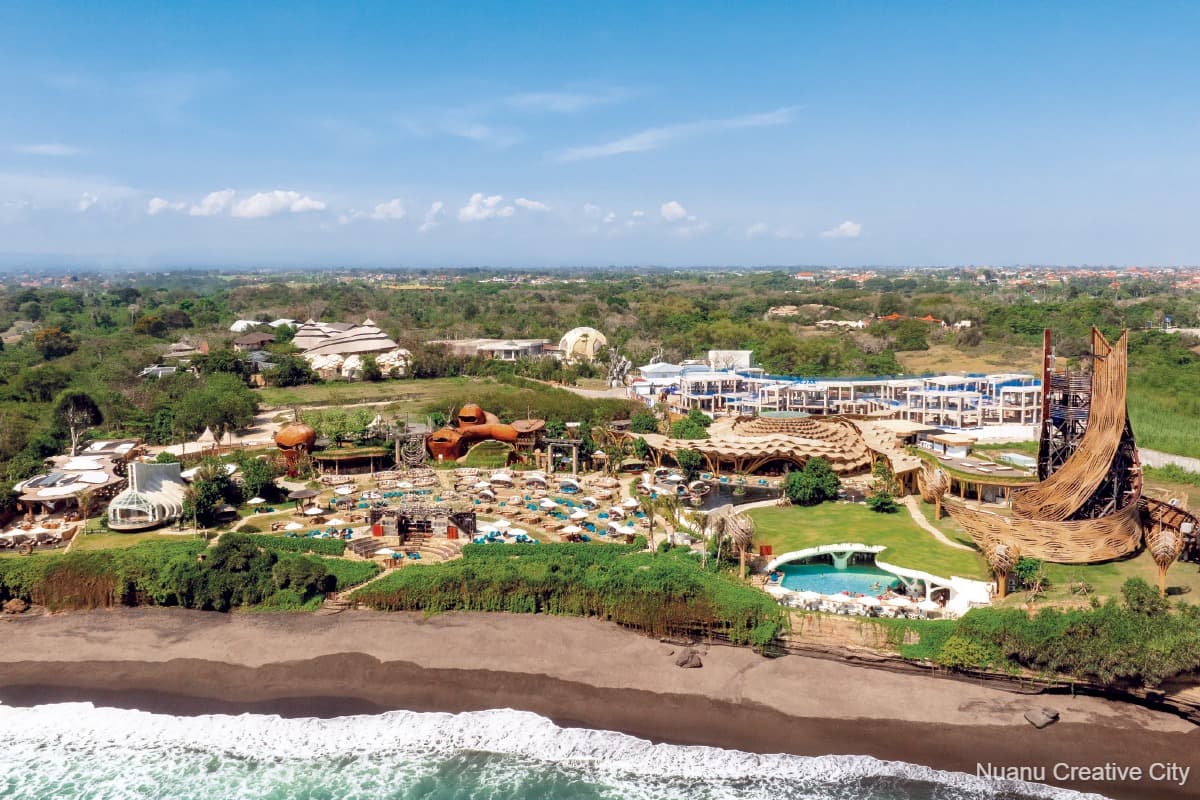
We were on a multi-day media tour, and within the first few hours, Nuanu’s ambitions were unmistakable. Spread across 44ha, the “creative city” is not quite a township or a resort, although both elements exist. Instead, it feels like a deliberately crafted environment, one that blends landscape, cultural venues, wellness centres, hospitality spaces and educational facilities into a walkable, cohesive framework.
Located along the southwest coast of Tabanan, Nuanu is the brainchild of Russian tech entrepreneur Sergey Solonin. He is a shareholder of NanduQ plc (formerly known as QIWI plc), which the World Economic Forum describes as the leading provider of next-generation payment services in Russia and the Commonwealth of Independent States (CIS), with turnover exceeding US$10 billion (RM41 billion).
Construction of Nuanu officially began in 2021, with ProEd Global School becoming the first operational project in 2023.
Across what was once barren land and wild jungle, interconnected pathways now weave through art installations driven by artificial intelligence (AI), boutique hotels, a beach club, a spa and wellness complex, an educational campus, sound-healing spaces, yoga studios and even an alpaca farm.
As we learnt during our tour, the building of the cultural, educational and lifestyle pillars first is a deliberate move and central to how the developer is positioning Nuanu in Bali’s evolving property landscape.
Over several days, as we moved between guided tours and shuttle rides, it became clear that Nuanu was not simply about building homes, but an attempt to develop a new model for urban life in Bali.

A city ‘in the process’
In an interview with City & Country, Nuanu CEO Lev Kroll talks about the origins of the project. “The idea for Nuanu came from the questions many of us had: Can we do things better? Can we do things differently? We felt that while progress in technology and ideas keeps evolving, traditional development doesn’t always reflect that. So we decided to rethink things from the ground up — to approach development with curiosity, almost as ‘professional amateurs’.”
That sense of experimentation is embedded in the name of the city itself. “Nuanu” is derived from a Balinese phrase meaning “in the process”, reflecting the idea that a city should evolve organically rather than arrive fully formed.
According to Kroll, this philosophy is closely tied to Tri Hita Karana, the Balinese principle of harmony between people, nature and the divine. The concept is evident throughout the city, from its abundance of green spaces and reverence for local culture to the community partnerships it fosters and the way buildings adapt to the natural landscape.
As the sun set on our first evening, our hosts led us on foot towards Aurora Media Park, a multimedia art corridor carved out of jungle pathways and digital installations. Soft lights illuminated the trees while immersive soundscapes reverberated in the background.
We continued on to the Earth Sentinels, two towering figures by South African artist Daniel Popper. Conceived as ancient stone guardians, they represent forgotten ancestors reclaimed by the forest. At night, light and sound projections animate the sculptures, bringing them to life and reinforcing Nuanu’s constant dialogue with nature.
For accommodation, Nuanu offers a curated mix. Nuanu Suites & Accommodations, located at the heart of the development, comprises 21 spacious suites along with the distinctive Shell House’s five rooms. Those seeking a tranquil retreat may prefer Oshom Bali, a boutique luxury hotel set amid mangroves overlooking the Indian Ocean. Meanwhile, Music Camp caters to creative travellers, offering nine units equipped with workspaces and access to a music studio, co-working facilities and wellness offerings. More adventurous visitors can opt for the charming Alpaca Lodge, a single unit within the Pacha Alpaca park, where gentle alpacas roam freely.

Real estate driving growth
While Nuanu’s arts, wellness and educational spaces draw immediate attention, their long-term sustainability hinges on the real estate model behind them.
The company’s real estate arm, Nuanu Real Estate, has an expanding residential and investment portfolio comprising 12 projects and a hotel investment, totalling 485 units. Together, they anchor Nuanu’s long-term identity and economic sustainability.
Since 2021, Nuanu has attracted over US$150 million in investment, including US$30 million allocated specifically to infrastructure.
“We’re committed to building one of the best places to live. Not just in terms of luxury, but in creating a community where people can thrive. Real estate lets people become part of this vision and participate in its long-term growth,” says Kroll.
This integrated approach has drawn a global mix of investors. Indonesians form the largest buyer segment at about 30%, followed by Australians and Singaporeans, with growing interest from the Middle East, Europe and CIS member states.
Nuanu’s real estate portfolio comprises a diverse range of villas, apartments and townhouses, each catering to a distinct lifestyle and price point. These projects are scattered in and around the city’s fringes, forming a mosaic of neighbourhoods with different identities.
Among the developments are The Collection series (Volumes 1 to 3), Nuanu’s most exclusive villas. Complementing these are developments such as Ecoverse, offering smart-home-enabled residences, and OXO The Pavilions, Indonesia’s first wellness-living concept with meditation zones, saunas, gyms and more.
Nuanu also offers a hospitality investment product: X Hotel. Located in the heart of the development on an 8,400 sq m site, the four-star hotel features 41 fully managed hospitality units. Buyers can choose from the mezzanine rooms (62 sq m), standard rooms (37 sq m) and corner balcony rooms (48 sq m). Units start from US$165,000 with a 27-year lease, extendable for another 20 years. Completion is targeted for 4Q2026.
“To ensure strong and consistent demand, X Hotel collaborates closely with the Nuanu events team, aligning with the city’s major festivals, international gatherings and year-round cultural highlights. Managed by Nuanu Hospitality Management, the hotel connects guests directly to Nuanu’s creative pulse while offering investors a uniquely positioned hospitality opportunity,” says Kroll.

Bali’s property investment scene
According to Knight Frank Indonesia country head Willson Kalip, Bali is one of the most promising cities in Indonesia’s property market.
“The number of foreign tourists has shown a positive trend, increasing by 76% compared to last year, which has had a positive impact on Bali’s property sector, particularly in commercial properties such as hotels, retail and offices, as well as residential, especially premium residences and rental apartments,” says Kalip, noting that this trend is supported by the growing supply of rental apartments in Bali, many of which are priced more affordably than older stock.
He adds that over the years, Bali has changed from being purely tourism-driven to becoming a lifestyle-driven destination. “This transition is marked by the rising presence of foreign visitors who are digital nomads, and investment hotspots have also expanded recently. What was once concentrated in Seminyak, Kuta and Legian has now spread to Canggu, Pererenan, Uluwatu, Ubud and emerging areas in north and west Bali.
“The majority of investors in Bali are expatriates who see the island as a dream destination for digital nomads, remote workers and retirees. Australians remain one of the largest expatriate groups living in Bali, and their long-term stays have contributed positively to the growing demand and overall performance of Bali’s property market. Basically, the investors can consist of both locals and foreigners, as Bali is one of the destinations for ultra-high- or high-net-worth individuals as an investment area, with some investing in ‘condotels’ or apartments with guaranteed rents.”
Kalip notes that the number of visitors in Bali in recent years has been larger than that before the pandemic. “This condition reflects the stronger demand for real estate, such as villas and apartments. Branded residences are also growing with strong demand in Bali, supported by its uniqueness and open-air architecture, with natural materials like wood, stone and bamboo creating a strong connection to nature and the island’s cultural identity. This makes Bali’s real estate distinct and highly attractive to both lifestyle seekers and investors.”
He explains that most properties in Bali are offered under a leasehold ownership structure and contract periods typically range from 20 to 30 years, with the option to extend. There are also alternatives such as the HGB (right to build) title, which can be obtained when purchasing property through a PT PMA (foreign-owned limited liability investment company).

Master plan rooted in sustainability
Nuanu’s dedicated Nature Team enforces stringent ecological policies. A core principle is the commitment to dedicate 70% of the land to green spaces, supported by an extensive plant propagation programme.
The city’s sustainability initiatives include adopting electric vehicles as official city transport from September 2024, installing solar panels at the office headquarters and implementing comprehensive waste management and recycling systems. It has also upheld a strict “no large tree cutting” policy from the beginning. “The trees are either carefully relocated or the structures are designed around them,” says Kroll.
“Doing things right is not just ethical, it’s good business. We want to show that sustainable development can be both morally right and economically successful.”

In the pipeline
The future plans for Nuanu are aimed at strengthening its identity as a hub for creativity, culture, innovation and sustainability.
“The vision is to have the city continually evolve as a global hub for creativity, social impact and positive change, offering residents and visitors an unparalleled experience at the intersection of art, nature and community,” says Kroll.
Upcoming initiatives include a museum, vertical farming facility and multifunctional complex serving as a one-stop centre for visitors. Acadia, designed for business tenants, will offer prime commercial space for entrepreneurs seeking to grow in an innovation-driven community.
“We see Nuanu as a long-term movement. What we build today will only grow in relevance as people seek more meaningful, nature-connected ways of living,” he says.
Save by subscribing to us for your print and/or digital copy.
P/S: The Edge is also available on Apple's App Store and Android's Google Play.