

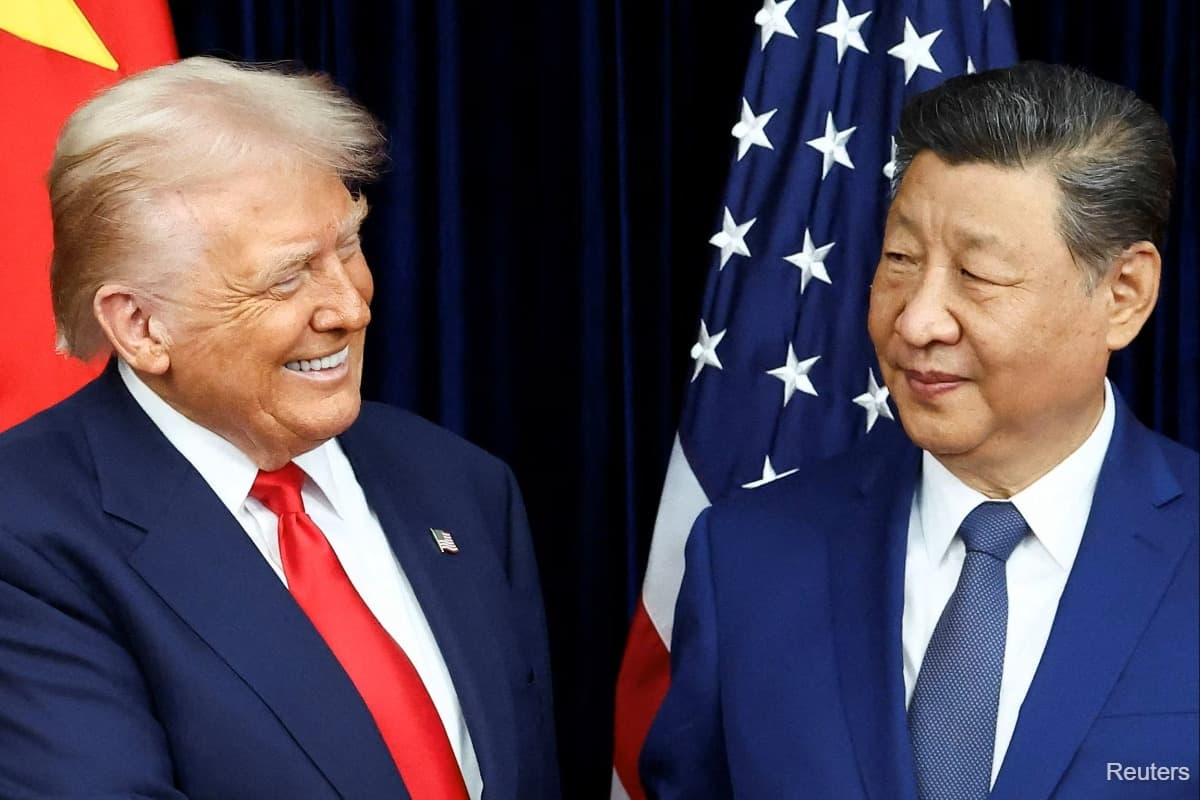
When US President Donald Trump met Chinese President Xi Jinping in October, markets breathed a sigh of relief. The handshake photo was meant to suggest stability. But behind the smiles lies a strategic drift that should concern Washington — and quietly excite much of the rest of the world.
The US is walking away from a decade of painful lessons about how to compete with China. After years of building a coherent framework that married selective protectionism, industrial policy, and allied coordination, Washington is now reverting to fiscal opportunism: sweeping tariffs for revenue, arbitrary reversals of export controls, and a willingness to politicise monetary institutions.
For the US, this confusion is a vulnerability.
For Asia and the Global South, it is an opening.
From strategy to short-termism
China today accounts for nearly 29% of global manufacturing output, more than the US, Japan, Germany, and India combined. Its manufacturing value-add hit US$4.66 trillion (RM19.23 trillion) in 2023, driven by a state-capitalist model that deploys subsidised finance, cheap credit, and industrial policy through programmes like Made in China 2025.
That dominance didn’t happen in a vacuum. The US waited too long to respond. Between 2001 and 2008, US imports of Chinese goods tripled, hollowing out factory towns across the Midwest. Washington could have invoked Section 421 of the Trade Act — the so-called “China safeguard” — but declined.
By 2018, Chinese goods made up 22% of all US imports. It was only then, under Trump’s first term, that Washington imposed large-scale tariffs — costly, blunt, and overdue.
The Biden administration refined that approach. It targeted tariffs at strategic sectors — semiconductors, batteries, clean energy — and launched an industrial revival through the CHIPS and Science Act, offering US$52 billion in incentives for domestic chip fabrication. That Act alone was expected to triple America’s semiconductor capacity by 2032 and lift its global market share from 10% to nearly 14%.
Equally important, Washington enlisted key allies — Japan and the Netherlands — to align export controls on advanced semiconductor tools. A bipartisan consensus had finally coalesced around a credible China strategy: selective decoupling, strategic investment, and allied coordination.
Trump’s second term has undone much of that.
The return of fiscal tariffs
In 2025, the White House began imposing broad tariffs not just on China but across the board, targeting allies such as Australia, Canada, and the UK. The intent: to raise US$300-400 billion a year to offset revenue losses from tax cuts.
The result: American manufacturers are now paying more for industrial inputs than their Asian competitors. Companies such as General Motors and Ford project billions in extra costs, while countries once aligned with Washington face punitive duties higher than those applied to Beijing.
Meanwhile, Trump’s administration has slashed funding for clean energy and electric vehicle (EV) incentives, allowing China to accelerate. In 2023, Chinese car exports surged to 5.4 million units, making it the world’s largest exporter. Of these, 1.6 million were EVs, backed by US$200 billion in state subsidies since 2009.
China now controls nearly 75% of global EV battery production and about 60% of the world’s rare-earth processing capacity — core components for EVs, wind turbines, and next-generation electronics.
As Washington walks away from green-tech investment, Beijing is doubling down. The International Energy Agency estimates that China invested US$680 billion in clean-tech manufacturing in 2024, almost equalling the combined efforts of the US and the EU.
Weakening the innovation ecosystem
Equally concerning is the Trump administration’s decision to restrict visas for foreign scientists and engineers while cutting federal research budgets. That is effectively a talent export policy.
In 2023, over 40% of AI researchers in the US were foreign-born. Many are now eyeing Toronto, London, Singapore, or Seoul. These cities are seizing the moment — offering stable visa pathways, generous research grants, and regulatory predictability.
Even in semiconductors — the crown jewel of strategic competition — Washington’s moves are increasingly contradictory. The CHIPS grants that once required firms to meet advanced-manufacturing benchmarks have been converted into government equity stakes, echoing the same state-capitalist tendencies Washington criticises in Beijing.
The dollar at risk
For 75 years, the dollar’s dominance has been the linchpin of American power. It underpins global demand for US Treasuries and allows the US to borrow at rates 100-200 basis points lower than it otherwise would. But that privilege depends on investor faith in America’s fiscal prudence and institutional independence.
That faith is wobbling. In 2024, US public debt passed US$35 trillion — over 123% of GDP — while 30-year Treasury yields climbed above 5%. The credit downgrade that followed has only deepened concerns about US fiscal sustainability.
The world is responding quietly but decisively. Central banks bought more than 1,000 tonnes of gold in 2023 for the second consecutive year, and global official gold reserves — valued at market prices — have surpassed the value of foreign-held US Treasuries for the first time since the mid-1990s. The dollar’s share of global reserves, long stable at 65%, has slipped towards 55%, once gold is accounted for.
Meanwhile, China is steadily promoting renminbi settlement in energy trade, particularly with the Gulf and Russia. Though the renminbi still represents only about 5% of global payments, its role in bilateral trade finance is rising — up 60% year-on-year in 2024.
This isn’t de-dollarisation, but it is diversification — and it’s happening on Washington’s watch.
The opportunity for Asia
For Southeast Asia, India, and the Gulf, America’s incoherent China strategy is not just a geopolitical subplot — it’s a once-in-a-generation realignment. The opportunity lies in five areas:
- Supply-chain capture
As US tariffs distort trade, production is shifting to Vietnam, Thailand, Malaysia, and Mexico. Chinese firms alone have invested over US$28 billion in Asean manufacturing since 2019, using the region as a tariff-free bridge into Western markets.
- Green-tech industrialisation
With the US retreating from EV and clean-tech subsidies, Asean economies can attract both Western and Chinese investment into components and midstream processing — especially nickel, lithium, and rare earths. Indonesia already supplies 52% of the world’s nickel, the key input for EV batteries.
- Talent magnetism
Singapore’s new ONE Pass, Dubai’s 10-year Golden Visa, and Malaysia’s DE Rantau Nomad initiative are positioning these hubs to absorb displaced global talent.
- Regional financial hubs
The dollar will remain supreme, but Asian markets that pair fiscal discipline with openness — Singapore, Hong Kong, Dubai — are quietly becoming diversification havens for reserve managers and sovereign wealth funds seeking insulation from Washington’s political volatility.
- Principled nonalignment
Countries that maintain balanced access to US and Chinese technology ecosystems — rather than picking sides — will enjoy leverage. Malaysia’s rare-earth refining ambitions, India’s semiconductor push, and Vietnam’s growing role in AI chip assembly are early examples.
Opportunity without illusion
None of this means American decline. The US economy remains a US$28-trillion engine, its innovation ecosystem unmatched, its military reach unrivalled. But power is relative — and when a superpower taxes its own producers, unnerves its allies, and weakens its own currency credibility, others will fill the vacuum.
For Southeast Asia and other middle powers, the goal should not be to choose between Washington and Beijing, but to position themselves where opportunity lies — in supply chains, green industry, capital markets, and talent flows.
The US may yet correct course. But until it does, its self-defeating China strategy is a rare invitation for the rest of the world to rebalance the global economy — not through confrontation, but through quiet competence.
Abbi Kanthasamy (www.abbiphotography.com) is a Canadian entrepreneur, photographer and writer.