

This article first appeared in The Edge Malaysia Weekly on December 1, 2025 - December 7, 2025
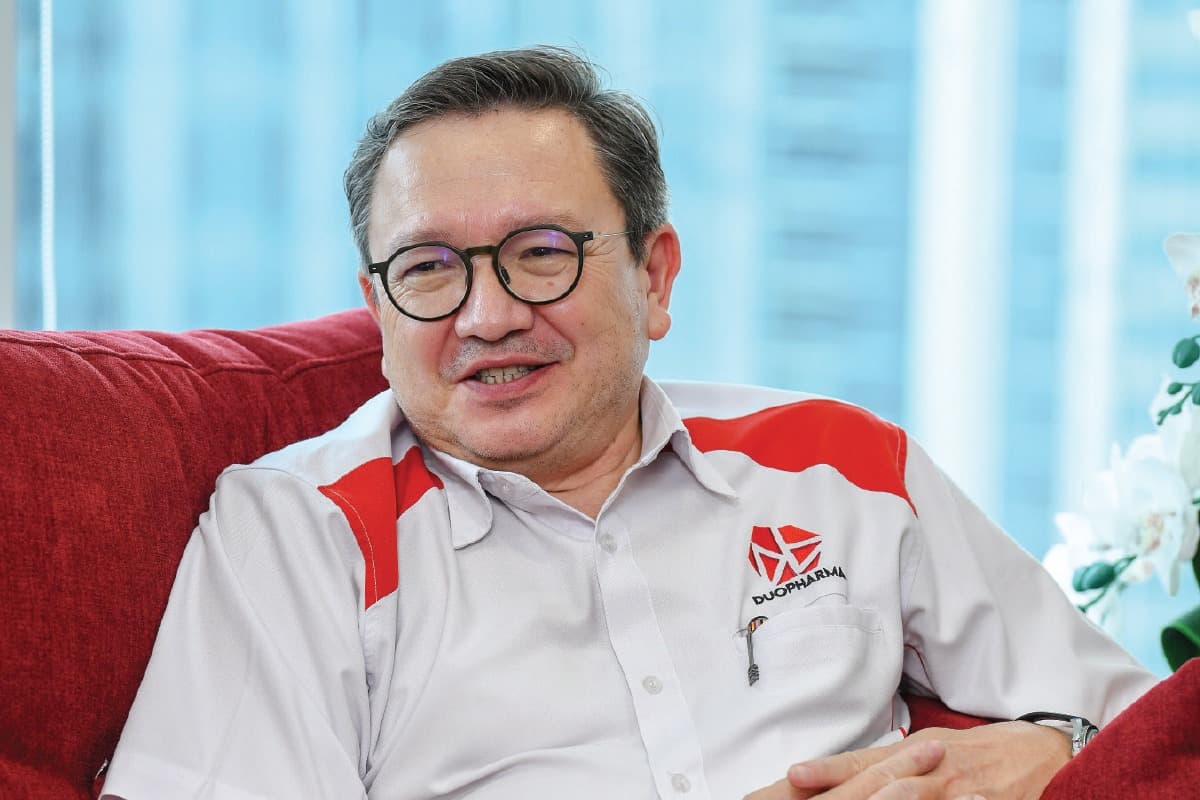
MALAYSIAN pharmaceutical companies need stronger government backing if they are to catch up with regional rivals in terms of scale, says Leonard Ariff Abdul Shatar, outgoing group managing director and executive director of Duopharma Biotech Bhd (KL:DPHARMA), the country’s largest generic drug maker by market share.
He also believes the days of multiple pharma companies producing identical generic molecules — drugs that contain the same active medicinal substance as the original brand-name drug — are coming to an end. “It just doesn’t make sense anymore. There’s so much wastage in the system,” he tells The Edge in an interview.
The core challenge lies in the government’s dominance as the country’s largest buyer of generic drugs, controlling 60% to 70% of the market. This dominance shapes pricing and volumes, leaving local players less agile than their regional counterparts, says Leonard Ariff.
“Why haven’t Malaysian pharma players been as successful as those in Indonesia or the Philippines? It’s because the government holds so much purchasing power in the local generic drug market,” he says.
Indonesia’s sector is led by companies such as Dexa Group, PT Kalbe Farma, PT Novell Pharmaceutical Laboratories and state-owned PT Bio Farma, while major players in the Philippines include Unilab, Mercury Drug Corp and Zuellig Pharma.
Leonard Ariff argues that Malaysia must confront two fundamental questions: why local pharma companies are expanding more slowly than their foreign counterparts and what the government can do to help local players achieve the scale needed to compete effectively.

“If we continue down the path of commoditised, low-cost generics, the industry will just go into a downward spiral. The industry needs to modernise and adopt new technologies. But I don’t see that happening without meaningful collaboration with the government,” he says.
According to Leonard Ariff, stiff competition, even among domestic producers, has made local pharma companies reluctant to invest in new capacity. “And that’s a shame. New capacity brings higher standards and ultimately strengthens both the company and the industry,” he points out.
“Competition is good, but it need not be wild. It needs to be managed carefully.”
He notes that Malaysia’s long-standing openness to multinational pharma players has come with trade-offs.
“It’s good for pricing, but it also leads to a problem of self-sufficiency as we saw during the Covid-19 pandemic. How do you build self-sufficiency if pricing is the only factor determining who wins contracts?”
Leonard Ariff acknowledges that the Ministry of Health (MoH) faces a difficult balance: pushing to secure drugs at the lowest possible cost while ensuring supply security — something imports cannot always guarantee.
“It’s about finding the right balance. In recent years, it has tipped a bit too much towards pricing and less of supply security. But since the pandemic, I have seen it shifting back,” he says.
He notes that the recently tabled Budget 2026 signals a positive shift, with Prime Minister Datuk Seri Anwar Ibrahim highlighting public-private partnerships aimed at strengthening the pharma sector. Still, real progress will require the government to actively leverage its influence to help local manufacturers scale up.
Another major reason local manufacturers hesitate to invest in new capacity is the substantial capital required, especially given Malaysia’s relatively small market, says Leonard Ariff.
“When you invest in a facility, you’re committing for 20 years. You need some assurance that the volume [demand] will be there. Without that, local pharma companies will hesitate to invest. That’s the situation in the industry today,” he adds.
He cites Indonesia as an example of how policy can amplify domestic capacity by prioritising local manufacturers. “Because of their large market, they strongly support local manufacturing. When they run tenders, they follow an ‘Indonesia-first’ policy. Only when no domestic producer exists do they import.”
Attracting multinational pharma players to Malaysia
The pharma industry has long urged the government to enter into agreements that support companies, both local and foreign, that bring new technologies and manufacturing capacity to Malaysia, says Leonard Ariff.
“The government should leverage its purchasing power to help these players scale, strengthening the country’s resilience. At a macro level, Malaysia is an excellent base for multinational pharma manufacturers in terms of our talent, infrastructure, land cost and logistics,” he says.
Supply diversification is particularly difficult in the pharma industry. “You can’t simply switch raw material suppliers without updating your regulatory dossier. That creates a structural limitation. If you’ve registered only one supplier and that source is disrupted, you can’t supply to your patients. For risk mitigation, MoH must ensure at least two approved suppliers for critical drugs,” Leonard Ariff explains.
He acknowledges that Malaysia has struggled to attract multinational pharma giants to set up manufacturing here. “But it’s not too late. As some foreign pharma companies move deeper into mainstream pharmaceuticals, opportunities may arise to draw these foreign drug makers to localise their manufacturing activities in Malaysia, potentially partnering with established local producers like Duopharma,” he says.
As an example of what Malaysia can achieve, he points to India-based Biocon Biologics Ltd, which has established an insulin manufacturing facility in Johor. The facility supplies not only to Malaysia but also the global market. Following Danish insulin manufacturer Novo Nordisk A/S’s exit from the human insulin market, global demand for Biocon’s insulin products has surged.
“With international demand rising sharply, we see this as the right moment to invest in a fill-and-finish facility for human insulin products,” says Leonard Ariff, noting that Duopharma has been in partnership with Biocon since 2012, culminating in the supply of Biocon insulin to all government hospitals and health clinics.
Under the plan, Duopharma’s facility will handle fill-and-finish work for human insulin on behalf of Biocon, while Biocon continues to produce both human insulin and insulin glargine, which has seen soaring demand.
“While Biocon’s finishing capacity can focus on analogue products like glargine, our facility will support human insulin for the Malaysian market. The earliest launch of the facility is expected between late 2027 and mid-2028,” he says.
“Biocon remains a producer of drug substances in Malaysia, but Duopharma’s fill-and-finish facility will help create a more resilient ecosystem. This gives Biocon the flexibility to use their own finishing lines or ours, enhancing long-term supply security for Malaysia.
“We could eventually see two or three suppliers in the market, but Biocon will continue to hold the core drug-substance capability.”
Critics question why Malaysian pharma companies focus on fill-and-finish rather than producing drug substances, as Biocon and Novo Nordisk do.
“Building drug substance capability requires massive investment. Biocon’s insulin facility, for example, cost more than RM1.5 billion. What we’re doing is adding value. We import the active pharmaceutical ingredients (APIs) and then build on them,” says Leonard Ariff.
Malaysia’s relatively small market shapes that strategy, he explains.
“If you build capacity upfront, the risk is enormous. But if you first develop the market and demand, then when you assess a manufacturing investment, you already have a base in Malaysia and can scale it for the region. That’s the only rational way to manage risk in pharmaceuticals, especially in biologics (a class of medications that come from living organisms),” he says.
‘FY2026 will be an equally good year’
Leonard Ariff, 61, is stepping down at a time when Duopharma has returned to growth in net profit. His last day with the group is Dec 31, 2025.
His successor has already been named. Wan Amir-Jeffery Wan Abdul Majid was appointed group CEO on Oct 1 this year. He most recently served as CEO of group operations and joined Duopharma in 2016.
For Leonard Ariff, the decision to exit after 18 years in leadership comes not from pressure, but from conviction.
“Eighteen years is a long time to lead any company, and the timing feels right. I’m not leaving because the company is in dire straits. It’s performing well this year, and I have every confidence it will continue to do so next year. It’s simply the right moment to step aside rather than overstay my welcome,” he says.
He notes that most employees have never known a different leader. “Roughly 20% of the employees have been with the company longer than I have, but the remaining 80% have only ever known me [as the group MD].
“Today, the organisation has about 1,200 people. We haven’t quite doubled our headcount over the years, but our revenue tells a different story — it has grown nearly fourfold over the past 18 years.”
This awareness shaped how he approached the leadership handover to his successor.
“That’s why we’ve managed this transition with great sensitivity. A change at the top isn’t just about continuity of strategy; it’s about people. You can deliver results for stakeholders only when the organisation’s talent feels secure, supported and motivated. It’s essential that our people feel as energised under the new leadership as they did under mine,” says Leonard Ariff.
He is also quick to shift the spotlight away from himself.
“Ultimately, the success of this company has never been about one person. If I had to point to the single-biggest driver of Duopharma’s achievements, it’s the people who make up this organisation,” he says.
After a “blip” in the financial year ended Dec 31, 2023 (FY2023), when net profit fell 25% to RM52.65 million from RM70.11 million in FY2022 amid rising costs and softer demand, Duopharma has returned to the growth path, with a net profit of RM62.65 million in FY2024. For the nine months ended Sept 30, 2025 (9MFY2025), net profit reached RM68.42 million, surpassing that of FY2024, supported by higher sales and favourable API and foreign exchange rates.
Revenue has also risen steadily, from RM696.72 million in FY2022 to RM704.73 million in FY2023 and RM813.7 million in FY2024. For 9MFY2025, revenue stood at RM707.01 million, up 14% from RM620.02 million a year earlier.
“I’m confident next year [FY2026] will be an equally strong year for Duopharma,” says Leonard Ariff.
According to Bloomberg data, analysts expect Duopharma to end FY2025 with a net profit of RM92.74 million and FY2026 with RM103.2 million.
Duopharma is now vying for a new MoH contract worth more than RM400 million to supply human insulin products over the next three years, following the expiration of the previous contract on Oct 28, 2025. The group also holds an ongoing contract to supply 100 products to public hospitals and health clinics until Dec 31, 2026, with a combined estimated value of RM684.15 million.
The deliberate way in which Duopharma has built its leadership bench is something Leonard Ariff views as one of the group’s lasting strengths.
“Every choice we made — whether developing internal talent or bringing leaders in from the outside — was intentional. We’ve embedded meritocracy and performance orientation into the organisation. My hope is that this remains a defining strength of Duopharma,” he says.
For him, the true legacy lies not in personal accolades but in the team he leaves behind. “It’s people who make the difference, not any one individual. If you ask me what my legacy is, it’s the team we’ve built. Duopharma has been blessed with strong leaders throughout its history. I’ve been standing on the shoulders of giants.”
Leonard Ariff also credits Duopharma’s board of directors for their constructive challenge during his tenure. “One of the things I really appreciated was the board that grew up alongside us. Over this period, I’ve seen three different boards, and they always questioned our decisions.
“Some of my management team used to get very frustrated and ask, ‘Why are they questioning us? We know what we’re doing.’ But I appreciated it because, in many cases, they raised issues that I might not have considered, which turned out to be very insightful. This is a publicly listed company, and the board is responsible for delivering results to all stakeholders.
“It’s important to have strong rapport between the board and management. The board’s role is to challenge us, not because they oppose what we’re doing, but to ensure we’ve thought things through. We’ve had medically trained directors, pharma specialists and former civil servants — a very balanced mix of expertise.”
State-owned Permodalan Nasional Bhd (PNB) is the largest shareholder of Duopharma, with 44.1% equity interest, followed by the Employees Provident Fund with a 9.3% stake.
Although Duopharma is a government-linked company, Leonard Ariff says stakeholder interference has never been an issue. “We have three board members appointed by PNB, but never once has any stakeholder said, ‘You must do this.’ It has always been about creating value for all stakeholders. And since I joined the company [then CCM Duopharma Biotech Bhd] in 2008, the majority of our directors have always been independent.
“The intent from the start was for professional managers to run the company. We’ve also been open with shareholders, particularly during annual general meetings. Our annual and sustainability reports contain extensive disclosures. In fact, Duopharma has been producing sustainability reports for more than five years now and I believe we are leading the way in the healthcare sector.”
CCM Duopharma was demerged from Chemical Company of Malaysia Bhd in 2017 and adopted the Duopharma name two years later.
As he prepares to hand over the reins, Leonard Ariff expresses confidence in his successor. “Every company is striving for growth, none is perfect. But I leave with a clear mind knowing that Wan Amir-Jeffery, who has earned the respect of the organisation, brings strong leadership skills and a solid moral compass. He will steer Duopharma in the right direction.”
He adds that fresh thinking is essential for the next chapter. “Companies thrive on new blood and new ideas. I don’t want the new leadership team to feel constrained by what came before them. They should run Duopharma in the way they believe will take it forward, even if that means emphasising areas I may have overlooked.”
Life after Duopharma
What comes next for the long-time group MD? For the first time in nearly two decades, he plans to take a pause.
“I’ve told myself that from January to March next year, I won’t consider any options. I want to experience what it’s like not waking up and checking sales numbers first thing in the morning. But I do know retirement brings its own set of challenges,” says Leonard Ariff.
He is not ruling out adding value to non-governmental organisations. Private companies have already approached him, though none in competing sectors. “I’ve sat on a number of boards, and I enjoy the pace and the ability to apply years of experience, especially in helping younger companies adopt best practices. That’s where I believe I can make a positive impact.”
He currently serves as a director of Monash University Malaysia Sdn Bhd, sits on the advisory committee of the Monash University Malaysia Business School, is an adjunct professor at Universiti Kebangsaan Malaysia’s Faculty of Pharmacy, and is a council member of the Action Group for Entrepreneurship at Universiti Malaysia Kelantan.
Still, his loyalties remain clear. “I’ve worn a Duopharma shirt for 18 years. Whatever I do, it won’t be with an organisation that competes with the company. I still have Duopharma red flowing in me.”
Save by subscribing to us for your print and/or digital copy.
P/S: The Edge is also available on Apple's App Store and Android's Google Play.