

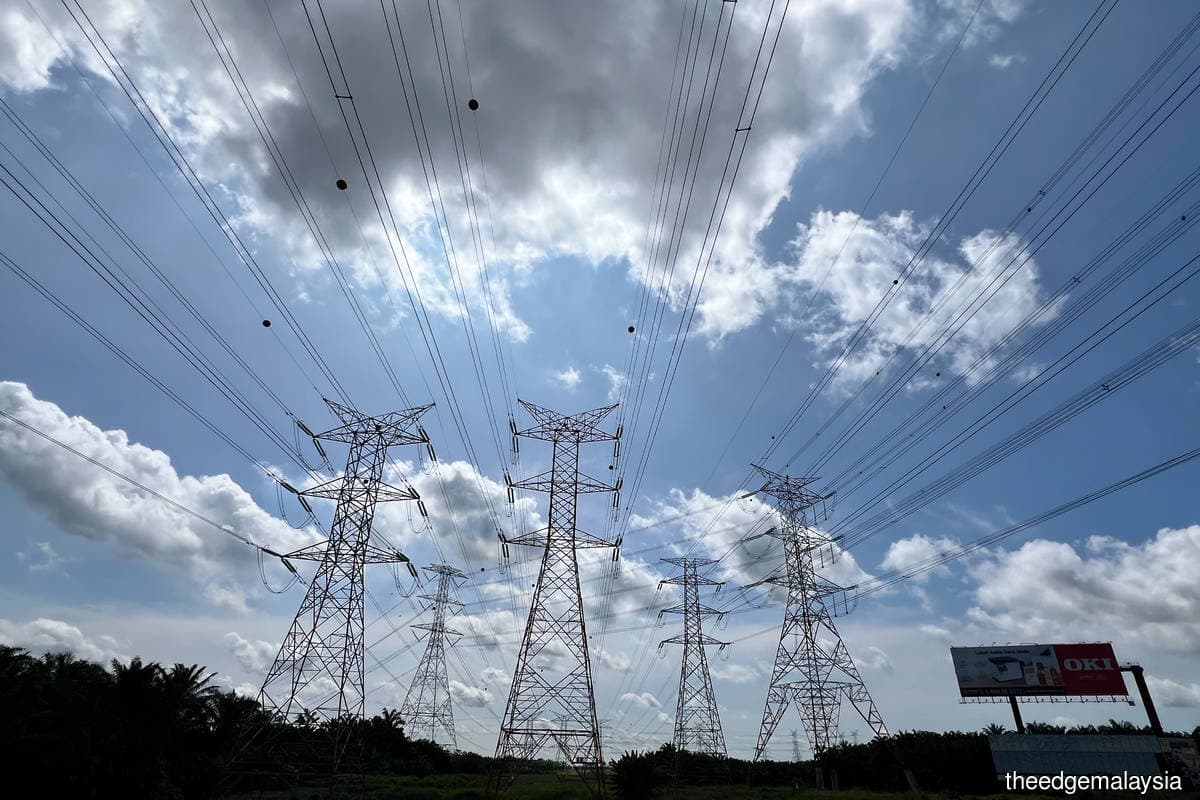
KUALA LUMPUR (Nov 28): Moody’s Ratings has upgraded its outlook on Malaysia's A3-rated power sector to 'positive' from 'stable', citing the regulated industry’s shift to a monthly fuel-adjustment mechanism from the prior biannual method.
The newly implemented automatic fuel adjustment (AFA) mechanism enables more timely and effective fuel cost adjustment, the credit rating agency said in a note on Friday.
It also represents a shift to a more positive regulatory environment, coupled with a supportive policy setting, underpinned by protection against potential decline in power demand and fluctuations in fuel prices, Moody’s added.
Notably, it is Moody’s sole outlook change made for the region this year.
Over the next six years, power demand from data centres in the Asia-Pacific region is expected to grow at 15% to 20% annually, it noted.
Malaysia, which is experiencing a rapid build-up of data centre capacity, will require a sharp increase in infrastructure investment to meet demand growth.
Regionally, the Asia-Pacific region will need to spend US$90 billion to US$110 billion (RM372 billion to RM454 billion) over the next five to six years to expand generation capacity to meet power demand from data centres.
Looking to fuel prices, Moody’s expects coal prices to be less volatile over the next 12 to 18 months versus the prior three years, while crude oil prices are expected to average around US$60 per barrel in 2026 and 2027.
While costs of renewable energy generation and storage remain high and above coal-fired generation, the credit rating agency sees costs trending downwards over the next five to seven years. It expects costs of power for wind and solar assets with storage capacity to become more competitive with coal-fired power by 2030.
“Overall, the reducing production costs will relieve funding pressure for the power sector,” it added.
Overall, Moody’s expects the Asia-Pacific power sector to remain stable over the next 12-18 months, projecting total annual capital spending of major-rated regional power issuers to increase to US$300 billion in 2026, compared with US$220 billion in 2022.
Their total adjusted debt will increase to US$1.6 trillion from US$1.3 billion over the same period, it added.