

This article first appeared in The Edge Malaysia Weekly on December 1, 2025 - December 7, 2025

A healthy economy is stable and its growth powered by investments, but to support the long-term competitiveness of industries and well-being of communities, the natural ecosystem must be intact, said Lara Ariffin, co-founder and president of Rimau, a non-governmental organisation (NGO) dedicated to the preservation of the Malayan tiger.
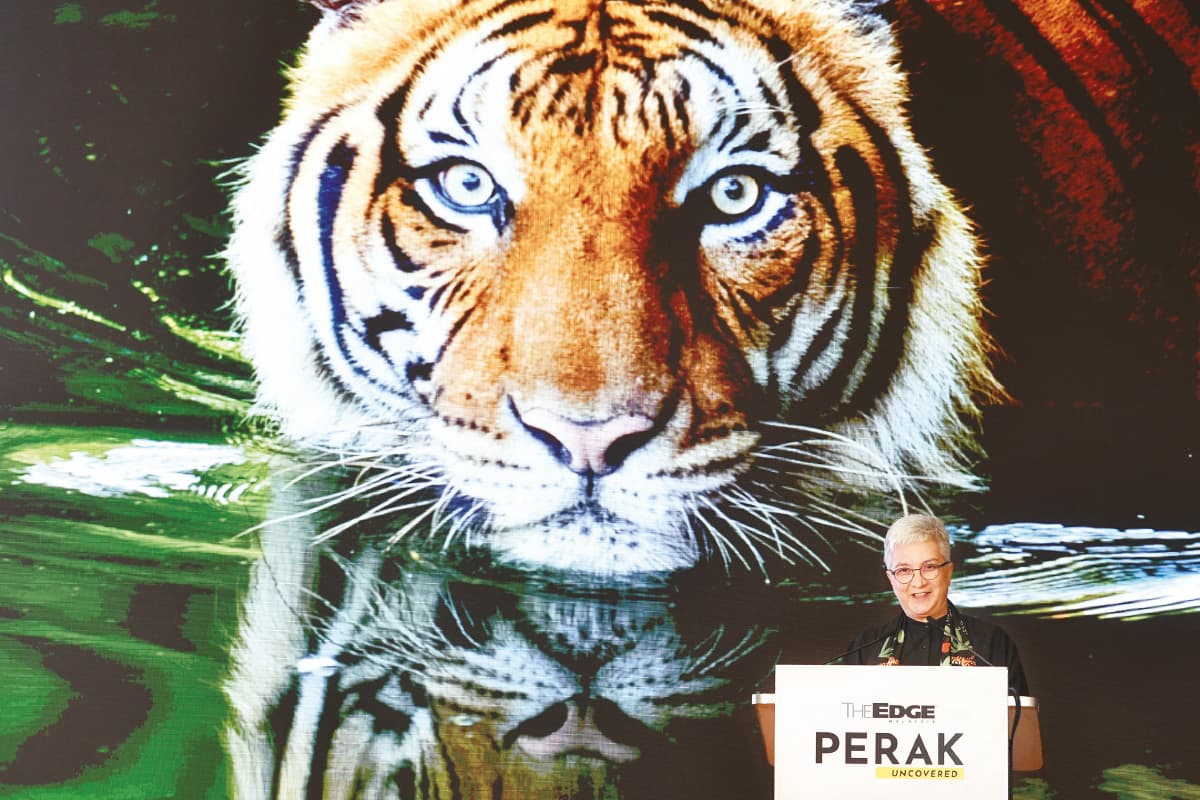
Lara was presenting on Rimau’s conservation efforts in Perak at the launch of The Edge Malaysia’s special-edition magazine, Perak Uncovered, in Ipoh on Nov 25.
Rimau, which was founded in 2018, empowers local indigenous communities to become rangers in the forest.
“Tigers are far more than a powerful symbol. They are a keystone species, essential to the health of Perak’s forest and, ultimately, to our own survival. The Malayan tiger is now on the brink of extinction, brought to its knees with fewer than 150 remaining in the wild. Perak is one of the last strongholds of the species,” she said.
“People often ask me, ‘Why do you care so much about tigers? They eat people.’ But that question misses something important. Tigers are more than just predators. They are vital threads in the web of life.”
When tigers disappear from the ecosystem, it is a sign that the forest ecosystem is collapsing. This is because tigers are apex predators. If this species thrives, it means its prey populations — including the wild boar and sambar deer — are stable, and the ecosystem is in balance.
“Tigers are what we call an umbrella species. If we protect enough habitat for tigers, we automatically protect thousands of other species, too. Saving the tiger isn’t only about saving one animal. It’s about safeguarding the entire ecosystem,” said Lara.
A tiger needs at least 100 sq km of forest to roam, hunt and thrive. Therefore, large continuous forests are critical for their survival. Perak’s large protected forests, such as the Belum-Temengor forest complex, which includes the Royal Belum State Park, and the Bintang Hijau forest reserve, are home to many Malayan tigers.
The protection of these forests is important not only for tigers. Forests are also a source of water and clean air, regulating the climate, storing carbon and preventing floods. “The same ecosystem that sustains tigers also sustains generations of communities, whose cultural identity, livelihoods and well-being are deeply tied to the land,” said Lara.
Rimau started its work with the Jahai community in Royal Belum State Park. It formed a patrol team called Menraq, which means “people” in the local language. From just five rangers in the state park, the NGO has expanded its work to the Amanjaya forest reserve, which is an important ecological link between Royal Belum and the Temengor forest reserve.

Rimau is also working in the Korbu forest complex, which is part of the central forest spine of Peninsular Malaysia. The rangers trek in the jungle for up to 14 days at a time, dismantling snares, tracking human and animal signs, and collecting essential data.
“They are the guardians of the tiger’s last stronghold. Although snaring has dropped sharply in recent years and tiger numbers are rising slowly, vigilance is critical. Poachers continue to target our forest because the illegal trade in tiger parts is still lucrative and unrelenting. The Orang Asli have truly risen to the challenge,” said Lara.
Many of the Orang Asli rangers have little formal education, but with their deep knowledge of the land, combined with their willingness to learn to use new tools, such as navigating with satellite phones and using camera traps, they have managed to make the programme a success. In 2023, the Menraq patrol unit won the IUCN WCPA International Ranger Award for its work.
“For many rangers, this is the first time they have a steady income, working in the forest they call home. It brings stability, dignity and new opportunities to their families and communities,” she said.
The rangers are paid for their work, and for each day that they patrol the forest, RM10 is given to the ranger’s community to build schools and other projects.
“Through our rumah baca programme, we are training teachers in the Orang Asli community, so children can learn to read, write and dream of a better future. We are seeing improved literacy, sparks of curiosity and children who say, ‘Maybe I want to be a ranger one day.’ This is what real conservation looks like: protecting the wild while uplifting people who live closest to it,” said Lara.
“We’re not stopping there. In 2026, we are expanding further into Bintang Hijau. Partnerships make our work possible. Every strategic ally strengthens our collective mission, from the support of foundations to responsible businesses, government agencies and local communities.”
Through the camera traps installed in the forest, Rimau is able to track the biodiversity of the forest and identify, count and study the tigers in the wild. It also provides the government with critical data.
Lara cited the example of the Amanjaya forest reserve, originally slated for logging.
“We showed the camera trap evidence to the Perak Forestry Department, and they demonstrated exceptional leadership and reclassified the area from a production forest to a protected forest for wildlife. Their action deserves praise and recognition,” she said.
The camera trap data also revealed to Rimau’s team the collapse of the tiger’s prey population in 2022. Because African swine fever sharply reduced the wild boar population, the tigers were forced to roam farther in search of prey, which increased the likelihood of conflict with humans.
“We are witnessing this situation in Perak. In the past two years, the impact has been devastating, claiming eight wild tigers from their natural habit,” said Lara.
Yet, there is still hope. She recounted the story of Cahaya, a tiger caught on the camera trap with a snare around her neck — a sight that was heartbreaking for the team. Fortunately, Cahaya recovered and later gave birth to two cubs, also captured on camera. “Her story is one of hope and resilience, a reminder of why we do what we do,” she said.
Rimau’s plan now is to work with WWF-Malaysia and Yayasan Sultan Azlan Shah — its partners in Perak — to develop the Perak Tiger Conservation Plan.
“This plan brings together the government, NGOs, researchers and communities on the fundamentals of tiger recovery. We need enough patrollers and enforcement on the ground, enough prey in the forest, and enough cameras to monitor, learn and adapt,” said Lara.
“We need corridors restored and planted so that the tiger landscape is connected. We need continuous nature education that keeps people informed, empowered and proud of Perak’s biodiversity.”
The plan will also address the financial mechanisms to sustain this work in the long term.
“We need a plan that will outlast all of us, so that when we are no longer in the roles that we play, the mission to protect tigers and safeguard Perak’s rich biodiversity continues,” she said.
Save by subscribing to us for your print and/or digital copy.
P/S: The Edge is also available on Apple's App Store and Android's Google Play.