

This article first appeared in City & Country, The Edge Malaysia Weekly on December 1, 2025 - December 7, 2025
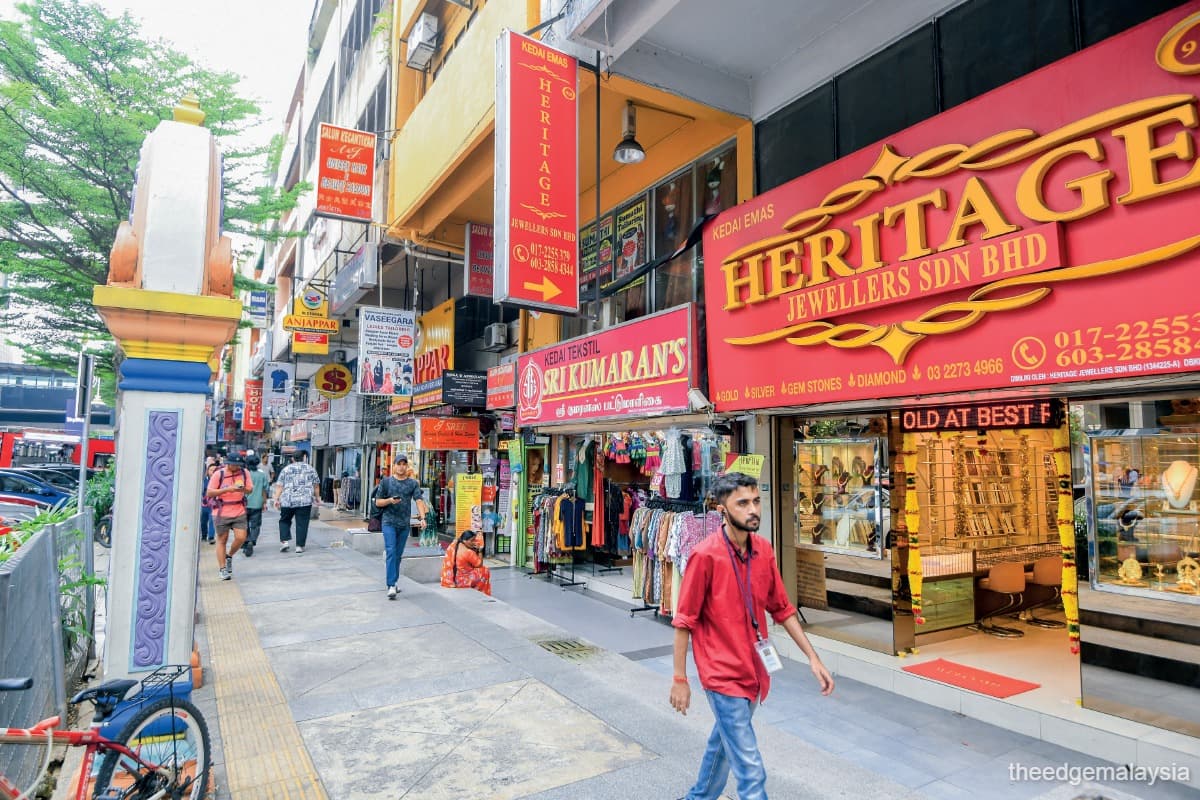
It is mid-morning and Jalan Tun Sambanthan is already teeming with life. The air is thick with the aroma of freshly fried vadai wafting from a nearby stall, and on the sidewalk a man is busy pouring cups of hot masala chai from his bicycle cart for customers. Meanwhile, mini markets selling vegetables, spices and bright garlands of jasmine are packed with shoppers.
This is Brickfields in motion. Known affectionately as Little India, it is one of Kuala Lumpur’s oldest and most storied precincts. Located just a stone’s throw from the bustling KL Sentral transport hub, Brickfields has temples, traditional shops and eateries that have stood the test of time.
Brickfields got its name from its original role as a centre for brick-making during the late 19th century — it was literally the source of bricks for Kuala Lumpur’s early expansion. The area later became a settlement for Indian labourers who were brought in by the British to work in tin mining and railway construction. This gave rise to a close-knit Indian community that became the backbone of what is now known as Little India.
Today, the vibrant enclave offers a dynamic blend of old-world charm and urban development, known for providing a sensory feast as well as for its notorious rush-hour traffic. While the area is undergoing rapid development, it remains deeply rooted in its cultural heritage.

The transformation
According to PPC International Sdn Bhd managing director Datuk Siders Sittampalam, the precinct’s evolution has been defined by a series of catalytic infrastructure projects.
“Brickfields has always been a historically significant precinct. From its colonial origins, it gradually evolved into a culturally vibrant district. But the most defining change came with the development of KL Sentral, which turned Brickfields from a local neighbourhood into a national gateway,” says Siders.
The turning point came in the 1990s, when Malaysian Resources Corp Bhd (KL:MRCB) was appointed to redevelop the old Kuala Lumpur railway station into what would become KL Sentral, Malaysia’s most prominent transit-oriented development (TOD). Its first phase opened in 2001 with the launch of the KL Sentral station, which integrates all major rail lines and connects Brickfields seamlessly to the rest of Peninsular Malaysia.
That connectivity changed everything. Commercial activity flourished, residential towers sprouted, and international corporations — from IT firms to global logistics players — made their base here. KL Sentral’s status as the country’s largest transport interchange has since anchored Brickfields as a dynamic urban extension of the city centre. In 2006, it was awarded the MSC Malaysia (now known as Malaysia Digital) Cybercentre status, attracting multinational companies and tech firms.
The precinct’s next major leap will come from the redevelopment and expansion of KL Sentral, which was approved in 2023 by the government as a public-private partnership project spearheaded by master developer MRCB. The project will upgrade facilities and increase capacity for growing commuter traffic — a move that Siders believes will further enhance Brickfields’ long-term investment value.

Amid modern redevelopment, Brickfields remains deeply tied to its cultural roots, anchored by century-old landmarks such as the Sri Kandaswamy Temple and Vivekananda Ashrama Kuala Lumpur, which stand as testaments to its enduring heritage.
“Brickfields is one of the oldest commercial areas in Kuala Lumpur and remains deeply rooted in Indian culture. You can see it in the architecture, the businesses and the vibrancy of the streets. It’s a living heritage district,” PA International Property Consultants Sdn Bhd group managing director Subramaniam Arumugam tells City & Country in an email interview.
While the Indian community continues to define the area’s identity, Brickfields has evolved into a multicultural enclave. Over the years, it has attracted Chinese and Malay residents, students from nearby institutions, as well as expatriates drawn by its accessibility and character. Educational institutions such as Methodist College Kuala Lumpur, Brickfields Asia College, which has since moved its campus to Jalan Utara in Petaling Jaya, and the Global Indian International School further enrich the local landscape.
“Brickfields today offers a blend of tradition and urban convenience. It’s a community-driven neighbourhood that has adapted without losing its soul,” says Siders.

Steady appreciation in price
Brickfields’ property market reflects its dual personality, which is part heritage and part modern. Around the area of Jalan Tun Sambanthan, decades-old shopoffices with traditional façades stand beside modern serviced apartments and high-rise condominiums catering to professionals and expatriates.
Data from PPC International, PA International and the National Property Information Centre shows varied but steady prices across both residential and commercial segments.
For instance, ground-floor retail units in 4- or 5-storey shops along Jalan Tun Sambanthan typically fetched RM1.5 million to RM1.8 million in 2024, remaining stable over the years.
Meanwhile, transacted prices for entire shoplots have varied over the past 10 years, ranging from RM943,396 to as high as RM9.5 million.
“The shops along Jalan Tun Sambanthan were constructed at least two decades ago and feature unique traditional architecture. When assessing the shops’ values, factors such as condition, design, functionality and architectural or cultural significance must be considered,” notes PA International’s Subramaniam.
On the residential front, serviced apartments and condominiums dominate, appealing to both investors and owner-occupiers. Units in Suasana Sentral Condominium with built-ups of 797 to 1,528 sq ft have recently transacted between RM622 and RM869 psf.
Siders adds that other developments such as Menara Pelangi, Villa Scott and Alila Bangsar also record consistent secondary market activity. “Rental demand remains robust, especially near KL Sentral and Jalan Ang Seng, with rates ranging from RM1,000 to RM1,350 per month for flats/apartments and RM1,500 to RM2,900 per month for condominiums, supported by strong commuter traffic and expatriate occupancy,” he says.
The commercial rental market in Brickfields is vibrant. Ground-floor shopoffices along Jalan Tun Sambanthan can command premium rents of RM7,500 to RM12,000 per month for units between 1,100 and 2,000 sq ft, while upper-floor units cater to smaller offices, tuition centres and service providers at RM950 to RM3,500 per month, according to Subramaniam.
This diversity mirrors Brickfields’ mixed urban ecosystem, where old-school spice shops, eateries and clothing stores coexist with modern cafés and convenience chains. Yet, as Subramaniam points out, rising costs and redevelopment pressures are slowly reshaping the local business fabric.
“While new developments bring growth, smaller traditional businesses struggle with higher rentals and changing demographics. There is a risk of losing the local identity that defines Little India,” says Subramaniam.
Given its mature urban fabric and central location, vacant land in Brickfields is extremely limited. Most parcels have already been developed into residential, commercial or mixed-use projects.
Among the ongoing projects, Riveria City stands out as a significant TOD off Jalan Sultan Abdul Samad, 100m from the Tun Sambathan Monorail station.
A joint venture between Titijaya Land Bhd (KL:TITIJYA) and Prasarana Group, Riveria City comprises multiple phases, including The Riv (completed and fully sold in 3Q2024) and The Ria, now open for sale, offering 752 serviced apartments (650 to 800 sq ft) from RM685,000.
Meanwhile, SkyAwani Prima, a collaboration between SkyWorld Development Bhd (KL:SKYWLD) and PR1MA Corp Malaysia, introduces a dose of affordability with 491 units of 900 sq ft apartments priced around RM390,000.
“These projects reflect the dual market in Brickfields. You have compact urban homes targeting young buyers alongside higher-end developments for professionals. The challenge will be maintaining balance and ensuring that affordability remains part of the mix,” says Subramaniam.

Growing pains
With growth comes congestion. Narrow roads, high population density and increased plot ratios under the TOD concept have worsened traffic bottlenecks and parking shortages.
“The physical constraints are real. As more high-rises come up, infrastructure improvements must keep pace, otherwise liveability will suffer,” notes Subramaniam.
A restaurant operator on Jalan Tun Sambathan, who has been in operation since 1989, recalls that the stretch of road used to be double-laned. “Now it’s a one-way street, so parking is a major problem. As a result, we lost many customers initially. All those who double-parked would be fined, so people slowly avoided coming.
“But ever since the offices started opening around the area, we have seen more office crowds coming in during lunch hours. Plus, we’re open 24 hours every day, so we’re a favourite among the night shift workers as well. Additionally, since KL Sentral is nearby, we often attract tourists who come to try our Indian food. So in a way, we’re benefiting from the developments here,” says the operator.
Equally concerning is the risk of cultural dilution. As chain retailers and modern cafés replace long-standing traditional trades, some fear that Brickfields’ identity as Little India could fade. PPC’s Siders emphasises that urban renewal should not come at the expense of heritage.
“Brickfields’ charm lies in its authenticity. Preserving cultural landmarks and local businesses must go hand in hand with redevelopment. That’s what will sustain its appeal over time,” says Siders.
He adds that the introduction of international chain stores and retail outlets in NU Sentral, which is located along Jalan Tun Sambathan, has also created fierce competition for local businesses that previously catered to a more budget-conscious clientele.
“Additionally, while Brickfields has seen an increase in high-end residential developments, affordable housing options have become scarce. The demand for affordable homes has been overshadowed by luxury developments, making it harder for middle- and lower-income groups to find suitable housing within the area,” says Siders.
Nonetheless, both consultants agree that certain sectors have benefited from the rapid development, notably real estate, retail, hospitality and F&B. With its connectivity and steady commuter flow, Brickfields continues to attract multinational corporations, business travellers and urban dwellers, supporting strong demand across both the property and services sectors.

A resilient outlook
Both Siders and Subramaniam are optimistic about Brickfields’ long-term potential. The redevelopment of KL Sentral and ongoing TOD projects are expected to sustain property values and reinforce Brickfields’ role as a transit-centric hub.
“The market should remain resilient. Future values will likely stabilise or improve once the KL Sentral upgrade materialises, as better connectivity and commercial vibrancy lift surrounding assets,” says Subramaniam.
For Siders, the key lies in smart regeneration. “The future of Brickfields is not about building higher or denser, it’s about integrating the new with the old. Adaptive reuse, community-oriented projects and heritage-led design will unlock value while keeping the area’s identity intact.”
For all its challenges, Brickfields remains a microcosm of Malaysia’s urban evolution — a place where progress meets memory, and where the heart of Little India continues to beat beneath the rhythm of the city.
Save by subscribing to us for your print and/or digital copy.
P/S: The Edge is also available on Apple's App Store and Android's Google Play.