

This article first appeared in The Edge Malaysia Weekly on November 24, 2025 - November 30, 2025
AXIS Real Estate Investment Trust’s (KL:AXREIT) (Axis REIT) proposed RM800 million land acquisition in Seberang Perai is seen as a landmark deal in both size and value. It reinforces optimism about the long-term potential of mainland Penang, which is often perceived as the economic backwater of the state.
In one of this year’s largest industrial land deals, the trust is acquiring a 135.53-acre tract in Seberang Perai from Ann Joo Steel Bhd. The asset comprises freehold land and existing industrial facilities in the strategic industrial zone on the mainland.
After the acquisition, Ann Joo will lease back the property for eight years at RM4.156 million per month. From the fifth year, the lease structure allows for phased surrender of portions of the site to Axis-REIT, with rental adjustments made accordingly.
JLL Malaysia managing director Jamie Tan tells The Edge that Axis-REIT’s acquisition stands out for its scale and price. “RM800 million for a single industrial parcel in Seberang Perai is very large for the northern market,” Tan says, noting that Penang recorded just 214 industrial transactions worth nearly RM866 million in 1H2025, highlighting the concentration of value in this deal.
He adds that the freehold site offers significant redevelopment potential once the lease expires. “Axis-REIT will be well placed to reposition or redevelop the asset to meet future industrial demand. With Penang’s growing role in advanced manufacturing and logistics, coupled with rising land scarcity, the long-term potential to unlock higher-value uses on the site could prove highly strategic,” he says.
Knight Frank Malaysia advised both parties on the transaction. Allan Sim, head of land and industrial solutions, says Penang’s industrial sector continues to attract strong FDI into manufacturing, making it an opportune time for landowners to unlock the value of their assets amid steady demand for industrial space.
He adds that sustained demand from local and international manufacturers, backed by Penang’s industrial ecosystem, strategic connectivity and proactive government support, reinforces confidence in the state’s long-term growth and its position as a top destination for quality industrial developments in Malaysia.

Strong fundamentals
Penang continues to affirm its position as one of Malaysia’s leading destinations for foreign direct investment (FDI) in manufacturing, driven by robust demand across key industrial zones including Bayan Lepas, Batu Kawan and Seberang Perai. This momentum is fuelled by expansion in high-value sectors such as logistics, electronics and semiconductors.
The state recorded RM12.5 billion in approved manufacturing investments in the first half of 2025, with RM10.5 billion attributed to FDI — representing 84% of total approved manufacturing investments, Raine & Horne International consultant Datuk Linda Geh tells The Edge, citing data from InvestPenang. The top three sources of investment originated from the US, China and the Cayman Islands.
She adds that a major highlight from the World Expo 2025 in Osaka was the unveiling of more than RM5 billion in development projects, including the Penang International Logistics Aeropark (Pila). Spearheaded by Penang Development Corp (PDC), Pila will operate as a free commercial zone (FCZ) at Penang International Airport. FedEx has committed RM46 million via a memorandum of understanding with PDC to develop a 100,000 sq ft integrated logistics facility between 2028 and 2030.
JLL Malaysia’s Tan notes that Penang’s industrial market remains stable, supported by strong fundamentals and a consistent pipeline of high-value investments. “The state’s globally recognised electrical and electronics (E&E) cluster — accounting for about 40% of Malaysia’s total exports in 2024 — continues to attract multinational corporations seeking diversification under the ‘China+1’ strategy,” he adds.
In recent years, there has been a surge in foreign investment, particularly in semiconductor assembly, testing and advanced packaging. “These anchor projects have generated positive spillover effects across the supply chain, increasing demand for modern, high-specification industrial and logistics facilities,” says Tan. “Penang’s strategic location, coupled with its connectivity via Penang Port (which handled more than 32 million freight weight tonnes in 2024), road networks and air infrastructure, provides manufacturers with significant logistical and cost advantages.”
Tan also emphasises the importance of Penang’s skilled workforce and mature industrial ecosystem. Decades of E&E activity have cultivated a deep talent pool of engineers, technicians and specialised operators, supported by local universities and vocational institutions, he says. This talent availability enables manufacturers to scale high-value operations efficiently.
While the National Property Information Centre (Napic) reported a 2.7% year-on-year dip in industrial property transaction volume in 1H2025, the total transaction value rose 1.7%, indicating a shift towards higher-value assets in prime locations. Tan suggests this may reflect cautious investor sentiment amid global trade uncertainties, though long-term interest in Penang remains strong.
Raine & Horne’s Geh concurs, highlighting Penang’s resilience and attractiveness amid evolving trade policies. With its skilled workforce, robust supply chain, world-class infrastructure and longstanding multinational presence, Penang has earned its reputation as the “Silicon Valley of the East”.

Stable upward momentum
Malaysia’s industrial property market outlook remains broadly positive, supported by a resilient manufacturing base, strong export performance and improved policy clarity, following the recent Agreement on Reciprocal Trade (ART). Tan adds that the exemption of 1,711 goods under the ART is expected to bolster investment sentiment, particularly in export-driven sectors such as electronics, automotive components and precision engineering.
“Regional performance will vary based on fundamentals such as infrastructure connectivity, proximity to ports and airports, talent availability and ecosystem maturity. Penang stands out for its advanced manufacturing capabilities, particularly in the E&E sector, which continues to attract multinational and domestic investors,” he says.
To sustain this momentum, Tan underscores the importance of continued infrastructure investment — especially in transport and utilities on the mainland — and talent development to support the growing E&E cluster. Policy consistency and trade clarity will also be critical in maintaining long-term investor confidence.
“As global supply chains diversify and manufacturing strategies evolve, Penang is well positioned to consolidate its role as one of Southeast Asia’s most competitive and innovation-driven industrial hubs. While transaction volumes have moderated slightly, the value of industrial property deals has increased, reflecting a shift towards higher-value assets in prime locations,” he says.
Tan concludes that industrial land and rental prices are expected to stabilise soon, supported by a growing supply pipeline. “However, ready-built facilities with substantial power capacity — particularly those equipped with 11kV substations — will continue to attract strong interest,” he says, noting that such assets offer immediate operational-readiness, reducing time-to-market and capital expenditure on infrastructure upgrades.
Notably, Penang is undergoing a series of robust infrastructure upgrades aimed at sustaining operational capacity, meeting rising industrial demand and reinforcing its competitiveness as a regional economic hub.
A cornerstone of Penang’s transport transformation is the LRT Mutiara Line — a 29.5km route featuring 21 stations. The line will connect Penang South Reclamation Island A (PSR-A) to key urban and industrial nodes, including Penang International Airport, Macallum and Komtar, terminating at Penang Sentral. Upon completion, this transit corridor will significantly improve accessibility across the island and mainland, supporting workforce mobility and industrial logistics.
The expansion of Penang International Airport, which is expected to be completed by 2028, will see increased annual passenger handling capacity almost doubling to 12 million, from 6.5 million.
Scheduled for completion by 2030, the Juru–Sungai Dua Elevated Highway will streamline traffic flow by segregating local traffic from northbound and southbound through-traffic. This infrastructure will alleviate congestion at critical intersections, including the Penang Bridge, Prai and Permatang Pauh, improving access to industrial zones and logistics hubs.
The Ministry of Transport plans to construct an additional railway track in Penang Port to facilitate direct loading of rail carriages. This enhancement is expected to improve cargo handling efficiency, reduce road congestion in surrounding areas, and strengthen Penang’s position as a logistics and export-oriented manufacturing hub.
Land constraints on island drive demand in mainland
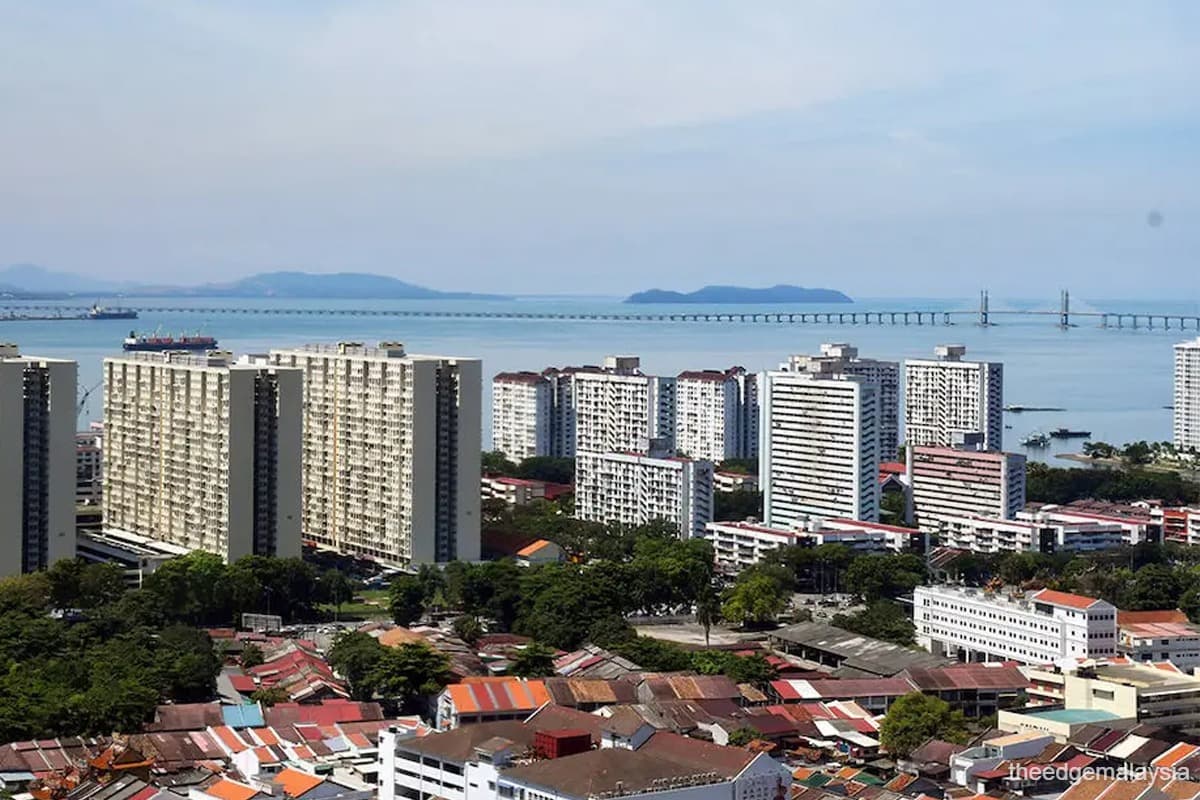
Penang’s industrial property market is experiencing a strategic shift towards the mainland, driven by the limited availability of greenfield sites on the island. According to Geh, this scarcity has redirected industrial expansion to mainland zones such as Batu Kawan, Bukit Minyak, Bukit Tengah, Valdor and Perai. These locations offer larger, contiguous land parcels and superior infrastructure connectivity, making them highly suitable for purpose-built industrial developments and long-term investment.
Geh notes that the Batu Kawan Industrial Park (BKIP), comprising BKIP 1 to 3 in Bandar Cassia, has emerged as a key industrial hub. Its proximity to the Second Penang Bridge (Sultan Abdul Halim Muadzam Shah Bridge) provides seamless access to Bayan Lepas Industrial Park and Penang International Airport, enhancing logistics efficiency. Industrial land prices in these zones are said to have remained stable with an upward trend.
Tan concurs, highlighting that the mainland’s appeal lies in its accessibility to the North–South Expressway and Penang Port, as well as its ability to accommodate larger-scale developments. The scarcity and fragmentation of land on the island — coupled with higher price points — have prompted investors to seek expansion opportunities across the bridge. Asking prices of prime, privately owned industrial land on the mainland typically range between RM100 and RM150 psf, depending on tenure and infrastructure-readiness.
PDC is also actively developing other “infra ready” industrial parks, including BKIP3, Bandar Cassia Technology Park and Penang Science Park South. The selling price of industrial land (with a leasehold tenure of up to 60 years) for the newly launched BKIP3 developed and managed by PDC, for example, is said to be around RM105 psf.
Save by subscribing to us for your print and/or digital copy.
P/S: The Edge is also available on Apple's App Store and Android's Google Play.