

This article first appeared in The Edge Malaysia Weekly on November 24, 2025 - November 30, 2025
THE end of this month marks two years since GXBank officially launched its application (app), becoming the country’s first digital bank.
Operated by GX Bank Bhd, it commenced operations on Sept 1, 2023, and after a series of beta tests, opened its app to all Malaysians on Nov 30 that same year.
Today, it serves “1.2 million-plus” customers, according to its CEO Kaushik Chowdhury — better known as KC in the industry.
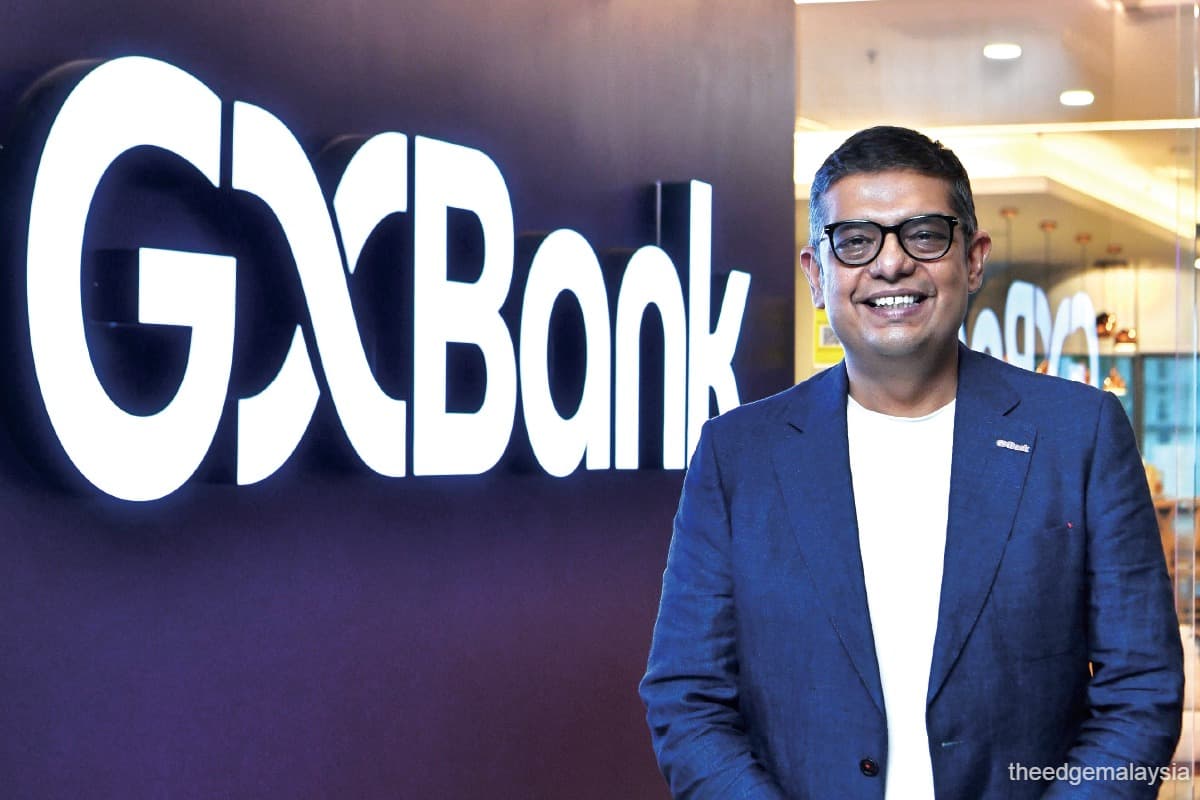
“It’s been really thrilling,” says KC, who was part of the founding team and took over as CEO in June this year after his predecessor, Pei-Si Lai, was appointed group CEO of Singapore-based GXS Bank Pte Ltd.
“I joined the bank before the first line of code was written. The progress has been immense, and the destination is nowhere in sight — that’s what makes it exciting,” he tells The Edge at the bank’s headquarters in 1 First Avenue, Bandar Utama, Petaling Jaya.
GXBank kicked off with what KC calls the “foundational products” of any bank: savings accounts and payments. On the payments front, the bank embedded itself into daily user journeys by offering full DuitNow functionality, rolling out a debit card that has now surpassed one million cards issued — “we crossed a million just recently,” KC reveals — and integrating seamlessly with the Grab app to allow users to pay directly from their GXBank accounts.

Deliberate deposit strategy
Deposits are a bank’s lifeblood, enabling lending. However, according to KC, despite strong customer acquisition, GXBank has maintained a conscious restraint on deposit growth so far.
Public filings show customer deposits ended 2024 at around RM1.32 billion, before easing slightly by about 4.9% to RM1.26 billion as at end-June this year. Total assets stood at about RM1.58 billion at that point.
“If you track our publicly declared numbers, you will see that we have actually not grown deposits. In fact, deposits have come down. That is a conscious strategy,” KC shares.
GXBank launched with a 3% savings rate — applicable to both its main accounts and its “pockets” feature used for goal-based savings — before revising it to 2% in October last year. The rate has stayed unchanged since, even as competitors launched aggressive promotional campaigns, KC points out.
“We’ve never touched the basic rate apart from that one revision. We don’t intend to. That pricing philosophy is part of our DNA. Five years later, if half our users realise this, they will love us more than the other banks.”
While the bank does run occasional promotional rates, he stresses these are tactical in nature. “We will certainly do something for our users around our anniversary. But this is not our business strategy. We won’t keep changing rates or creating [different tiers].” (The bank plans to celebrate its second anniversary on Nov 27.)
Offering appealing rates at launch is typical for digital banks, he acknowledges. “You will have to come with a higher rate for people to even try you out in the beginning, which is what we did.” GXBank’s highest-ever promotional rate was 5% per annum for a Hari Raya pocket that ran for about a month last year.
Rapidly scaling lending
GXBank’s second year has centred on expanding its lending portfolio.
“This year, we were super-focused on growing our lending book. There’s going to be a phenomenal year-on-year growth,” KC says.
GXBank rolled out FlexiCredit — a personal line of credit — to the general public in February, after a pilot phase that began in November 2024. Unlike a traditional personal loan, FlexiCredit offers users a credit line they can draw down as needed, with fully digital approvals and no prepayment penalties.
“We can give you a loan in eight to 10 minutes flat,” KC says. “If you pass the credit assessment, it’s instant. In an emergency, that matters.” The average individual drawdown is RM7,500 to RM8,000, which is about half the given credit line.
The bank has received half a million applications for FlexiCredit, he shares.
To better understand user experience, the bank surveyed 19,000 FlexiCredit customers. “What they told us gives us a lot of confidence. They love the speed, the convenience and especially the flexibility. Why take a big personal loan if all you need is RM1,000?” KC says.
He adds that the “most powerful feature” is the fact that there are no prepayment fees. “We’re the only product in the market with no prepayment fee. Users love it because they feel we’re not punishing them for being responsible. It gives them incentive to pay back faster, which improves their credit scores.”
GXBank has also expanded into micro-SME (small and medium enterprise) financing, launching FlexiLoan for sole proprietors — a segment underserved by the banking system. “This is the part of the market that traditional financial institutions don’t cover well. That’s why we started here,” he says. The average FlexiLoan ticket size is “more than RM35,000”.
The bank intends to accelerate this segment further. “We want to really double down on sole proprietors. Next year, we want the kind of growth we saw in retail to be replicated in micro-SMEs.”
GXBank also sees strong demand in other categories, such as used-car financing for Grab workers and other gig workers, but KC intends to move cautiously. “We see a big market in autos, especially used cars, but it will require more capital and investment [before we go there].”
Home loans, he says, are not in the bank’s near-term plans for similar reasons.
GXBank’s lending book — combining retail and micro-SME — surged to RM174.18 million as at end-June from just RM4.94 million six months earlier.
“We are getting ourselves into a position where our lending is growing fast enough. And now, I really have a requirement to raise more deposits next year. So that creates the flywheel.”
KC says many have asked why GXBank did not simply push aggressively for more customers and deposits early on. “We are just being very calibrated and thoughtful about it. We need to manage user love with commercial acumen and a great technology company. We need to balance all three.”
Early signs of fulfilling its mandate
GXBank was one of five digital banks licenced by Bank Negara Malaysia to cater to those unserved or underserved by the banking system.
The bank is a subsidiary of GXS Bank Pte Ltd — the 60:40 joint venture between Grab Holdings Ltd and Singapore Telecommunications Ltd — and is also owned by a consortium of other Malaysian investors, including Kuok Group. (The Edge was not immediately able to obtain the bank’s latest shareholding.)
According to KC, GXBank’s core customer base is aged between 21 and 30, with monthly incomes below RM4,000. More than half of the bank’s customers fall into the underserved segment, defined as Malaysians earning less than RM3,000 or gig workers.
Notably, “almost 30%” of its customers are unserved — earning less than RM2,000 a month — and are receiving their first-ever loan from GXBank.
Asked whether GXBank feels it is fulfilling its digital banking mandate, KC says: “We are showing early promise that we can indeed do it. But I will not go and claim victory. We definitely see that you can build a business that caters to this segment, serve them digitally, and keep them away from informal lenders [such as loan sharks].”
Early indicators of asset quality have been encouraging. “My real credit losses are less than 1% if you take out fraud,” KC notes. But he caveats this with: “It is still early, so the prudent view is to monitor over a full credit cycle. But current flow rates are low, and customer intent has been very positive.”
The bank checks Central Credit Reference Information System (CCRIS) records, CTOS scores and, with customer consent, Grab behavioural data to assess applicants — particularly those new to the formal credit system.
“This is where our ecosystem advantage becomes clear. If a customer has no bureau history, but consents to sharing relevant Grab data, we have enough signals to assess creditworthiness responsibly,” KC says.
He also challenges assumptions about higher-risk segments. “There is a hypothesis that lower-income customers carry higher risk. But what we have observed so far is that many of our lower-income borrowers repay reliably because they are using the funds for genuine, immediate needs, not discretionary spending.”
Originally from India, KC previously held retail banking and digital roles at Standard Chartered in both Singapore and Malaysia before joining GXBank.
On track for a 2027 break-even
Like most digital banks in their initial years, GXBank continues to record losses. KC says the bank remains “absolutely on track” to break even by 2027 — technically, its fourth year of operations. Bank Negara requires digital banks to show a path to profitability in year five.
“2027 is our break-even year, and 2028 will be a full profitable year,” he says.
Digital banks in Malaysia are subject to a RM3 billion asset cap during their foundational phase, covering their first three to five years. GXBank’s assets stood at RM1.58 billion as at end-June.
According to KC, GXBank hopes to “graduate” from this phase next year. (It hits the three-year mark in August.)
“We intend to go to Bank Negara [in August] and ask for approval to graduate. They will obviously have to assess us, and we will work with them,” he says.
Last year, GXBank widened its net loss to RM234.6 million from RM193 million in 2023. For the first half of 2025, net loss stood at RM119.9 million.
Save by subscribing to us for your print and/or digital copy.
P/S: The Edge is also available on Apple's App Store and Android's Google Play.