

This article first appeared in Forum, The Edge Malaysia Weekly on November 24, 2025 - November 30, 2025
Across sectors and over recent years, increasingly sustainability has become part of every strategy presentation and annual report. Boards of directors have been signing on to net zero commitments, investors scrutinising environmental, social and governance (ESG) performance and consumers rewarding responsible brands. Yet, when it comes to decisive action on climate, progress appears to be falling short of ambition.
The sustainability paradox: Awareness doesn’t always lead to action
We have been witnessing pledges made — and postponed. Targets set — and quietly revised. It does not appear to be a lack of data, capital or capability. The true challenge perhaps lies elsewhere: in the way humans think and decide.
Businesses already know the risks, and scientists, insurers and economists have quantified them in painful detail. Climate disruptions are now made a culprit to affect everything from agricultural yield to supply chains, insurance premiums and consumer preferences, yet most organisations still treat sustainability as an initiative, not an operating principle.
Sustainability demands decisions that are long term, cross-functional and uncertain — conditions under which biases thrive. Even experienced executives fall back on habits of thought that prioritise the visible, immediate and familiar.
Our brains, shaped for short-term survival rather than long-term planetary stewardship, are prone to subtle distortions, known as cognitive biases. These mental shortcuts on the one hand help us simplify complex decisions but can also cloud judgment, especially on issues like climate change that have been unfolding for over a decade now, not days.
Understanding these biases makes leaders aware, as an important step toward designing decisions that account for human nature, rather than being blindsided by it.
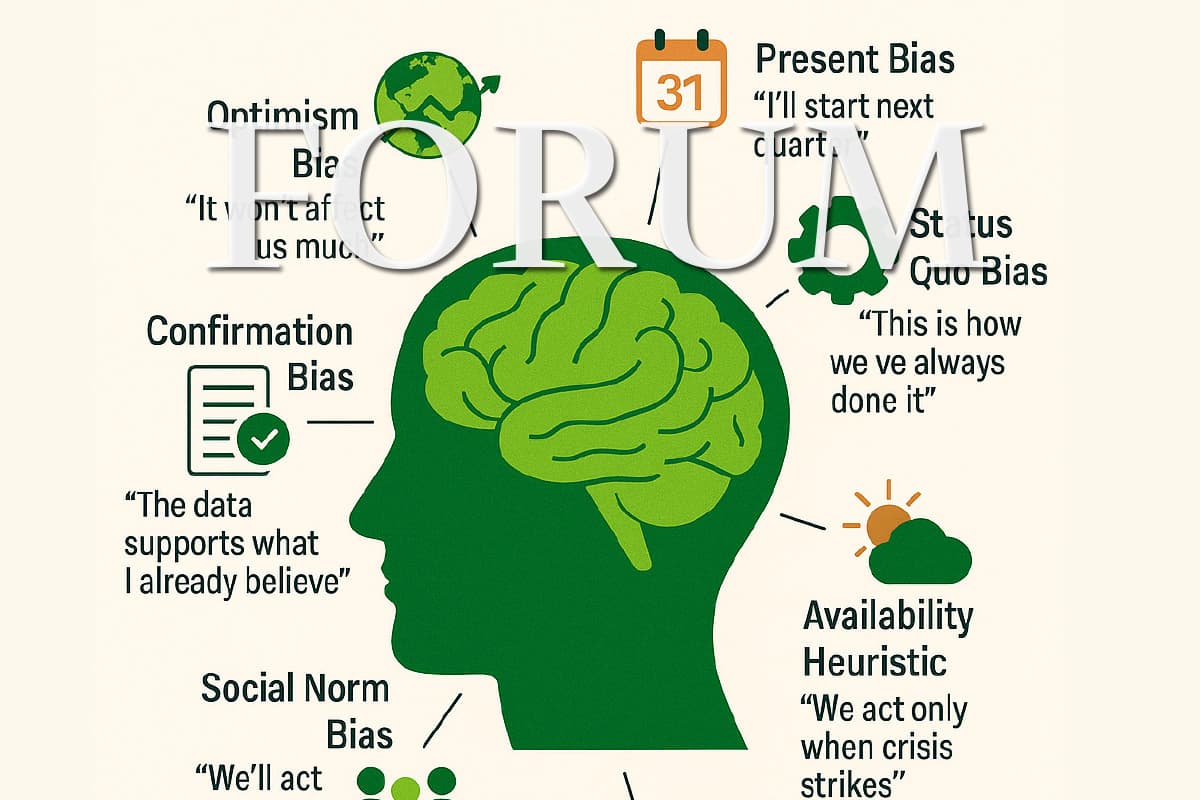
1. Present bias: The tyranny of the quarter
Short-termism is one of corporate life’s most powerful gravitational pulls. Most incentive systems — from quarterly earnings to annual key performance indicators (KPIs) — reward the immediate. That makes climate action, whose benefits often unfold over a decade, a hard sell internally. An energy-intensive manufacturer may delay adopting renewable systems because the payback horizon exceeds its current planning cycle. A retailer may stick to low-cost packaging even when sustainable alternatives could yield long-term loyalty benefits.
In behavioural terms, this is present bias — our tendency to overvalue the “now”. To overcome it, even possibly incentives need to be redesigned: perhaps include three- to five-year sustainability outcomes with quarterly metrics to redesign executive rewards and growth plans, set near-term milestones visible through interim reporting and link immediate business value such as cost savings or risk mitigation to long-term climate goals.
2. Status quo bias: The comfort of the familiar
Organisations, like individuals, prefer what’s familiar. They operate on established supply chains, technologies and vendor relationships built over years. Changing those systems — even for better environmental performance feels risky and disruptive. This status quo bias explains why many industries cling to incrementalism: adding recycling drives or paperless billing rather than reimagining entire business models. Take fast fashion. Despite global attention on textile waste, most brands still run high-churn product cycles because the existing model “works”. It delivers quarterly growth, even if it undermines long-term sustainability.
Once recognised, this bias can be countered by reframing sustainability as modernisation — not disruption — with “green transformation” not being seen as a threat to legacy models but a way to future-proof them.
3. Confirmation bias: Selective optimism in the boardroom
Executives often interpret climate data through the lens of what they already believe about their business. This confirmation bias shows up in phrases like “Our footprint isn’t significant” or “Consumers in our segment don’t care much about sustainability”. Organisations tend to highlight successes (carbon offsets, corporate social responsibility programmes) and downplay inconvenient data (Scope 3 emissions, unsustainable sourcing). As a result, decisions too are often based on curated evidence rather than complete reality.
Companies that avoid this trap usually build internal “dissent mechanisms” — cross-functional review teams, third-party audits or sustainability councils empowered to challenge assumptions. The approach isn’t that of denial or confrontation. It is clarity.
4. Social norm bias: Waiting for others to move first
Few companies want to be the first to incur costs that competitors have not. This is social norm bias at play: the instinct to conform to what others in the ecosystem are doing. Consider how earlier on several organisations waited for their peers to commit to net zero before making their own announcements. Even within industries, many sustainability efforts gain momentum only once a critical mass forms.
This herd behaviour isn’t always negative — it can be harnessed. Positive peer pressure can be created by publicly sharing sustainability metrics, forming coalitions or participating in industry commitments. When responsibility becomes visible, imitation becomes a catalyst, not a barrier.
5. Optimism bias: ‘It won’t affect us directly’
Executives are often optimists by necessity. But overconfidence can dull the perception of risk. Optimism bias could lead companies to assume that climate disruptions will affect “others” — suppliers, markets, regions — but not them. The 2022 floods in Thailand that disrupted global automotive and semiconductor supply chains, or the 2023 droughts that affected European manufacturing cooling systems, proved otherwise. The ripple effects of climate risk are no longer abstract.
Businesses that internalise this lesson begin treating sustainability as risk management, not philanthropy, embedding it into supply chain resilience, procurement policies and financial planning.
6. Cognitive dissonance: Reconciling intent and action
When words and actions diverge, organisations experience cognitive dissonance, often reflected through selective storytelling. A company might publish an ESG report highlighting community projects while continuing to invest in carbon-heavy operations.
This isn’t hypocrisy — it’s psychology. Leaders and organisations rationalise conflicting actions to maintain a coherent self-image. Recognising the gap between intention and implementation is an opportunity, not a flaw. Companies that acknowledge their limitations soon enough and correct them often build more trust than those claiming perfection.
7. Availability heuristic: Acting only after crisis
Humans react strongly to what they can see and feel in the present. Climate events like floods or wildfires trigger temporary surges in awareness, but once the headlines fade, urgency fades too.
This availability heuristic explains why sustainability programmes often spike after crises, losing momentum over time thereafter. The challenge is to make future risks visible now. Scenario simulations, interactive dashboards and storytelling can help executives visualise how today’s choices shape tomorrow’s business continuity.
Bringing behavioural insight into climate strategy
Recognising biases such as some outlined above is only half the journey. The real opportunity lies in redesigning decisions so they work with human tendencies rather than against them. For starters, just a few practical ways organisations could do this are brainstormed and outlined below.
- Using defaults wisely: Make sustainable options the default in procurement, travel or product design such as paperless billing or energy-efficient settings.
- Framing sustainability as opportunity: Link it to cost optimisation, brand differentiation and investor confidence.
- Making progress visible: Create short-term wins and feedback loops, so teams experience the satisfaction of forward movement.
- Leveraging social proof: Publicise success stories internally and externally to normalise sustainable behaviour.
- Embedding of behavioural checkpoints: Include behavioural-risk reviews in project planning, alongside financial and operational reviews.
These approaches, known collectively as behavioural design or “nudge strategies”, respect human psychology while steering it towards more sustainable outcomes. The underlying principle: if we design systems that acknowledge how people actually decide, not how we expect them to, sustainability goals could become achievable.
From awareness to accountability
The climate challenge is no longer about awareness, as that stage is well past — it is about action. Business leadership is now at the intersection of economics and ecology, and the choices today shape the resilience of tomorrow’s markets. Yet acting decisively requires a mindset shift: seeing sustainability not as a cost centre or a moral statement but as a core business strategy guided by an understanding of human behaviour.
The more forward-looking companies are already doing this — tying executive compensation to long-term climate goals, integrating behavioural metrics into ESG reporting and treating every operational decision as a behavioural opportunity.
Because, ultimately, climate strategy is not only about technology or policy — it is about people. The more we understand human biases, the better we can design for them. And the more we design for them, the closer we get to translating climate awareness into meaningful, measurable and lasting action.
Dr Salim Khubchandani is a marketing and consumer-insights professional with over four decades of industry experience across India and Southeast Asia. He is founder of On-Target, a consulting practice specialising in consumer neuroscience, data analytics and behavioural insights, and serves on the advisory board of companies.
This column is part of a series coordinated by Climate Governance Malaysia, the national chapter of the World Economic Forum’s Climate Governance Initiative. CGI is an effort to support boards of directors in discharging their duty of care as long-term stewards of the companies they oversee, specifically to ensure that climate risks and opportunities are adequately addressed.
Save by subscribing to us for your print and/or digital copy.
P/S: The Edge is also available on Apple's App Store and Android's Google Play.