

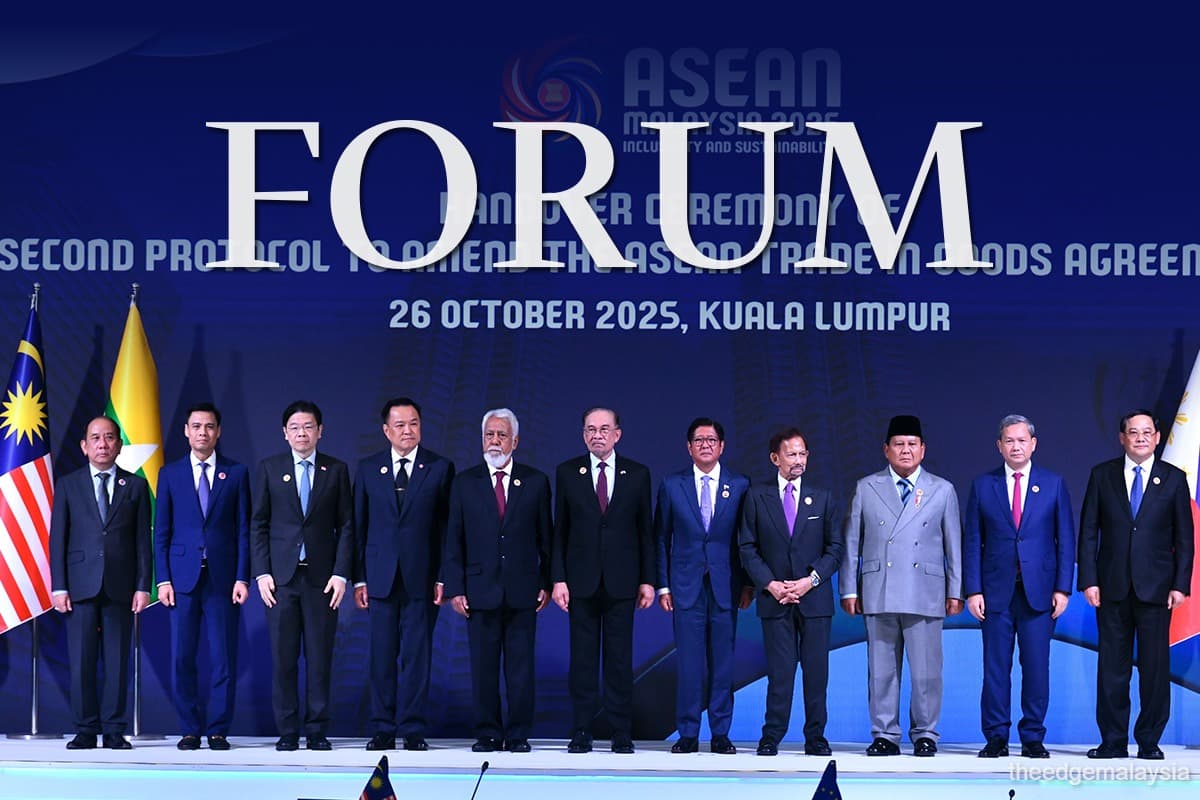
This article first appeared in Forum, The Edge Malaysia Weekly on November 24, 2025 - November 30, 2025
The global trade map is being redrawn, and Asean has a window of opportunity to not just adapt, but to lead. The decisions taken now will shape whether the region continues as a passive recipient of external shocks or emerges as an active shaper of its own economic destiny. As this year’s Asean chair, ensuring the region takes practical steps to build long-term resilience is one of the top priorities for Malaysia.
Against this backdrop, Asean businesses are clear and vocal about what they need. Volatility is not new to the region — firms have navigated currency crises, trade disruptions and shocks before — but the simultaneity and scale of today’s geoeconomic shifts have created a uniquely complex challenge.
Three forces in particular stand out: economic fragmentation with diverging policies and standards reshaping trade flows; the reconfiguration of economic blocs as partnerships are redrawn; and a surge in industrial output, driven by global overcapacity, that risks displacing Asean’s domestic industries.
With this heightened urgency, Asean has begun to take more proactive measures. A series of high-level meetings was convened earlier this year and consultations with key partners took place. It had also established the Asean Geoeconomic Task Force (AGTF), designed to strengthen early warning systems, coordinate crisis responses and promote policy coherence. The AGTF, co-chaired by Malaysia’s Deputy Minister of Investment, Trade and Industry Liew Chin Tong, is working to synthesise strategic recommendations on how Asean can navigate the intensifying global economic headwinds, and capture it in the Asean Integration Report.
In the light of these developments, Boston Consulting Group (BCG) conducted a survey of over 100 businesses across Asean spanning the impacted sectors, including automotive, machinery, consumer electronics, fashion and luxury, and energy. The findings paint a revealing picture — the shocks from geoeconomic disruptions are being felt, but the resilience Asean businesses have built since Covid-19 means they are not paralysed by the impacts. More importantly, firms are sending a clear signal that what they need now is structural interventions at the Asean level, not short-term relief.

Geoeconomic risks are real, but businesses are adapting
More than 90% of businesses surveyed acknowledged being directly impacted by recent geoeconomic events. The effects range from input-cost volatility and shipping delays to raw material shortages. On average, supply chain disruptions stretched delivery times by six weeks and cut production capacity by 17%.
Yet, despite these headwinds, companies remain resilient. The majority (70%) of respondents expressed confidence in their ability to withstand future shocks, citing dual sourcing strategies, higher inventory buffers and real-time supply chain tracking as key tools. For many, Covid-19 served as a crucible for resilience, forcing firms to rethink supplier networks and build redundancy into their operations.
Tariffs are only one part of the puzzle
When asked which risks mattered most, businesses ranked economic fragmentation as a top concern, followed closely by the surge in industrial output and the reconfiguration of blocs. But the picture is uneven across sectors.
In the automotive sector, 38% of firms cited import surges as the most significant threat, particularly from an influx of low-cost electric vehicles flooding the region. In fashion and luxury, 47% pointed to shifting markets and sustainability standards in Europe as disruptive risks.
These differences underscore that visible measures like tariffs are only the tip of the iceberg. Beneath them lie deeper structural shifts such as standards, overcapacity and bloc realignment that require a coordinated response.

Asean: A winner so far, but the rules are changing
BCG’s survey highlights how Asean has benefited from supply chain shifts to date. Two-thirds (65%) of companies reported changing suppliers over the past year, with many reducing their reliance on China and broadening sourcing within Asean. Nearly half had also adjusted their customer base, with some firms expanding exports to new markets.
However, businesses caution that Asean cannot afford complacency. While 60% of respondents plan to invest further in Asean over the next 12 months, the drivers are still low costs and a growing market size. Moving forward, long-term competitiveness will depend on productivity, innovation and the ability to comply with evolving global standards, not just cost advantages.
Absorbing costs, but at what price?
The survey also reveals a telling detail — more than 80% of firms have seen their input costs rise in recent months, with 64% choosing to absorb the costs rather than pass them on. While this preserves competitiveness in the short term, it squeezes margins and limits capacity for reinvestment.
The pressure will be felt most acutely by micro, small and medium enterprises (MSMEs), which often lack the buffers of larger firms. As businesses increasingly relook at their financing options and tighten supplier management to cope, MSMEs risk being caught in the squeeze — facing higher financing costs, stricter terms and fewer opportunities to reinvest for growth. In the long run, this approach is unsustainable unless structural conditions like stronger regional value chains improve.
What businesses want: Structural Asean interventions
Perhaps the clearest message from the survey is what businesses do not want — fiscal bailouts. Fewer than 20% of firms cited pooled fiscal support as a priority. Instead, more than 80% called for Asean-level measures to strengthen resilient value chains.
The top asks were:
- Coordinated market diversification efforts;
- Stimulating regional demand;
- Developing regional champions; and
- Assisting in cross-border supply chain reconfiguration
As one fashion company put it, “Trade policies within Asean need to be more seamless to navigate.” Another consumer electronics firm stressed, “We would love to see partnerships across new markets such as Canada, South America and Australia.”
The findings carry important lessons for Asean governments and policymakers:
● Move beyond cost competitiveness: Asean’s advantage as a low-cost production hub is eroding. Businesses are asking for investments in productivity, skills and innovation ecosystems.
● Accelerating regional integration: Asean’s resilience will hinge on how quickly it can move from a collection of national strategies to a truly integrated market. Reducing regulatory frictions will enable supply chains to function seamlessly across the region.
● Strengthen Asean as a consumption market: Today, Asean is still seen primarily as a production base. Stimulating intra-Asean trade, deepening regional demand and building seamless payment and logistics systems can unlock the region’s potential as a consumer powerhouse.
● Invest in standards and credibility: From carbon regulations to supply chain traceability, global markets are demanding higher compliance. Asean needs to harmonise standards and support businesses in meeting them.
● Enable regional champions: Coordinated policies to scale local firms across borders will help Asean build its own multinationals that can withstand global shocks.
The road ahead: Resilience through integration
Asean businesses have shown resilience. They are holding up and adapting despite recent global shocks, and they are far from paralysed. At the same time, they are clear-eyed about the limits of going it alone — resilience cannot be achieved firm by firm or country by country.
Ultimately, what Asean businesses are calling for is a regional approach that deepens integration, strengthens value chains, expands demand and invests in the structural levers needed to thrive in this new geoeconomic context. Malaysia, as Asean chair 2025, has a unique opportunity to champion this agenda, translating business priorities into regional commitments that can anchor resilience for the decade ahead.
Vincent Chin is managing director, senior partner and global vice-chair of the public sector practice and Colin Teo is managing director and partner at Boston Consulting Group
Save by subscribing to us for your print and/or digital copy.
P/S: The Edge is also available on Apple's App Store and Android's Google Play.