

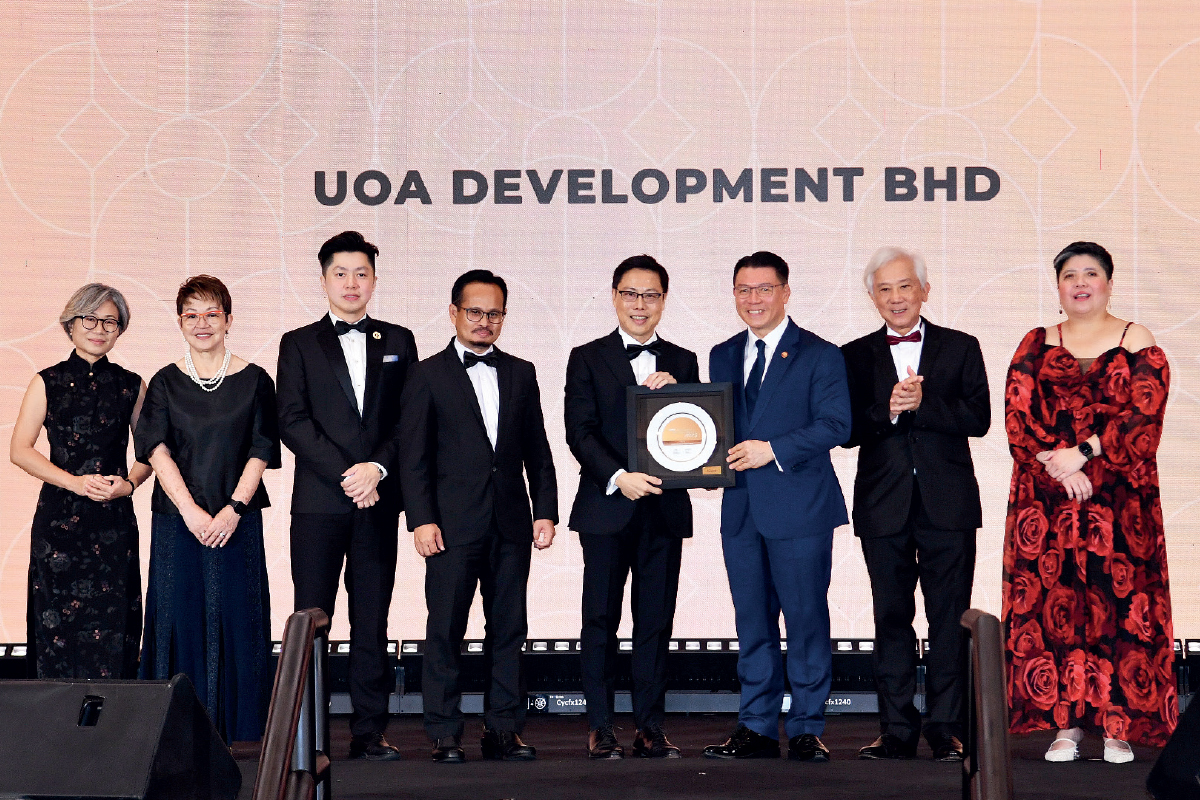
This article first appeared in City & Country, The Edge Malaysia Weekly on November 24, 2025 - November 30, 2025
Property development is a tricky business. Numerous parts must work together to produce the final result, be it a home, office building, mall, hotel or a public facility.
UOA Development Bhd (KL:UOADEV) has navigated this environment with cautious optimism and scrupulous planning. As a result, it has been rewarded with healthy financial results.
For FY2024 ended Dec 31, 2024, UOA’s revenue grew 36.6% to RM545.7 million from RM399.39 million in the previous year. Its pre-tax profit rose 6.8% to RM393.51 million from RM368.4 million a year earlier.
UOA’s projects are located in the Greater Kuala Lumpur area, namely Bangsar South and Kuala Lumpur.
In FY2024, it completed Laurel Residence in Bangsar South, which consists of two 42-storey blocks with a total of 1,260 units. Laurel Residence has a gross development value (GDV) of RM550 million.
UOA also has several ongoing projects, one of which is Aster Hill, a residential development in Sri Petaling, Kuala Lumpur. Aster Hill has two 32-storey residential towers with a total of 1,150 units. The project, which has a GDV of RM480 million, is slated for completion in FY2026.
In Bangsar South, UOA is developing Duo Tower, which consists of two office blocks. The 34-storey Tower A will have 239 office units while the 38-storey Tower B will have more than 700,000 sq ft of lettable area. Duo Tower, which has a GDV of RM1.3 billion, was launched in FY2024 and is expected to be ready in FY2027.
Also launched in FY2024 was Bamboo Hills Residences, which sit on a 9.8-acre freehold plot. Its three 51-storey blocks have a total of 2,517 units. The development has a retail podium, a connecting bridge to Kentonmen MRT station and a wide array of facilities. Slated for completion in FY2028, it has a GDV of RM1.4 billion.
For FY2025, UOA will continue to focus on these ongoing projects while looking out for opportunities.
In an interview with City & Country, UOA managing director C S Kong provides greater insight into the company and how it plans to continue delivering quality products and services. Here are excerpts from the interview.

City & Country: Unlike most developers, UOA has always launched one or two projects per year, some years none. For FY2024, you also have only two new projects — Duo Towers and Bamboo Hills Residences. Can you share your thoughts behind this strategy?
C S Kong: It is about supply and demand. When we first came here [Bangsar South land] 30 years ago, you didn’t need to look at the market. When you launch, you don’t worry about people not queueing up. Now when you launch a project, very seldom do you get people queueing up.
When you build something, it must be convenient to the purchaser. For example, you have to think about what facilities you’re going to have. If you build something in a place with no public transport, I think you will face difficulty. Recently, you see those [developments] that can sell very well are near the MRT stations.
So you ask me, why do I only build two projects? When I build something, I must make sure it can sell.
Also, we made a conscious decision to focus on fewer but more strategic projects. This allows us to stay agile, minimise risk and deliver positive outcomes. Doing less, but achieving more.

Which projects are creating momentum for UOA and why?
Bangsar South and Bamboo Hills. We have made them very environment-friendly and with a lot of facilities. We also have a Johor Bahru project [coming up].
In Bangsar South, our VE Hotel & Residences sometimes has 100% occupancy. On average, we achieve 82%. This is because of the location. It is very convenient. For conferences or talks, we have enough parking bays. There are also a lot of open spaces and trees. People feel nice here.
We also have medical facilities like Cengild GI Medical Centre, LifeCare Diagnostic Medical Centre, Curie Oncology, Komune TCM and Sunfert International Fertility Centre. At Nexus, on the ground level, it is all F&B (food and beverage) restaurants. We also have a food court. So people who come here, invest here, the rental rates for their property will go up.
What is the reason we are doing well in Bangsar South? Everything is integrated.
Also, we have Duo Tower in Bangsar South. It will have connections to retail, hospitality, healthcare and transit infrastructure. It will offer tenants not just an office, but a vibrant ecosystem. It will have sustainability features and smart building technologies. Already, it has attracted top-tier businesses and elevated our profile as a developer of choice for the next-generation commercial environment.
For Duo Towers, we are quite confident that it will sell well. By the time the lobby is completed, people can see the quality we are giving, and the price will appreciate.
In Bangsar South, out of the 60 acres, we have 30% land left. Our future plans for the land may include more medical facilities and offices.
In Bamboo Hills, the focus will be on Bamboo Hills Residences. Whatever we want to sell, we have almost sold [out]. So we are quite happy with Bamboo Hills. The project blends lifestyle, convenience and community. It is linked to Kentonmen MRT station by a pedestrian link bridge, for easy access to public transport.
We have 1.2 acres of land in Johor Bahru for a 52-storey residential project comprising 786 units, with built-ups from 620 to 2,547 sq ft. The GDV is about RM800 million. The location is very convenient because it is near the Bukit Chagar RTS station and not only that, you can walk there in five minutes using a 400m elevated pedestrian bridge. We will launch it maybe at the end of the year.
We are leveraging the cross-border connectivity with Singapore, and the development of serviced apartments will strengthen regional integration, improve urban accessibility and elevate the quality of life with well-planned infrastructure and community-focused amenities.

UOA looks to be moving into the wellness and F&B business. What is the reason for doing so?
Our move into the wellness and F&B sectors is a deliberate strategy to strengthen our mixed-use developments. These business units may not contribute significantly to the company’s bottom line on their own, but they play a big role in enhancing the value, appeal and long-term viability of the projects we build.
For Komune Living & Wellness, the inclusion of traditional Chinese medicine like Komune TCM and senior care services with our Komune Care is not just complementary — it is essential. The needs of the senior community require accessible, trusted wellness support and providing these services on site will directly improve quality of life while making the development more attractive and self-sustaining.
Also, the curated F&B ecosystem in Bamboo Hills is a strategic need. A happening dining and retail environment is a big draw for the nearby residential development, increasing footfall, enriching the lifestyle offering and elevating the project’s overall desirability.
All this, the wellness and F&B things we are doing, are not about standalone profit but more to create integrated environments where residents, tenants and businesses all work together to reinforce the value of our developments.

What is your strategy for UOA moving forward?
We will continue to focus on developments that cater to real demand, particularly in highly sought-after urban locations. This approach allows us to remain agile in a soft property market while delivering consistent value to both buyers and stakeholders.
For the first half of 2025, UOA achieved new property sales of RM413 million, where Bamboo Hills Residences, Laurel Residence, Aster Hill and Duo Tower accounted for the bulk of the transactions.
To date, Tower A of Duo Tower office suites has a take-up rate of 40% and its construction progress is 50%. As for Bamboo Hills Residences, the take-up rate is 63% and its progress so far is 35%.
As for recurring income [from our properties], about 40% of our total income comes from the rental of our offices and commercial properties, as well as from our hotel income and our car park.

Where are you looking to acquire more land and what products are you thinking of developing?
Our land acquisition strategy is creating long-term value through careful and thoughtful urban development.
But we are very conservative. If we are to acquire land, it will be next to an MRT station. We will continue to explore areas where infrastructure investment and demographic trends support demand. We are not looking at the moment, but it all depends on the price. You must be able to make a profit.
Looking ahead, our development priorities include transit-oriented projects, mixed-use precincts and wellness-centric residential communities.

What environmental, social and govenance (ESG) initiatives has UOA implemented?
We adopt more green certification and use green materials for projects. Environmentally, UOA emphasises energy-efficient design, green spaces and transit-oriented planning to reduce our carbon footprint. From a company point of view, environmental, social and governance standards help tenants to meet their ESG mandates.
Duo Tower (Tower A) and Duo Tower (Tower B) are designed to achieve GreenRE Silver certification and GreenRE Gold certification respectively. Duo Tower is also aiming for WELL certification for building health and wellness.
Laurel Residence earned GreenRE Bronze certification, while Bamboo Hills Residences is also designed to achieve GreenRE Bronze certification.
The certifications highlight the projects’ aligning with Malaysia’s green building standards and contributing to a more sustainable urban landscape.
Socially, our developments aim to foster inclusive communities that support modern urban lifestyles. Governance efforts include aligning with Malaysia’s evolving ESG regulations and enhancing internal oversight.
What are your future plans for sustainable growth?
UOA’s growth strategy is anchored in disciplined expansion, product innovation and strategic diversification. We will continue to develop projects in prime urban locations, focus on transit-oriented, mixed-use and wellness-centric developments to meet evolving market demand.
To ensure long-term sustainability, we must keep a robust balance sheet and a pipeline of developments tailored to real demand.
Our sustainability road map supports responsible growth through energy-efficient design, community-first planning and transparent governance. We stay agile and open to new opportunities that allow us to scale while cultivating growth with purpose.
We have a balance of 30% of land in Bangsar South not yet developed, which may keep us busy for the next 10 years. We will try to make use of the space that we have available.
Also, the government is looking for land for a new MRT station and we may be lucky to be selected for it. Here you have got two LRT stations — Kerinchi LRT station and Universiti LRT station. If we get selected there will be three stations here. So Bangsar South will still be one of the main drivers for the company.
Save by subscribing to us for your print and/or digital copy.
P/S: The Edge is also available on Apple's App Store and Android's Google Play.