

This article first appeared in The Edge Malaysia Weekly on November 17, 2025 - November 23, 2025
PENANG is widely recognised as a semiconductor hub, but few are aware that the state also houses a specialist in food processing and packaging automation.
This quiet specialist is EPB Group Bhd (KL:EPB). It builds the automated machinery that processes and packages everything from chilli sauce to frozen sausages. As the region’s growing appetite for convenience food clashes with rising labour costs and tougher hygiene mandates, EPB is becoming a vital partner to many food producers.
“A lot of people still don’t really know what we are doing. Some investors even thought we were producing sausages or selling coffee. Actually, we are in automation. We build machines that help factories, particularly in the food and frozen food sectors, to reduce labour costs and improve efficiency,” EPB managing director Yeoh Chee Min tells The Edge in a virtual interview.
The group’s core business involves designing, customising, fabricating, integrating and automating production lines for food manufacturers and processing companies.
Beyond the heavy machinery, the group supplies cellulose casings — consumables used mainly in the processing and manufacturing of frozen food products, predominantly sausage production — and flexible packaging materials such as packaging film, three-side seal bags and stand-up bags.
The group, which was listed on the ACE Market of Bursa Malaysia in August 2024, also provides after-warranty maintenance and repair services, as well as replacement parts for its clients’ packaging lines.
Asean focus and market position
EPB has been focusing on strengthening its footprint in high-growth consumer markets in Asean. Its key markets are the Philippines and Indonesia, where demand for food automation solutions is growing alongside consumer populations and increasingly stringent food safety standards.
“For Indonesia and the Philippines, we see strong market demand for convenient foods as more families have both husband and wife working. That’s why food manufacturers there are increasing their investment in automation,” Yeoh says.
In its first half ended June 30, 2025 (1HFY2025), the bulk of EPB’s revenue came from three major countries: the Philippines (33%), Malaysia (31%) and Indonesia (25%). The remaining 11% came from other markets.
The company’s niche is creating efficient production systems for four key segments — coffee and tea; chilli sauce; frozen food; and sausages. The group serves about 600 customers across Malaysia, Indonesia, the Philippines and several other markets.
Yeoh, who is now 60, started EPB in 1992. Together with his wife Ooi Kim Kew — an executive director of EPB — he controls a 54.8% stake in the company. EPB’s deputy managing director Liew Meng Hooi has a 13.23% stake.
Other top 30 largest stockholders include institutional investors such as Eastspring Investments Small-cap Fund, KAF funds, Manulife funds, Ethereal-Alpha Eq Fund, Majlis Amanah Rakyat, Pelaburan MARA Bhd and Kenanga Growth Opportunities Fund, according to the company’s annual report 2024.

Financial engine and distinct advantage
Food processing and packaging machinery solutions contribute the lion’s share of EPB’s turnover, accounting for 82.4% of its RM56.8 million revenue in 1HFY2025. The flexible packaging division provided 10.2%, while the cellulose casings trading division contributed 7.4%.
On competition, Yeoh suggests that EPB’s closest comparison is probably ASM Automation Group Bhd (KL:ASM), although their focus areas differ.
“ASM is more into snack food automation. We’re stronger in coffee, tea, sauces and frozen food — that is our niche,” says the industry veteran with over three decades of experience.
While Mainland Chinese equipment players are strong and competitive, Yeoh believes Malaysian companies like EPB maintain their own distinct advantages. “We focus on quality, provide good service and are able to meet halal standards and stringent food safety and hygiene requirements.”
Yeoh thinks EPB stands out in Malaysia as the one-stop solution for end-to-end food processing machinery solutions and packaging consumables.
“While companies like Scientex Bhd (KL:SCIENTX), Tomypak Holdings Bhd (KL:TOMYPAK), SLP Resources Bhd (KL:SLP) and Thong Guan Industries Bhd (KL:TGUAN) operate in adjacent spaces [of flexible packaging], our integrated model remains distinct,” he says.
A new plant to cater for Europe
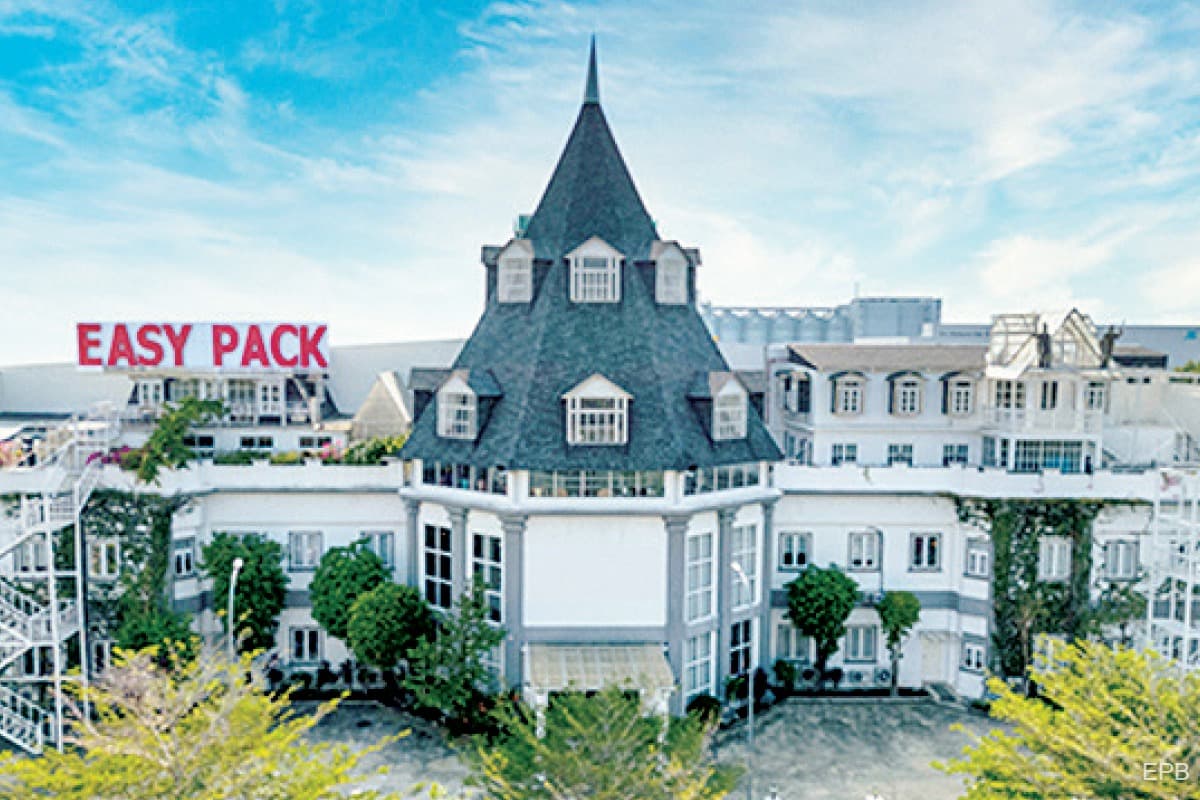
The Penang-based equipment firm currently operates two facilities — one is 24,038 sq ft and the other is 61,250 sq ft. It is in the process of building its third plant, which will span 90,000 sq ft. The first phase of 70,000 sq ft is slated for completion by March 2026.
The new plant is primarily to serve the European markets. The expansion will significantly enhance EPB’s production capacity and operational efficiency to meet rising demand across Southeast Asia.
“We’re expecting an initial turnover of about RM10 million in FY2026 from this expansion,” he estimates.
EPB bought the land for RM22 million and is spending another RM19 million for the two-phase construction. So far, the company has paid about RM3 million to RM4 million for construction fees.
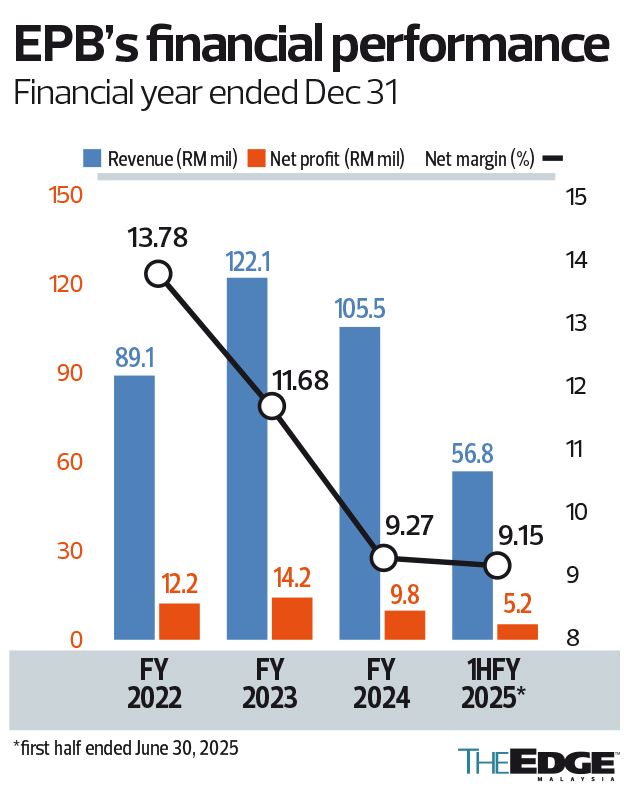
From FY2020 to FY2024, EPB’s revenue grew from RM61.69 million to RM105.51 million, as the group scaled its operations while maintaining healthy margins.
It appears this growth momentum has been sustained in 1HFY2025, with the group reporting a cumulative revenue of RM56.86 million and profit after tax of RM5.22 million, translating into a net margin of 9.15%.
“Our group maintains a healthy financial position with consistent profitability and a growing order book that provides earnings visibility. We just have to keep proving ourselves — continue to grow, deliver good margins and good returns. Eventually, the results will speak for us,” says Yeoh.
Meanwhile, EPB is developing its own software using a UK-based technology to strengthen its automation solutions. The company employs 164 staff, most of whom are based in Bukit Minyak, with smaller teams in the frozen food machinery division and flexible plastic packaging division based in Simpang Ampat.
EPB’s order book usually averages between RM70 million and RM90 million, Yeoh says, giving the group earnings visibility until at least the second half of next year. “We’re cautiously optimistic on the company’s performance and hopefully will see a 20% profit growth year on year, and we are confident of replenishing new orders after that.”
Acknowledging that tariff developments, commodity price volatility and global geopolitical shifts may influence procurement cycles and input costs, Yeoh is of the view that supportive policy measures and sustained consumer demand in Asean would provide “a constructive environment” for EPB to keep the momentum going”.
“The majority of our order book, amounting to RM70.08 million, is contributed by our group’s core segment in food processing and packaging machinery solutions, with RM40.48 million scheduled for the second half of FY2025 and RM29.6 million for the first half of FY2026,” he says.
Net cash and maiden dividend
As at June 30 this year, EPB maintained a healthy balance sheet with cash and cash equivalents of RM61.58 million, against total bank borrowings of RM8.69 million. This translates into a net cash position of about RM52.9 million.
EPB has declared its maiden interim single-tier dividend of one sen per share for FY2025, payable on Nov 26.
“We hope that we are able to declare yearly dividends, subject to our group’s earnings performance and future expansion plan,” Yeoh says, as he points to the rapidly evolving food processing and packaging machinery industry in Southeast Asia, driven by rising consumer demand for convenience foods, higher hygiene standards, and the growing shift towards automation and sustainability.
“EPB is positioning itself to capitalise on these trends through capacity expansion, technological innovation and strategic partnerships,” he says.
Year to date, EPB’s share price has declined 31% to close at 38 sen last Wednesday, giving it a market capitalisation of RM141.36 million. According to AskEdge, the counter is currently trading at a historical price-earnings ratio of 13 times.
Save by subscribing to us for your print and/or digital copy.
P/S: The Edge is also available on Apple's App Store and Android's Google Play.