

This article first appeared in The Edge Malaysia Weekly on November 17, 2025 - November 23, 2025
Malaysia is gearing up to face a significant challenge: managing an estimated 870,000 depleted electric vehicle (EV) batteries.
As the number of EVs increases and their batteries eventually degrade, developing essential recycling and material recovery capabilities will become important for sustainable EV adoption in the country, says Azrul Reza Aziz, CEO of Malaysia Automotive Robotics and IoT Institute (MARii).
“Not all of those 870,000 depleted EV batteries are going to end up in the landfill. Some will be upcycled, recycled, repurposed and given a second life. Let’s say the battery’s state of health is 60% to 80% and above; it can still be repurposed or reused. The recommendation is [for it] to be repurposed. For instance, it can become a generator,” he adds.
While internal combustion engine (ICE) vehicles typically use lead-acid batteries, EVs use lithium-ion batteries. Each presents different recycling and upcycling challenges.
According to the International Energy Agency (IEA), conventional vehicle batteries typically use lead-acid chemistry, which consists of lead and lead dioxide electrodes immersed in a diluted sulphuric acid electrolyte.
In contrast, an EV lithium-ion battery is a complex system comprising numerous cells and the anode and cathode — which are made up of lithium, nickel, cobalt, manganese and graphite — all bound by an organic electrolyte.
The processing of end-of-life EV batteries involves two main stages. The first is pre-treatment, which involves discharging the battery and disassembling the pack into smaller components to prepare it for material recovery. Then it has the post-treatment, which is the material recovery and refining, says Azrul.
Malaysia, however, only has the capacity to complete the pre-treatment stage, he says.
“The pre-treatment stage involves the battery package. There are a lot of parts in it, steel and aluminium. In a battery recycling centre, they will dismantle that first. And only then will they take the battery and extract the important bits like copper, nickel and other metals,” he says.
The electrodes or components inside the battery are turned into a black powder called black mass.
“This black powder, Malaysia only does the pre-treatment side. Normally until it turns into black powder; the black powder will then be exported back to their home countries for the post-treatment for extraction of pure metals or compounds that can be used to manufacture new EV batteries,” Azrul adds.
At the moment, Malaysia’s capacity for recycling and post-treatment battery breakdown — where valuable metals like lithium, cobalt and nickel are recovered — remains limited.
Companies such as EcoNiLi Battery New Energy Sdn Bhd are taking the lead in lithium battery recycling, mainly focusing on batteries from electronic devices.
The Ipoh-based lithium battery recycler is currently recycling mostly lithium batteries from electronic gadgets and importing black mass from recyclers. After extraction, the lithium, cobalt and nickel are exported to countries like China.
While there are intentions to expand this to EV lithium-ion batteries, Azrul shares that processing black mass and extracting these metals is cost intensive.
“When it comes to technology and building facilities, there’s definitely a high cost of investment. And when there is a high cost investment, they need volume [in EVs]. In Malaysia, if you ask me right now, the volume is not that big. It is still in its infancy,” he adds.

Introducing battery passports
According to the IEA, greater recycling of critical minerals could reduce the need for new mining by as much as 40% by mid-century.
The IEA also notes that many governments are creating policies to encourage recycling. For instance, in 2023, the European Union (EU) introduced a new battery regulation which will introduce increasingly stringent requirements for “recycling efficiency, material recovery and recycled content” beginning in 2025.
In Malaysia, MARii is developing a battery passport that acts like a digital ID or “birth certificate” for the battery.
“When we think of the battery passport, there are three things that we need to have to promote it. First is transparency, so we know where it’s sourced; and number two is traceability, where it goes for the entire value chain. And then there’s sustainability, whether it can be or will be recycled, repurposed, given a second life and whatnot,” says Azrul.
“By providing transparency and traceability, a battery passport can facilitate the efficient recycling and reuse of lithium-ion batteries, thereby creating a more circular economy for this essential technology.”
The battery passport is a crucial tool within the life cycle assessment framework, tracking the environmental impact of batteries from production to disposal.

Mandate EV battery recycling
In June, former Minister of Natural Resources and Environmental Sustainability Nik Nazmi Nik Ahmad announced plans to introduce an Extended Producer Responsibility (EPR) initiative for EV batteries.
Under this scheme, EV manufacturers would be held accountable for the end-of-life management of their batteries, including retrieval and recycling processes.
EPR schemes are a widely used policy strategy that assigns responsibility for end-of-life management of products to the original producer. Producers under this definition typically include manufacturers, importers and retailers.
The EPR scheme currently considered by the Ministry of Housing and Local Government is targeted at plastic packaging and could start with a voluntary scheme before making it mandatory. The Department of Environment (DoE) is also exploring EPR for selected consumer electronics categories.
Blueshark Malaysia Sdn Bhd’s senior brand and communications manager Eric Lim shares that implementing EPR would be beneficial to the industry if done properly. For instance, it can catalyse innovation, foster customer trust and ensure environmental accountability.
“Battery second-life usage in energy storage opens up new business models while EPR enforcement may spur public-private partnerships to scale recycling infrastructure,” he says.
Blueshark is an EV tech mobility company that focuses on two-wheelers. To manage the uptake of EV bikes, Lim says the company has internal policies that address the life cycle of its batteries and adhere to government regulations concerning the handling and disposal of hazardous materials.
“Our Lithium Iron Phosphate (LFP) battery packs are designed with a long first life, typically four to five years or around 2,000 charge cycles, with a structured second-life application in mind. Once these batteries are no longer roadworthy, they are repurposed for energy storage solutions, particularly in off-grid or commercial settings,” says Lim.
In the case of electric motorcycles such as the ones in Blueshark, full recycling will then follow through licensed recycling partners once secondary uses are exhausted.
In October 2024, Malaysia introduced the Electric Vehicle and Battery Management (EVBM) Guidelines.
Lim says while the EVBM Guidelines provide a foundational framework, operationalising these mandates will require collective effort from original equipment manufacturers (OEMs), regulators, recyclers and logistics partners. Financially, the costs of battery transportation, interim storage and specialised recycling are significant.
“The costs of each activity along the chain have also not been determined yet. Ensuring the availability of certified, environmentally responsible recycling partners in-country remains a hurdle. But, we are addressing [it] through partnerships and ongoing dialogues with local players,” he says.

Provide more information on battery end-0f-life management
According to the Malaysian Green Technology and Climate Change Corporation (MGTC), Malaysia has a comprehensive regulatory framework for the safe disposal of hybrid and electric vehicle (xEV) batteries, governed by the DoE through three key mechanisms.
This includes Authorised Automotive Treatment Facilities (AATF), which manage the dismantling of non-roadworthy xEVs and battery removal; licensed recycling centres which conduct battery pre-treatment and processing in compliance with the Environmental Quality Act 1974; and the scheduled waste SW103 protocol which oversees the handling, storage, transport and disposal of hazardous battery materials.
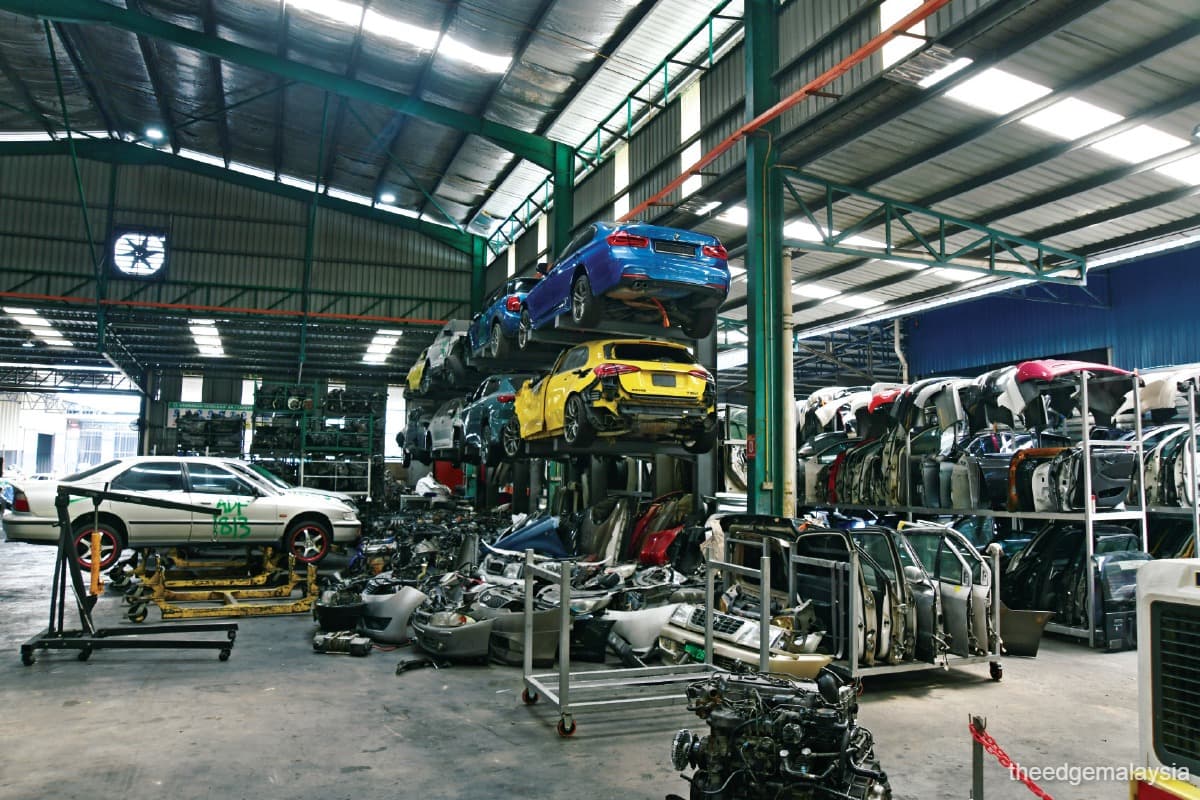
AATF, which is a programme and accreditation initiative by MARii in collaboration with the DoE, manages the end-of-life vehicle ecosystem in Malaysia.
Dismantling EV batteries and identifying proper recycling facilities poses its own set of challenges, says Kwan Kian Heng, director at Car Medic Sdn Bhd.
“When an EV is at a destroyed stage [due to an accident], you will need to send it to a dismantling facility to get that lithium-ion battery out of the car before you can actually have the downshift. This is because lithium ions are highly flammable. The challenge [for us as AATFs] is to actually remove the battery from the car,” says Kwan.
Some batteries are in such poor condition that they must be dismantled using specialised tools. However, in most cases, the batteries are sent in their entirety to licensed recycling facilities which have the expertise to safely dismantle and process them.
On the other hand, Kwan says these components must be handled by qualified professionals and if workshops that are not well equipped attempt to service or dismantle them, it can cause a fire or electrocution and, in some cases, an explosion.
“Without clear regulations governing the end-of-life management of EVs, this poses a major safety and environmental issue. Which is why maybe one of the roles that the OEMs can contribute is to actually provide more information in terms of the end of life of these batteries, how they may be dismantled and how they should be disposed of. If they can make things a little bit clearer in this aspect, it would help the industry in general,” he says.
Save by subscribing to us for your print and/or digital copy.
P/S: The Edge is also available on Apple's App Store and Android's Google Play.