

This article first appeared in The Edge Malaysia Weekly on November 17, 2025 - November 23, 2025
The United Nations (UN) Conference of the Parties 30 (COP30) is currently underway in Belém, Brazil until Nov 21. A few key issues, such as climate finance, protection of indigenous peoples’ rights and insufficient climate ambition, will be on the table.
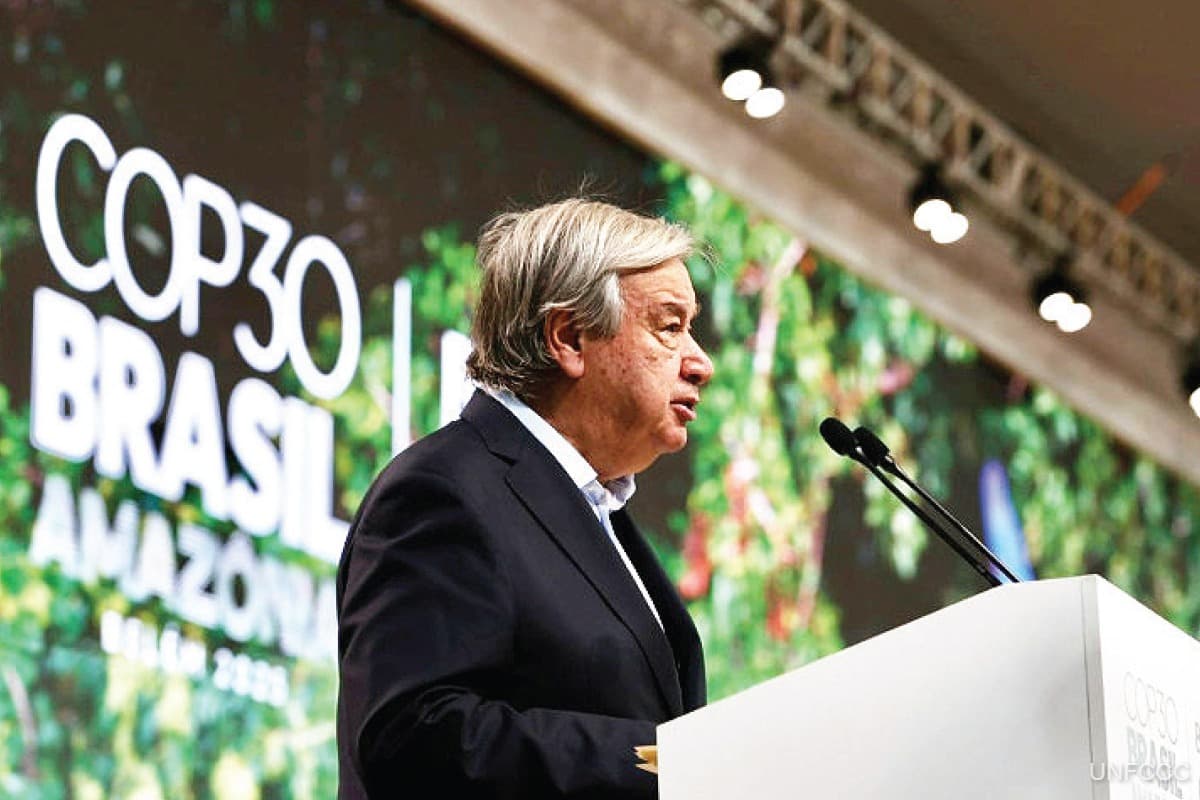
At the Leaders’ Summit held right before the conference on Nov 6, UN secretary-general Antonio Guterres highlighted how the accelerating climate crisis is resulting in record-breaking wildfires and deadly floods, and the record-high emissions last year.
He was referring to the Global Climate Update released recently by the World Meteorological Organization, which showed that the past 11 years (2015-2025) are set to be the warmest on record, and that concentrations of heat-trapping greenhouse gases and ocean heat content reached record levels in 2025.
“What’s still missing is political courage. Fossil fuels still command vast subsidies — taxpayers’ money. Too many corporations are making record profits from climate devastation, with billions spent on lobbying, deceiving the public and obstructing progress,” said Guterres.
He called for countries to agree on bold plans to close the emissions gap, and following through on the commitment in COP28 to transition away from fossil fuels.
However, the struggle between developed and developing countries and the provision of climate finance for the transition will continue to be a theme at COP30.

Meenakshi Raman, president of Sahabat Alam Malaysia, stresses that COP30’s success hinges on concrete progress on means of implementation (MOI), which developing countries need to deliver climate action.
For instance, the Global Goal on Adaptation (GGA) — the Paris Agreement’s framework for strengthening countries’ ability to adapt to climate impact — must conclude with meaningful indicators on MOI, says Meenakshi, who is currently at COP30.
“COP30 must deliver justice. Across the board, the main stumbling block was advancing on the issues of MOI: climate finance, technology transfer and capacity building. Also, the developed countries’ refusal to speak about their overuse of the global carbon budget and historical responsibility remains the biggest blockage in achieving the goals of the Paris Agreement,” she adds.
The US is not sending any delegates to COP30, in line with President Donald Trump’s anti-climate change stance and exit from the Paris Agreement.
Financing for forest conservation
During the Leaders’ Summit, Brazil President Luiz Inácio Lula da Silva launched his flagship project, the Tropical Forest Forever Facility (TFFF), to enable governments and local communities to protect forests.
The TFFF entails performance-based payments — judged via satellite remote sensing data that tracks forest canopy — to countries that keep their forests standing, with a target of 20% of payments going to the indigenous peoples and local communities.
The facility has received endorsements from 53 countries, including 19 potential sovereign investors. The TFFF design was led by Brazil in partnership with 10 countries, including Malaysia.
Brazil targets US$125 billion (RM519 billion) for the TFFF, and aims to raise US$10 billion initially from governments and philanthropic organisations.
Henry Chan, senior director of conservation at WWF-Malaysia, estimates that if Malaysia can retain forest cover of 18 million ha in perpetuity, it can receive US$72 million a year.
“Through the penalty system of forfeiting payment at 100 times arising from deforestation, TFFF will incentivise Malaysia to expedite the phasing out of deforestation,” says Chan.

However, June Rubis, consultant to the Convention on Biological Diversity Secretariat on Indigenous and Traditional Territories, cautions that the TFFF risks becoming another technocratic instrument that is well-branded but detached from those who actually keep the forests standing.
To avoid this, she says the facility must be built on rights-based governance with roles for indigenous peoples to lead. Additionally, there must be a focus on ecological integrity, community well-being and safeguards such as free prior and informed consent, data sovereignty and independent grievance and redress mechanisms.
“We need climate finance that doesn’t just offset emissions but strengthens the living systems and communities that make resilience possible. That means indigenous custodianship must move from recognition to co-governance and direct access. The gap isn’t technical; it’s political. If indigenous and local community governance remains peripheral, the climate architecture will keep replicating the same extractive logic under a green banner,” she says.
James Pilkington, senior sustainable finance specialist at the Zoological Society of London, adds that better domestic recognition of indigenous peoples and local community rights is key to effective implementation, and should be included in the eligibility criteria.

“Another key missing piece is that much degradation of tropical forests, such as through selective logging, mining and roads, is not penalised, meaning we could see continued forest loss even if the headline deforestation rate is zero,” says Pilkington.
Malaysia could play a dual role like Indonesia and both contribute and receive the funds, although it is contingent on Malaysia reducing its deforestation rate to the 0.5% TFFF requirement. The funds received could be used to compensate companies, in exchange for losing the right to clear forested areas, suggests Pilkington.
Stronger climate ambitions
Another issue to watch at COP30 is the pressure on countries to step up on climate action. Countries party to the Paris Agreement were also supposed to submit their new Nationally Determined Contributions 3.0 (NDC), which are emissions reduction targets, earlier this year.
According to ClimateWatch (as at Nov 11), 111 out of 197 countries, representing 71% of global emissions, have submitted new NDCs. But it will not enable the world to achieve the Paris Agreement target of keeping warming well below 2°C.
The annual UN Emissions Gap Report, released on Nov 4, shows that full implementation of NDCs will still result in warming of 2.3°C to 2.5°C over this century, while current policies will contribute to warming of 2.8°C.
To have strong climate ambitions, there must be greater commitment to climate finance.
This is why COP30 negotiations on the Just Transition Work Programme (JTWP) matter, says Meenakshi. The JTWP is the UN Framework Convention on Climate Change (UNFCCC) process tasked with helping countries shift away from fossil fuels in ways that create decent jobs, protect workers and communities and ensure no one is left behind.
Meenakshi says the JTWP needs to advance with new institutional arrangements such as the proposed Belém Action Mechanism (BAM), which is critical for strengthening technical assistance, access to finance and international cooperation. It must also address climate-related trade-restrictive unilateral measures that could undermine developing countries’ transition efforts.
On its part, Malaysia must advocate for new arrangements such as BAM, she says. Such an institution could also help monitor and assess gaps in international support and recommend solutions within the broader UNFCCC and financial architecture.
“We also call on the government to establish a national mechanism for people’s participation to ensure the meaningful engagement and agency of workers, affected communities, women, youth, indigenous peoples, and all other sectors in the planning, implementation, monitoring and evaluation of just transition processes at both national and local levels” she adds.
Another issue is the commitment made during COP29 to mobilise US$1.3 trillion annually from global sources to support developing countries’ climate action by 2035. The planned Baku-to-Belém Roadmap is supposed to lay out the strategies to achieve this goal.
Clarification on how this financing will be given is important, says Faizal Parish, director of Global Environment Centre, who is also at COP30. He adds that a clearer framework for a just transition is needed, to ensure communities and workers impacted negatively by climate mitigation measures are supported.
Faizal is also keen to see the launch of the process to establish a global peatland breakthrough and support the protection of tropical peatlands in Asean, the Congo Basin and Amazon.
Save by subscribing to us for your print and/or digital copy.
P/S: The Edge is also available on Apple's App Store and Android's Google Play.