

This article first appeared in The Edge Malaysia Weekly on November 10, 2025 - November 16, 2025
SUN Life Malaysia, a mid-sized life insurer and family takaful operator, aims to double its profitability within three years while strengthening its position in Malaysia’s increasingly competitive and challenging insurance market.
Jointly owned by Khazanah Nasional Bhd (51%) and Sun Life Assurance Co of Canada (49%), the insurer has been operating in Malaysia since 2013.
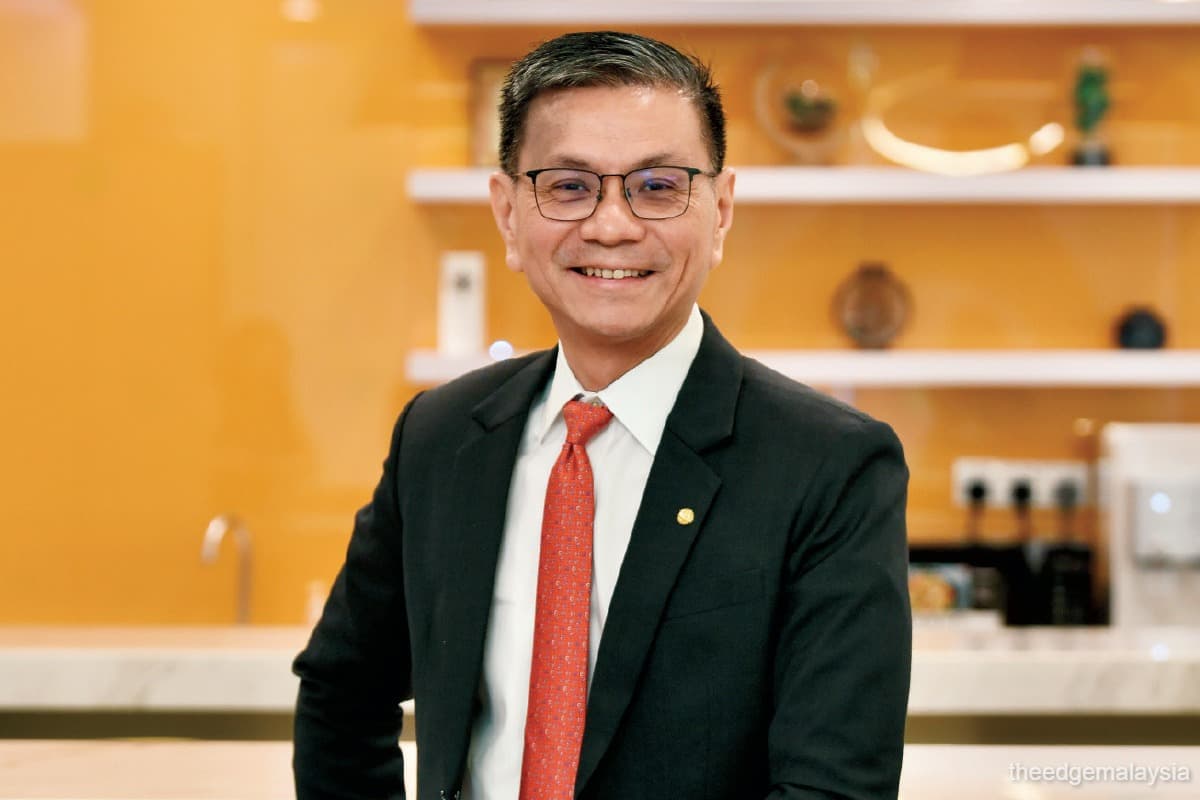
Its president and country head, Ho Teck Seng, who took the helm in July, has outlined a five-year plan with what he concedes are “ambitious” targets.
“In the next five years, we want to improve our top line and ensure we are among the top five players in Malaysia. We are pretty close now, at No 7. And in terms of profitability, we want to double it within three years. It’s a very ambitious goal [given that] under the new accounting standard, IFRS 17, profit recognition is not immediate the way it was before,” Ho tells The Edge in an interview.
Implemented in 2023, IFRS 17 has significantly changed how insurers recognise profits. Instead of booking most profits upfront, earnings are now recognised over the lifespan of an insurance contract.
A substantial portion of the group’s gross written premium (GWP) comes from bancassurance. Sun Life Malaysia’s key bancassurance partner is CIMB Bank, which distributes its products through an extensive branch network.
“Bancassurance has become one of our most important distribution avenues, contributing significantly to our overall premium income. While we don’t disclose the exact percentage of premiums from bancassurance, it’s safe to say that it represents a substantial portion of our GWP, underscoring the strength and strategic importance of our bancassurance partnerships,” Ho says.
IFRS 17 aside, Sun Life Malaysia faces another challenge: falling footfall in bank branches, post-pandemic.
“We are very strong in bancassurance, [but] there is falling footfall in the bank branches. That is one of the challenges,” acknowledges Ho.
He stresses that Sun Life Malaysia must remain relevant to its customers through both the agency and bancassurance channels.
Sun Life Malaysia comprises Sun Life Malaysia Assurance Bhd (SLMA), which operates the conventional life insurance business; and Sun Life Malaysia Takaful Bhd (SLMT), which handles the family takaful segment.
For the financial year ended Dec 31, 2024 (FY2024), SLMA posted a net profit of RM116.64 million, up from RM98.16 million in the previous year, with revenue rising slightly to RM365.32 million from RM360.8 million. Its highest annual profit since 2013 was in 2018, at RM130.44 million. In the first half of FY2025, net profit fell to RM42.99 million from RM60.83 million a year earlier.
As for SLMT, it recorded a higher net profit of RM44.63 million in FY2024 compared with RM35.94 million previously, despite lower takaful revenue of RM347.6 million versus RM370.84 million. In 1HFY2025, its net profit rose to RM31.35 million from RM22.79 million.
As at Sept 30, Sun Life Malaysia’s GWP stood at RM1.27 billion, while total assets under management climbed to RM7.7 billion from RM2.39 billion in 2014.
Growing the agency force
Ho, who is also the CEO of SLMA, says Sun Life Malaysia intends to expand its agency force to complement its bancassurance channel. The company currently has about 1,200 agents and plans to grow that number to 3,000 within two years.
“It’s a very ambitious goal, and we are investing heavily in that segment,” he says.
The expansion will help rebalance growth between its conventional and family takaful businesses. Ho adds, “In the past five years, the growth rate of the takaful market has probably doubled that of conventional. That’s what we’ve experienced. Looking ahead, our intention is to balance our growth between takaful and conventional.”
In bancassurance, Sun Life Malaysia ranks fourth in the country with a 9.8% market share, while in bancatakaful it holds a leading position with a 20.1% share, Ho shares.
The company continues to invest heavily in digital capabilities to support both its agency and banca distribution channels.
“We look at digital as an enabler,” he explains. “For our [agents], it’s about how technology can smoothen the process, address pain points and make onboarding faster. For banca, big data helps a lot.”
He notes that one in three customers each month is a repeat client — a sign of loyalty the group wants to deepen.
“We want to make sure that the journey is continuous rather than transactional,” he says.
About 20% to 30% of the group’s annual expenditure is allocated to IT and digital transformation. Ho says the next phase is ensuring those investments translate into customer benefits. “After substantial investment, we need to couple it with process transformation. For example, one of our targets is to pay some claims within seconds. We can’t do that yet, but we want to.”
He adds that understanding shifting customer preferences is equally important. “We notice that the younger generation today prefers products that are simple, flexible and transparent — and that’s how we want to pivot, by connecting with them. As for the more mature segment, we notice there is a focus towards legacy planning.”
Industry challenges and medical inflation
Medical insurance costs remain a key concern across the industry, with premiums rising amid inflation and higher claims.
“One leading insurance broker reported that medical inflation this year will most likely be around 16%. Every year, it’s been in the region of 12% to 18%,” Ho notes.
Though Sun Life Malaysia is not currently a major player in health insurance, it is gradually expanding into health and wellness offerings, including critical illness coverage.
Ho says the group supports an ongoing effort by Bank Negara Malaysia and the Ministry of Health to work with the industry on developing a sustainable model to address medical inflation. “There are some preliminary suggestions that have been put forward. At the moment, all the stakeholders are still debating. I am hopeful of an outcome that benefits the public.”
As at September this year, Sun Life Malaysia has “touched 3.3 million lives and paid close to RM2 billion in claims since 2014”, Ho says.
Asked about the rise of digital-only insurers, Ho says they are not yet a threat. “At the moment, they are not a threat, but we won’t discount that possibility. We’re working hard to stay competitive, and need to change our mindset.”
Ho declines to comment on reports that Khazanah is considering exiting the insurer. In June, The Edge reported — citing unnamed sources — that Khazanah was exploring the sale of its stake in Sun Life Malaysia and had appointed investment bankers to scout for buyers. The report noted that a sale could be difficult, given ongoing developments in the healthcare industry.
“All I can say is that we maintain a very good relationship with both shareholders (Khazanah and Sun Life Co), and both sides are very happy with their investment. Beyond that, I don’t know,” he says.
According to him, Sun Life Malaysia has been one of the country’s fastest-growing insurers, delivering a 16% compound annual growth rate in new business annualised first-year premiums.
“Over this period, our market share expanded from 1.7% in 2013 to 4.4% in 2024, propelling us from 10th to seventh position,” Ho adds.
Although CIMB Bank — part of CIMB Group Holdings Bhd (KL:CIMB), in which Khazanah is also the largest shareholder — remains its main bancassurance partner, Ho says Sun Life Malaysia is exploring partnerships with digital platforms and lifestyle ecosystems to reach new customer segments.
Save by subscribing to us for your print and/or digital copy.
P/S: The Edge is also available on Apple's App Store and Android's Google Play.